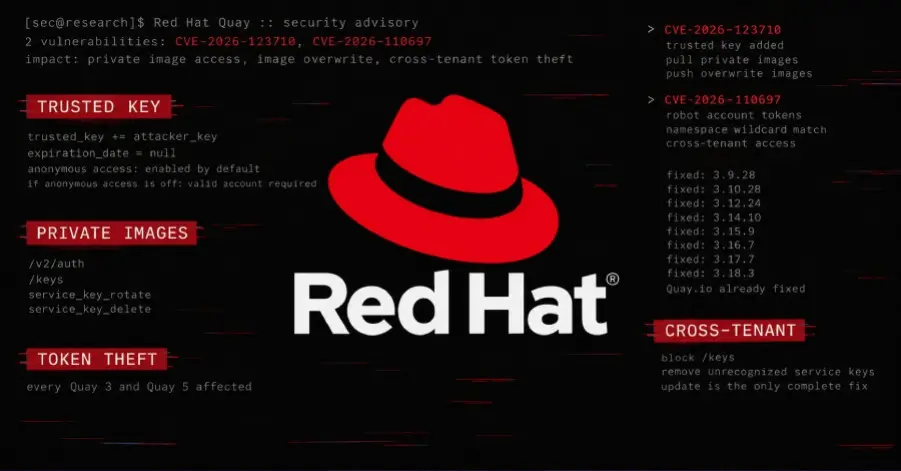
Discovered by researcher Dave O’Connor, the vulnerabilities impact multiple deployments of Red Hat Quay, including standalone installations, instances deployed via the Quay Operator on OpenShift, and the mirror registry for Red Hat OpenShift. Security advisories detailing the issues underscore the severe risks involved, particularly given that the foundational logic behind one of the vulnerabilities has remained embedded within the Quay codebase since its initial public commit.
The first and more pervasive of the two vulnerabilities is tracked as CVE-2026-123710, carrying a critical CVSS score of 9.8. This flaw stems from a fundamental design weakness in how Quay handles access tokens for pushing and pulling container images. Quay traditionally relies on trusted cryptographic keys to sign these tokens, ensuring that only authorized entities can interact with specific repositories.
However, the vulnerability allows an unauthorized attacker to introduce their own arbitrary key into the pool of keys trusted by Quay, effectively establishing a persistent trust relationship without any expiration date. Once this malicious key is planted, the Quay registry willingly accepts access tokens signed with it for any repository across the system.
The operational implications of this flaw are severe. Armed with fraudulently signed tokens, an attacker can silently retrieve private container images, exposing any underlying application secrets, database credentials, or API keys stored within those layers. Furthermore, the attacker gains the ability to push or overwrite existing images. Because these malicious modifications seamlessly propagate to every downstream system or environment that subsequently pulls the compromised images, the integrity of the entire software delivery pipeline is compromised.

Compounding the threat, the planted key exhibits remarkable persistence. It survives system restarts unless explicitly discovered and manually removed by an administrator. Additionally, an attacker can leverage this access to delete the legitimate cryptographic keys used by running Quay instances, instantly disrupting normal operations and causing standard image push and pull requests to fail with authentication errors.
The root cause of CVE-2026-123710 lies in the validation logic of Quay’s key server. While the server checks that requests to replace a key include a token signed by a trusted key with a matching audience and issuer, it fails to verify whether the token was genuinely authorized for key rotation. Consequently, an anonymous token generated via Quay’s standard authentication endpoint easily satisfies the check because Quay itself signs it with a trusted key, and the caller is permitted to arbitrarily choose the token’s audience.
Simultaneously, Red Hat disclosed a second critical vulnerability, tracked as CVE-2026-110697, which carries a CVSS score of 9.9. This vulnerability enables a standard Quay user who possesses the permissions to create a namespace to systematically target and compromise other tenants. By exploiting this flaw, an attacker can steal robot account tokens belonging to different organizations and subsequently leverage those credentials to read, push, or overwrite images across alien repositories.
The flaw exists within the backend functionality responsible for listing robot accounts. When processing these requests, Quay constructs an SQL LIKE pattern directly from the provided namespace name without properly escaping wildcard characters. Within SQL LIKE syntax, the underscore character acts as a wildcard matching any single character.
As a result, a malicious user who creates a namespace containing an underscore character in a specific position can inadvertently or intentionally match another tenant’s namespace pattern. This matching behavior causes the system to return the victim tenant’s robot accounts along with their decrypted credentials. Crucially, the exploit requires no elevated administrative privileges, and the victim organization is not required to take any action to trigger the exposure.

The downstream effects of CVE-2026-110697 extend deeply into enterprise deployment workflows. If an administrator subsequently deletes the attacker’s namespace, the system also purpses or disables the corresponding robot accounts, potentially cutting off critical automated systems that rely on them. More alarmingly, where Quay functions as the integrated container registry for Red Hat OpenShift, these stolen robot credentials provide a direct vector for injecting malicious images straight into continuous integration and continuous deployment pipelines.
Red Hat has confirmed that versions of Quay 3 and Quay 5 are broadly affected by both vulnerabilities. The company notes that any Quay instance reachable by untrusted clients—including internal enterprise registries—remains exposed to potential exploitation.
Mitigating the risks poses immediate operational challenges for administrators. Red Hat has emphasized that simply disabling anonymous access to the Quay registry does not provide adequate protection against CVE-2026-123710, as authenticated users can still execute the exploit. Furthermore, a maliciously planted key continues to function even after administrative password resets or modifications to robot tokens.
To address these vulnerabilities, Red Hat has released updated builds across multiple Quay 3 branches. The upstream fixes modify the key server logic to enforce proper rotation checks, require all keys added through the server to include an explicit expiration date, and prevent callers from arbitrarily dictating a token’s audience. The same code adjustments resolve the insecure SQL wildcard handling in the robot account search functionality.
While organizations work to apply the official patches, Red Hat recommends several interim defensive measures to limit exposure. Administrators are advised to restrict user permissions regarding the creation of organizations or namespaces that contain underscore characters, routinely rotate robot credentials for any namespace that matches an underscore pattern, and closely monitor container push and pull activity for behavioral anomalies that deviate from standard automated robot usage. While these steps help reduce immediate risk, full remediation requires applying the newly issued security updates across all affected Quay deployments.