In a sweeping international law enforcement operation coordinated across multiple continents, authorities have dismantled the core servers and infrastructure powering three notorious malicious software families: Gootloader, CastleRAT, and StealC. These sophisticated tools have long been utilized by cybercriminal syndicates to compromise unsuspecting individual and corporate computers, harvest sensitive user credentials, and serve as the foundational access layer for devastating ransomware campaigns.
The coordinated crackdown, which forms a major component of the ongoing international police campaign known as Operation Endgame, resulted in the seizure of approximately 6.4 million stolen login credentials. According to Germany’s Federal Criminal Police Office, commonly known as the BKA, these compromised datasets belong to more than 40,000 distinct victims globally. Across the entire operation targeting the three disparate malware networks, law enforcement agencies successfully knocked offline 235 servers and seized control of 257 distinct internet domains, with vital support and coordination provided by Europol.
The Anatomy of Gootloader and Its Path of Destruction
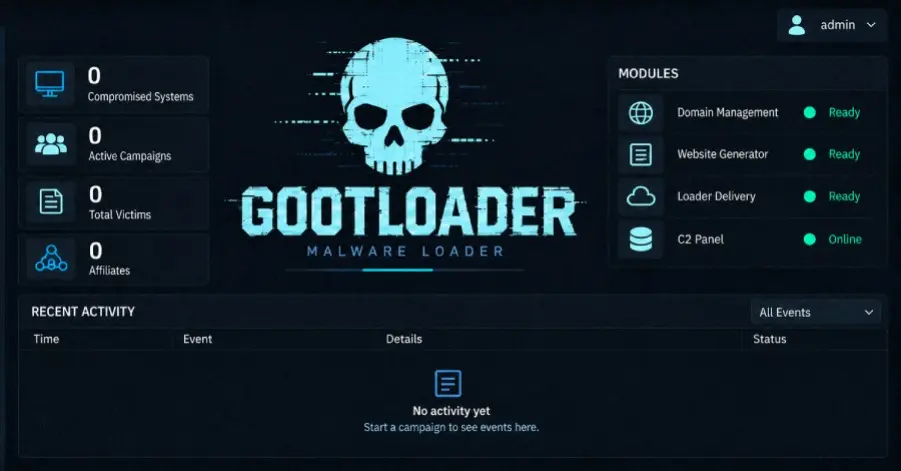
Among the tools targeted in the sweep, Gootloader has long stood out as a particularly persistent and dangerous loader. Once successfully deployed onto a victim’s computer, Gootloader functions primarily as an access conduit, downloading additional malicious payloads—most notably ransomware—onto the compromised machine. The malware has traditionally been propagated through compromised websites, heavily favoring WordPress installations, where criminals embedded fake legal documents and contracts. To lure victims, the operators relied heavily on search engine optimization, or SEO poisoning, manipulating search engine algorithms to push these malicious URLs near the top of legitimate search results.

Since its emergence around 2018, Gootloader has infected at least 25,000 computers worldwide, according to formal figures released by the United States Department of Justice. The operators behind Gootloader used these initial compromises as a springboard to infect deeper networks, subsequently monetizing their unauthorized access by selling entry points to specialized ransomware gangs. In the United States alone, Gootloader infrastructure has been directly linked to ransomware attacks against at least 44 known corporate and institutional victims, resulting in cumulative financial losses estimated at approximately $28.8 million.
Meanwhile, German police provided an even wider global scope in their official public statements. Based on comprehensive digital forensics and intelligence gathered by investigators so far, authorities estimate that Gootloader may have infected millions of individual computers worldwide since it first surfaced publicly in 2020.
To dismantle this sprawling network, police operations successfully knocked offline 14 dedicated servers, seized 218 malicious domains, and meticulously removed active malware injections from 681 hacked websites. Operating under formal court approval, American federal agencies alongside international partners successfully rooted out Gootloader from more than 100 hosting servers, including compromised WordPress platforms, while simultaneously seizing domestic domains that had been utilized to deliver and control the malware payload.
Targeting Remote Access and Information Stealers
In addition to Gootloader, the international operation dealt a heavy blow to CastleRAT and StealC, two distinct yet equally damaging categories of cybercrime utility. CastleRAT, a remote access trojan that first came onto the threat intelligence radar in 2025, grants unauthorized external operators full interactive control over an infected machine. Law enforcement agencies neutralized this threat vector by seizing 120 CastleRAT-associated servers alongside 39 functional domains.

StealC, on the other hand, operates as a high-volume information stealer designed to quietly exfiltrate stored browser passwords, cookies, autofill data, and other critical credentials from infected systems, providing criminal markets with a constant stream of credentials to monetize. This week’s action marked a renewed takedown of StealC’s infrastructure following an earlier law enforcement operation in June. Following that summer intervention, however, the resilient operators behind StealC quickly adapted by pivoting their infrastructure and bringing their command-and-control servers back online to evade tracking.
Investigations revealed that a significant portion of StealC’s resilient infrastructure was anchored by Virtualine and Omegatech, a notorious bulletproof hosting service that explicitly advertised its infrastructure-as-a-service offerings to cybercriminals looking to elude law enforcement. That critical bulletproof hosting provider was permanently knocked offline in a separate, coordinated late-October domain seizure led by the FBI.
While this week’s technical takedowns effectively disrupted active command-and-control operations, law enforcement agencies did not announce any immediate physical arrests in connection with the current phase. Nevertheless, European investigative bodies continue their pursuit, with Dutch police confirming that they are conducting targeted follow-up investigations focusing on the primary suspect behind the Gootloader operation.
Global Response and Steps for Victims and Site Owners
To mitigate the fallout from the massive trove of harvested data, law enforcement agencies have initiated widespread victim notification efforts. Dutch police have successfully integrated data recovered from the CastleRAT infrastructure into "Check your hack," an online public service portal enabling individuals to input their email addresses to check if they have been compromised. If a checked address appears within the recovered police datasets, the system dispatches an automated notification email within minutes, complete with step-by-step guidance on how to properly eradicate the malware. If an email address is not found in the database, no message is sent.

Authorities emphasize that the database will continue to be populated with newly processed victim datasets in the coming weeks. While the public search utility is designed to check individual email addresses rather than entire domains, affected organizations have been invited to participate in "No More Leaks," a collaborative police initiative that securely shares threat intelligence with private sector partners. Furthermore, the recovered compromised data is actively being shared with established cybersecurity platforms, including the Shadowserver Foundation and Have I Been Pwned.
Law enforcement agencies have issued strict warnings regarding fraudulent notifications, noting that cybercriminals may attempt to exploit the news by sending phishing emails masquerading as the police to trick users into clicking malicious links. Authorities reiterated that police agencies never send unsolicited emails containing direct links to security tools.
Cybersecurity experts and law enforcement caution that even after servers are seized and databases recovered, victims remain vulnerable if the underlying malware is not removed from their machines. As long as a computer remains infected, criminals retain the ability to capture new passwords and ongoing user activity.
To address infected infrastructure globally, the Shadowserver Foundation is actively collaborating with international internet service providers and computer security incident response teams to identify compromised systems and notify the respective network owners. In Germany, the Federal Office for Information Security has been assisting the Federal Criminal Police Office in reaching out to domestic victims.
Meanwhile, Denmark’s National Special Crime Unit played an instrumental role in cleaning the hundreds of hacked WordPress websites tied to the malware campaigns. Investigators determined that the original compromise of these sites typically stemmed from credentials stolen through underground criminal channels, which attackers used to plant persistent backdoors. Officers successfully cleared the malicious code, restored administrative security, and left direct advisory communications for site owners detailing necessary hardening measures to secure their platforms against future incursions.