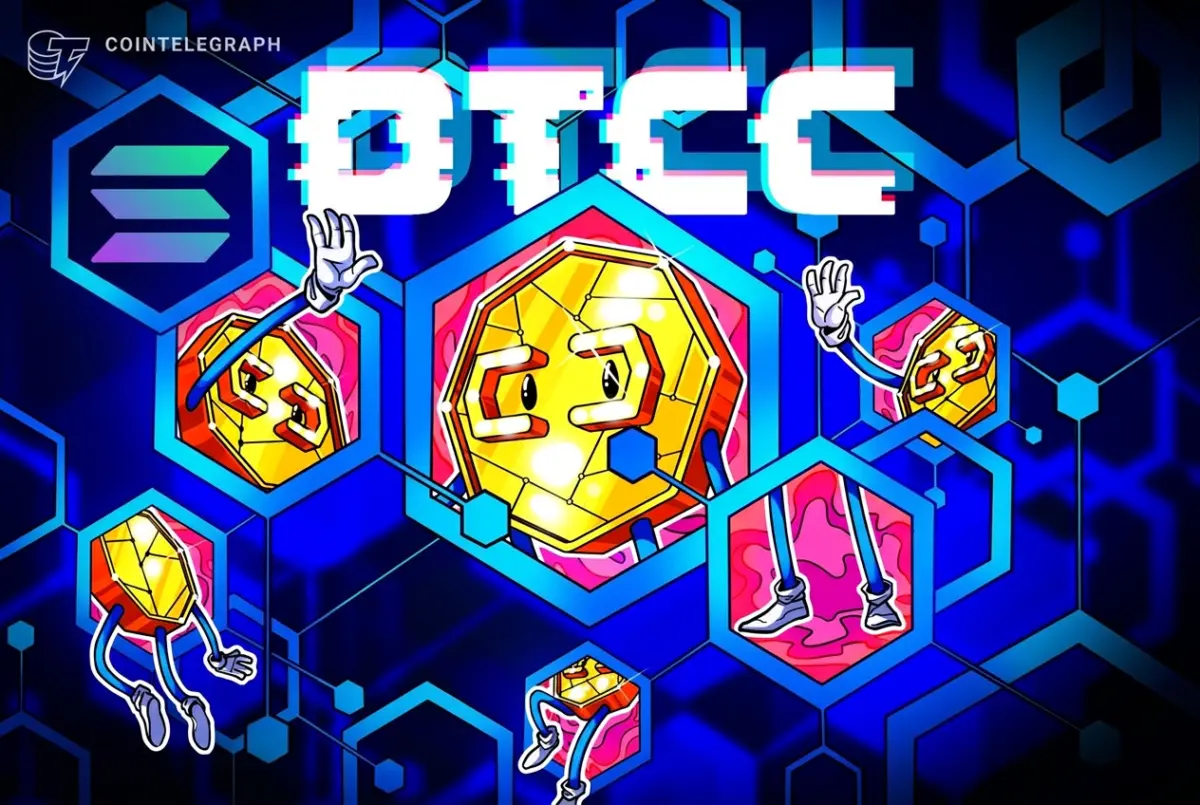
The Depository Trust & Clearing Corporation (DTCC) has announced ambitious plans to connect its burgeoning tokenization service to the Solana blockchain by the second half of 2027. While this milestone move signals a significant step forward in bridging traditional finance with high-performance public networks, industry analysts caution that regulatory roadblocks and strict compliance frameworks could severely restrict the immediate impact on the network’s broader liquidity and transaction volume.
Under the planned integration, certain eligible securities currently held within the Depository Trust Company (DTC)—the DTCC’s primary depository subsidiary—will be eligible for representation as digital tokens on Solana. The network, widely celebrated within the crypto ecosystem for its blazing-fast transaction finality and minimal gas fees, has traditionally served as a hotbed for high-frequency crypto trading and retail-driven memecoin activity. According to metrics from DefiLlama, Solana boasted approximately $4.94 billion in total value locked (TVL) as of mid-November.
Market experts suggest that the arrival of institutional-grade tokenization could help diversify Solana’s onchain economy, attracting substantive economic activity far beyond speculative retail tokens. However, veteran observers emphasize that considerable uncertainty remains regarding the exact volume of fresh capital and transaction throughput the initiative will genuinely inject into the ecosystem. Furthermore, stringent United States regulatory rules currently dictate precise parameters regarding who is legally authorized to custody and transfer these tokenized assets, creating a distinct chasm between institutional compliance and permissionless decentralized finance (DeFi).
Memes Paved the Way for Institutional Plumbing
Reflecting on how a network heavily associated with retail speculation came to the attention of traditional financial utilities, Alex Lin, founding partner at venture capital firm Reforge, noted that Solana’s operational history under intense network loads inadvertently served as a proving ground for institutional adoption.
"Memes were a public stress test that gave Solana credibility that it can handle retail-scale volume cheaply and reliably," Lin explained in an interview. "The casino paved the way for more institutional plumbing."
Despite this hard-earned technical validation, real-world execution faces an uphill battle due to existing legal frameworks. Under a December 2025 SEC no-action letter issued to the DTC, participants are strictly required to register their digital wallets in order to legally hold tokenized securities. Moreover, the regulatory guidelines stipulate that these digital assets may only be transferred exclusively between pre-registered wallets, effectively establishing a closed ecosystem.
"It’s overstated in the near term because the SEC relief from Dec 2025 keeps these tokens in a walled garden of registered DTC participants, so permissionless retail and DeFi liquidity can’t touch these tokens directly yet," Lin elaborated. "Regulators need to let these assets work as true onchain collateral and that’s more policy than tech."
The DTCC’s broader tokenization strategy is already unfolding across alternative enterprise environments. On October 28, the clearing giant officially launched its tokenization service on the Canton Network and a private Besu network, successfully enabling traditional securities to exist in digital formats while preserving critical investor protections. At the time of that initial rollout, the DTCC confirmed that 20 DTC participants had signed formal agreements to access the service, though the institution has yet to clarify which, if any, of those participants intend to deploy assets specifically onto Solana. Representatives for both the DTCC and the Solana Foundation were contacted for further commentary but did not immediately respond.
Solana Trading Slows, but Tokenized Assets Grow
Even prior to the DTCC’s formal announcement regarding Solana, the blockchain has experienced an organic surge in demand for tokenized stocks and real-world assets (RWAs). Kha Nguyen, CEO and co-founder of blockchain analytics platform Birdeye, noted that market demand for tokenized equities has expanded dramatically without direct institutional scaffolding.
Data compiled in Birdeye’s H1 report indicated that tokenized-stock trading volume on Solana reached roughly $4.9 billion during the first half of the year, marking a staggering six-fold increase compared to the previous six-month period. Subsequent findings from the platform’s third-quarter report revealed that more than 1 million individual accounts had successfully held tokenized stocks on the network by late September.
Concurrently, broader macroeconomic and network-level trading metrics on Solana have experienced a temporary cool-down. Token Terminal data reveals that the blockchain recorded roughly 6.9 billion transactions during the 30-day period ending November 11, representing a nearly 40% contraction compared to the preceding month. Decentralized exchange (DEX) trading volumes experienced a parallel decline of 34.4%, falling to $39.1 billion, while monthly active addresses dipped by nearly 13% to settle at 45.8 million. Network fees similarly contracted by 39% to approximately $17 million over the same timeframe.
Despite the broader contraction in speculative trading activity, the total valuation of tokenized real-world assets anchored on Solana actually expanded by nearly 7%, rising from $4.46 million in mid-October to $4.76 billion by mid-November.
"By late September more than a million wallets had held a tokenized stock, and real-world assets on Solana had grown five times in a year," Nguyen observed. However, he cautioned that simply porting tokenized securities onto a blockchain ledger does not automatically translate to heightened transaction velocity or increased organic demand for Solana’s native asset, SOL.
"A trade is one transaction whether it moves $100 or $100 million," Nguyen noted. "What matters is turnover, not value parked on-chain."
What Could Happen Next?
For the upcoming DTCC integration to genuinely move the needle for Solana’s long-term economic footprint, Nguyen argues that comprehensive participation from major commercial banks, brokerages, and corporate issuers will be mandatory. Furthermore, institutional market participants must establish deep liquidity pools capable of supporting high-value transactions seamlessly.
"Banks, brokers and issuers need to say they will issue, trade and settle there, and then do it," Nguyen said, emphasizing that institutional stakeholders must actively utilize the tokenized instruments rather than simply holding them in passive custody. "The assets must be active, not idle: traded around the clock, used as collateral to borrow against, and earning yield."
Echoing these sentiments, Lin reiterated that the ultimate success and long-term economic impact of asset tokenization will rely less on the underlying cryptographic architecture of a specific blockchain and more on the utility and flexibility afforded to market participants in the secondary markets.
"No one cares where the assets are issued, but more so where they’re used," Lin concluded. "It’s all about where secondary trading and collateral activity will happen and ultimately settle."