
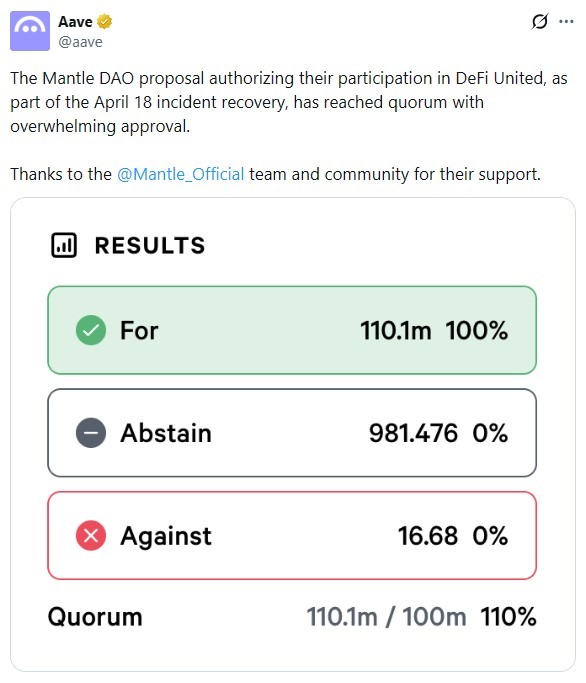
Mantle tokenholders have officially backed a pivotal governance proposal authorizing a credit facility of up to 30,000 Ether, valued at approximately $68 million, for the Aave decentralized autonomous organization. This significant move marks a major advancement in ongoing remediation efforts tied directly to bad debt stemming from the high-profile rsETH exploit that occurred back in April.
The proposal, officially designated as MIP-34, successfully passed following a rigorous seven-day Snapshot vote that concluded on Friday, according to data from the DAO governance platform Snapshot. The newly approved measure authorizes the Mantle Foundation to actively negotiate and execute definitive agreements with Aave DAO for a substantial loan originating directly from the Mantle Treasury. However, governance participants noted that the credit facility remains strictly subject to Aave successfully implementing its broader recovery plan and both parties finalizing the final, binding terms of the agreement.
This newly sanctioned credit facility is specifically intended to help address the severe multi-faceted impact that the rsETH security incident inflicted upon Aave V3. According to background details outlined within the proposal text, the malicious attacker was able to deposit a staggering 89,567 unbacked rsETH tokens onto the Aave protocol. Following this deposit maneuver, the exploiter proceeded to borrow approximately $190 million worth of Wrapped Ether, wstETH, and various stablecoins. This chain of events created potential bad debt estimated by risk analysts to fall somewhere between $123.7 million and $230.1 million, threatening the underlying health of the lending markets.

The successful passage of this vote arrives at a critical juncture when the fallout from the rsETH exploit has begun to evolve beyond the initial acute liquidity shock into a much broader, methodical remediation phase. Within this landscape, Mantle is effectively positioning its robust treasury as a vital structural backstop while Aave continues its tireless work to absorb and address the lingering bad debt, stabilize its platform metrics, and comprehensively restore user and market confidence in its industry-leading lending markets.
Aave WETH Market Cools After Post-Exploit Squeeze
The introduction of the Mantle credit facility is designed to decisively address the deep financial shortfall that also triggered severe liquidity stress across a wide array of Aave’s lending markets during and after the breach.
According to a comprehensive market report published on Thursday by Galaxy Research, the disruptive rsETH exploit forcefully pushed Aave’s Wrapped Ether market into a prolonged and intense liquidity squeeze. Statistical data from the report revealed that WETH utilization rates remained at exceptionally elevated levels, staying strictly above the 99% threshold for a staggering 12.7 consecutive days immediately following the incident.
Elaborating on the severity of these market mechanics, Galaxy noted in their analytical findings that across the full observation horizon, WETH utilization remained structurally elevated and stubbornly close to the absolute 100% ceiling. The analysis pointed out that utilization maintained an average of around 99.6% before only marginally easing down to approximately 98.47% by the very end of the designated snapshot reporting period.
In decentralized finance lending architecture, extraordinarily high utilization rates inherently mean that the vast majority of the asset supplied to the protocol by liquidity providers has already been borrowed out by market participants. This leaves very little idle liquidity sitting in the reserves available for immediate user withdrawals. In the specific context of Aave’s ecosystem, Galaxy explained that the WETH market remained exceptionally strained because the overall supply of the asset contracted at a much faster pace than borrows managed to decline, keeping utilization near maximum operational capacity long after the initial security shock had passed.
Fortunately, the broader market has since shown signs of cooling down significantly from the near-100% utilization extremes detailed in Galaxy’s exhaustive analysis. More recent data pulled from Aavescan on Friday indicated that Aave’s Ethereum V3 WETH market had experienced a notable easing of pressure, registering a utilization rate of approximately 91.6%. Underlying figures accompanying this data showed roughly 2.02 million WETH supplied to the protocol alongside approximately 1.85 million WETH actively borrowed by users, reflecting a gradual return toward healthier operational parameters as ongoing remediation strategies take effect across the decentralized finance sector.