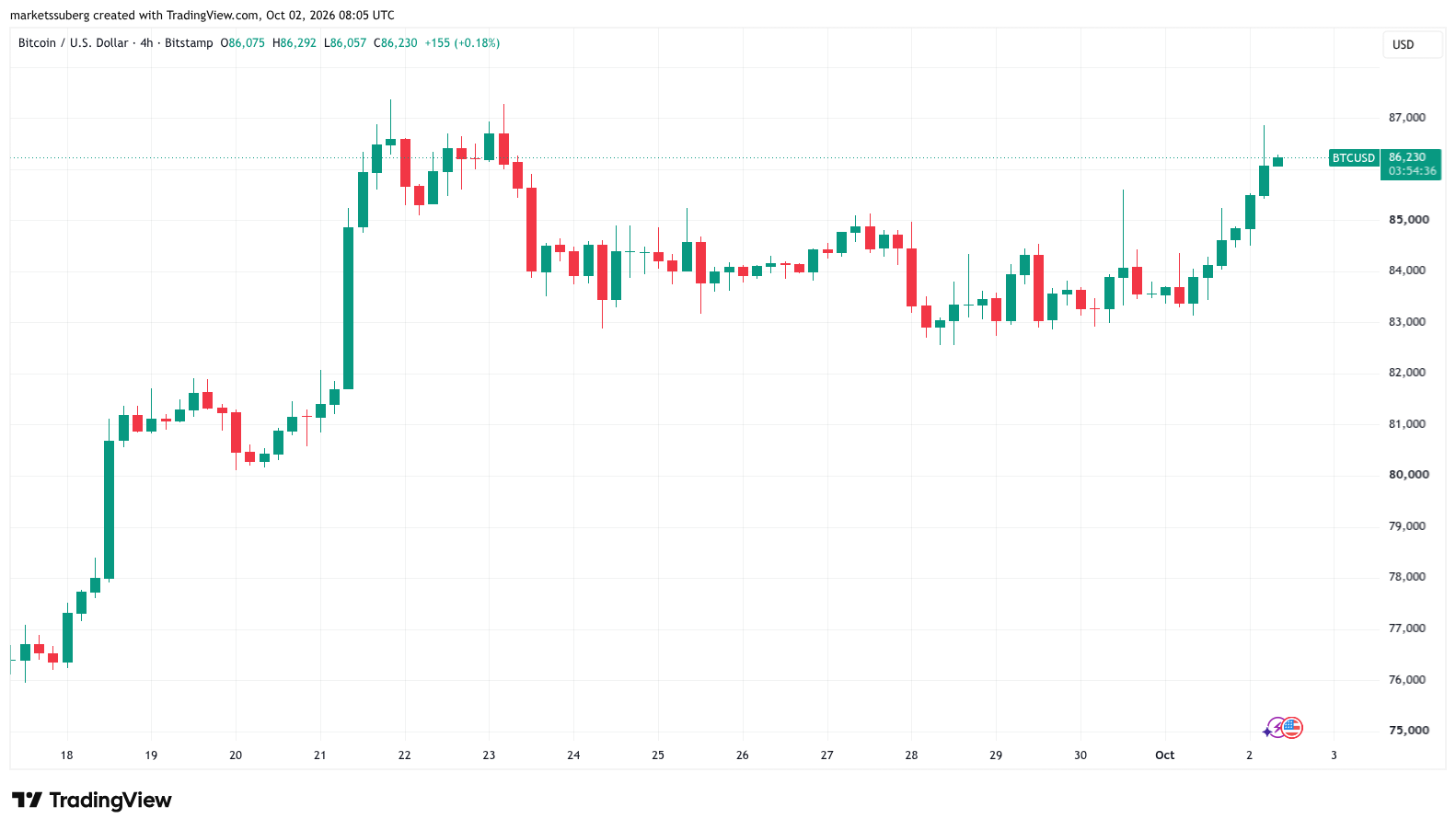
Bitcoin advanced sharply toward the $87,000 threshold on Friday, sparking a wave of market liquidations that saw short positions totaling over $120 million wiped out across a 24-hour window. The leading cryptocurrency reached an intraday high of $86,857 on the Bitstamp exchange before experiencing a minor pullback to trade just below the $0,000 mark.
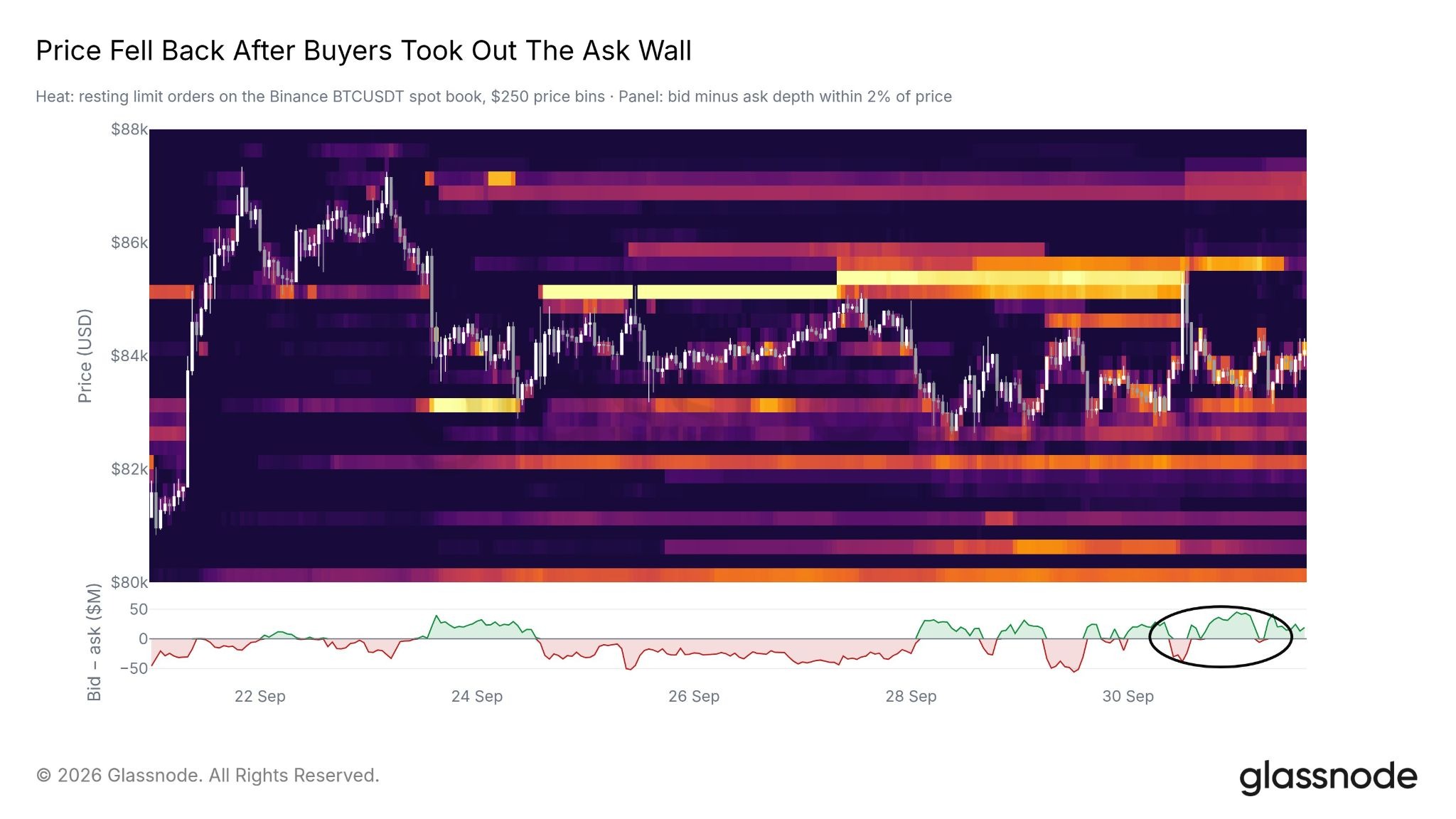
This upward price trajectory marked Bitcoin’s highest valuation since September 23, driven by shifting dynamics within exchange order books and the sudden clearance of persistent sell walls. Market participants had watched price action remain heavily rangebound throughout the week due to a dense concentration of sell orders clustered around the $85,000 level. However, persistent buying pressure ultimately allowed bulls to break through that critical barrier, according to metrics provided by onchain analytics firm Glassnode.
Market analysts observing the order books noted that the removal of these overhead sell walls fundamentally altered the short-term landscape. With reduced ask liquidity lingering above the market, analysts suggested that price acceleration could potentially encounter fewer immediate friction points. Glassnode noted via social media that the remaining sell orders above the immediate resistance zone appeared to have been actively cleared or removed from exchange books.

Earlier in the week, market observers had tracked approximately $30 million in sell orders accumulating around the $85,700 mark, acting as a temporary ceiling that kept bullish momentum in check. Data from CoinGlass subsequently highlighted a significant cluster of potential liquidations forming just above $87,300 following the initial breakout. This distribution indicated that as the price pushed higher, short-seller vulnerability rapidly concentrated at higher price brackets, setting the stage for cascading liquidations.
Over the 24 hours leading up to the report, Bitcoin short liquidations alone reached $122 million. When viewed in the broader context of the digital asset market, total liquidations across all cryptocurrencies climbed to approximately $210 million, underscoring the severity of the squeeze on bearish traders who had anticipated a prolonged consolidation phase below resistance.
Bitcoin buyers battle liquidity walls below $87,000
The latest market movements highlight the intricate relationship between order book liquidity and price discovery. Throughout the week, exchange order books reflected a classic battle between aggressive spot buyers and entrenched sellers defending key psychological and technical levels. The zone around $85,000 had repeatedly thwarted bullish attempts to establish a higher trading range, largely influenced by macroeconomic factors and fluctuating market sentiment following lower United States inflation data released earlier in the period.
Once buyers successfully absorbed the liquidity resting at the $85,000 threshold, the depth of active sell orders visibly thinned out. Heatmap data captured by Glassnode on Binance and aggregate liquidation maps from CoinGlass demonstrated how liquidity pools shift rapidly during a breakout. As prices climbed toward $87,000, traders caught on the wrong side of the market faced margin calls, triggering automatic buy-backs that further fueled the upward momentum.
Despite the intensity of the breakout, sustaining momentum above these levels requires ongoing participation from major capital allocators. Analysts point out that while short
squeezes provide explosive upward thrusts, organic market health ultimately depends on continuous spot demand and structural buying support.
ETF inflows decline after 11-month record
As Bitcoin flirts with the $87,000 range, attention has increasingly turned to the performance of US spot Bitcoin exchange-traded funds. The price region surrounding $86,000 holds particular structural significance, as it currently forms the aggregate breakeven zone for investors who entered the market through these regulated investment vehicles.
In its regular weekly research publication, "The Week Onchain," Glassnode emphasized that a truly sustained breakout will likely require confirmation from higher trading volumes and a noticeable resurgence in spot ETF inflows to validate the broader uptrend.
Daily capital flows into US-listed spot Bitcoin products have cooled notably since September 21. On that date, net daily inflows reached an impressive $999 million, marking the highest single-day accumulation tally in nearly a year. While institutional funds have continued to purchase underlying assets in the weeks following that peak, the current pace represents only a small fraction of the capital influx witnessed during those record-breaking sessions. According to the research report, a return to inflows approaching that magnitude would serve as the most definitive indicator of renewed, large-scale institutional demand.
Recent data compiled by Farside Investors illustrated the mixed nature of institutional activity. On October 1, US spot Bitcoin ETFs registered a collective net inflow of $102.7 million. The day’s activity was heavily anchored by BlackRock’s iShares Bitcoin Trust (IBIT), which successfully attracted $195 million in new capital. However, simultaneous outflows experienced by several competing fund issuers tempered the overall daily tally, reflecting a more cautious allocation environment as Bitcoin tests significant overhead resistance levels.