
Chaos Labs has officially severed ties with the Aave ecosystem, walking away from its position as the primary risk service provider for the leading decentralized finance lending protocol after a three-year tenure. The abrupt departure follows a growing budget dispute and fundamental disagreements between the risk firm and protocol contributors regarding how risk should be managed, evaluated, and structurally balanced within the expanding decentralized autonomous organization.
The split marks a significant turning point for Aave, considering the instrumental role Chaos Labs played in developing the protocol’s back-end infrastructure. Since November 2022, the firm has been responsible for pricing loans and managing underlying risk across the Aave V2 and V3 markets. During this partnership, the protocol experienced monumental growth, with its total value locked multiplying fivefold to reach an impressive $26 billion.
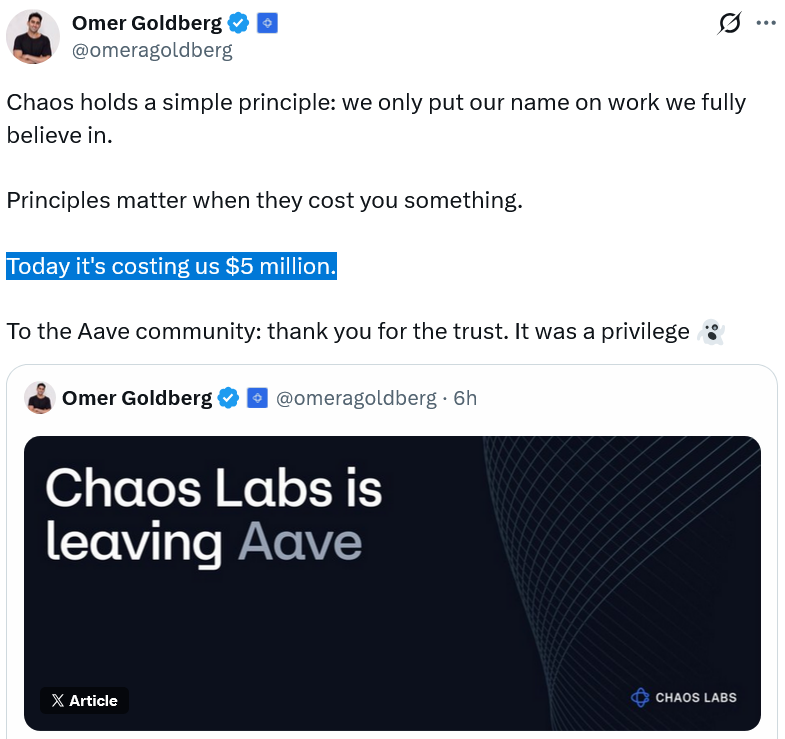
Omer Goldberg, the founder of Chaos Labs, announced the departure in a public post on the social media platform X on Monday, emphasizing that the decision was heavily weighed and deliberate.
"This decision was not made in haste," Goldberg said. "We worked in good faith with DAO contributors. Aave Labs was professional and supported increasing our budget to $5m to retain us. However, we are leaving because the engagement no longer reflects how we believe risk should be managed."

The parting of ways highlights underlying tensions within the decentralized finance sector regarding the immense operational, financial, and legal responsibilities placed upon third-party risk curators. Goldberg elaborated on the mounting pressures, pointing out that departures among other Aave contributors had significantly increased the workload for his team. Furthermore, he argued that the expanded functionality introduced by Aave V4 would create substantial additional operational and legal liabilities that would ultimately fall squarely on the shoulders of Chaos Labs.
Addressing the complexities of protocol upgrades, Goldberg noted that while Aave Labs remains optimistic about a swift migration to V4, historical precedence dictates that such technical transitions frequently take many months or even years to complete. Until the V4 iteration fully absorbs the markets and liquidity currently residing within V3, both complex systems must be operated, monitored, and managed simultaneously. According to Goldberg, the operational workload during this transition phase does not merely decrease or halve; it effectively doubles.
Weighing the severe risks associated with potential protocol failures, Goldberg highlighted a glaring vacuum in the regulatory landscape. He pointed out that there is currently no formal regulatory framework, no established safe harbor, and no settled law that definitively answers the question of what legal or fiduciary obligations a risk manager or protocol curator owes when a decentralized system encounters a catastrophic failure. Summarizing the precarious nature of the role, Goldberg noted that when everything operates smoothly, the underlying work remains invisible, but when systems break down, the blame is immediate and severe.
Despite Aave Labs offering to double its financial compensation to retain their services, Goldberg confirmed that his firm ultimately chose to walk away from a lucrative $5 million engagement rather than compromise on its operational philosophy.
Aave Labs CEO Stani Kulechov offered a contrasting perspective on the separation, indicating that while Chaos Labs did not depart on hostile terms, the firm had introduced a structural proposal that Aave was fundamentally unwilling to accept. According to Kulechov, Chaos Labs attempted to negotiate terms that would position it as the sole risk provider for the entire protocol, effectively forcing out competing partners and upending Aave’s established multi-layered risk architecture.
Kulechov stated that accepting this proposal would have forced Aave to push out its other vital risk protocol partner, LlamaRisk, and dismantle its tried-and-tested two-layer economic risk model. Furthermore, Kulechov revealed that Chaos Labs had requested that Aave integrate its proprietary price oracles instead of relying on Chainlink’s established infrastructure. Aave flatly rejected this request, citing its long-standing track record and comfort level with Chainlink’s services, which protocol users have grown accustomed to utilizing securely at scale.
Kulechov added that Chaos Labs was already exploring ways to wind down its broader risk consultancy services before the formal split was finalized, though Aave had actively attempted to maintain the partnership by increasing its payment package. He reassured the community that the departure of Chaos Labs has caused zero operational disruption to the Aave protocol, its underlying smart contracts, active token listings, or broader network integrations.
Moving forward, Aave confirmed that it will collaborate closely with LlamaRisk to ensure a seamless transition and maintain the structural integrity of its two-layer economic risk model.
The exit of Chaos Labs unfolds against the backdrop of heightened community sensitivity surrounding protocol safety and risk management. These concerns were thrust into the spotlight following a high-profile incident on March 12, when a user suffered a $50 million loss in a single trade while interacting with Aave’s user interface. In response to the backlash and community unease, Aave announced the upcoming rollout of a specialized security feature dubbed the "Aave Shield," designed specifically to deter users from engaging in excessively high-risk trades.
The ecosystem has also been navigating a broader protocol-wide governance dispute regarding the distribution of funding and revenue control between Aave Labs and the decentralized autonomous organization itself, touching on debates over how much financial autonomy development entities should retain. Despite these internal friction points, governance debates, and shifts in service providers, Aave’s operational momentum remains robust, highlighted by the protocol crossing the historic $1 trillion mark in cumulative lending volume in late February—a first-of-its-kind milestone for the broader decentralized finance industry.