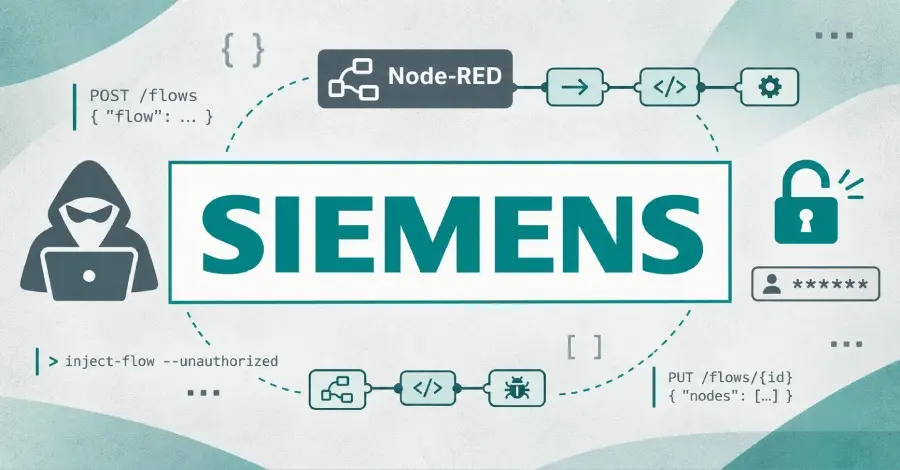
A maximum-severity security flaw impacting Siemens SIMATIC IoT2050 Advanced hardware running Industrial OS with Node-RED installed has officially come under active exploitation in the wild, cybersecurity researchers at VulnCheck have revealed. The vulnerability, which carries a maximum possible severity rating of 10.0 on the Common Vulnerability Scoring System (CVSS) and is tracked as CVE-2026-58115, represents a critical breakdown in access controls that allows unauthenticated remote attackers to achieve arbitrary code execution with maximum system privileges.
The underlying flaw stems from a fundamental lack of authentication mechanisms protecting critical operational functions within the Node-RED HTTP interface deployed on these industrial devices. According to the original security advisory published by Siemens back in August 2026, SIMATIC IoT2050 Advanced systems utilizing this specific software configuration are inherently exposed to remote interference. Without proper authorization checks guarding the endpoint, an unauthenticated attacker operating across a network can seamlessly create malicious execution flows and subsequently run arbitrary code directly on the underlying server. Because these operations are executed with maximum system privileges, a successful exploit effectively hands over complete control of the affected industrial hardware to unauthorized external actors.
Recognizing the gravity of the risk, Siemens released software updates to remediate the vulnerability in versions 4.3.4.1 and later. For environments unable to immediately apply the software updates, the industrial automation giant urged administrators to either completely uninstall Node-RED from the affected systems or implement rigorous hardening measures following standard runtime security guidelines to limit unauthorized access to the HTTP interface. However, despite the availability of patches and warnings issued months prior, threat actors have begun weaponizing the flaw against exposed instances deployed across the broader threat landscape.

The active exploitation campaign came to light after VulnCheck observed continuous targeting attempts directed against its network of internet-facing honeypots starting around October 30, 2026. According to Patrick Garrity, a researcher at VulnCheck, the incoming malicious requests captured by the monitoring infrastructure represented fully realized, highly sophisticated exploit chains capable of instantaneous deployment.
Detailing the mechanics of the attacks, Garrity noted that the malicious requests successfully deployed a custom Node-RED flow, triggered its execution automatically without requiring human intervention, and subsequently reached out to an attacker-controlled external server to retrieve a malicious binary payload. The entire payload delivery mechanism was heavily obfuscated, operating behind three distinct layers of encoding designed to evade casual detection and hinder automated signature analysis.
Specifically, the initial wave of observed attacks relied upon a malicious flow designed to invoke a shell script wrapper. This script leveraged the standard Linux utility wget to fetch a botnet binary compiled specifically for the AMD64 architecture from a remote IP address located at 85.215.73.250, which has since been flagged by threat intelligence platforms. As a contingency measure to ensure the payload retrieval succeeded even if the primary utility encountered environment restrictions, the script included a fallback mechanism utilizing curl. Once successfully downloaded from the remote server, the resulting binary was written directly into the device’s volatile shared memory filesystem under the discreet filename "/dev/shm/.b" and immediately executed by the system shell.
As threat intelligence analysts continued to monitor the campaign, they observed that the threat actors behind the infrastructure had already begun evolving their deployment tactics. In subsequent attack iterations, the methodology shifted toward a more modular, two-stage process. Instead of directly pulling the final botnet executable in a single step, the initial wget command was repurposed to retrieve an intermediary shell script, ominously designated as "wget.sh," from the same malicious hosting infrastructure. This staged approach allows threat actors greater flexibility in modifying their payloads on the fly, tailoring subsequent downloads based on the specific architectural nuances or defensive posture of the compromised target.

Further investigation into the campaign revealed additional variations in the malicious requests targeting the vulnerability. In one distinct instance, analysts intercepted activity involving the execution of wget and curl commands directed against an alternative remote endpoint hosted at 45.194.90.57 on port 38472. This particular vector was utilized to fetch a specialized payload bearing the filename ".sys_update." Upon successful retrieval, the malicious file was deliberately saved onto the local disk as "/tmp/.kworker"—a calculated attempt to masquerade the unauthorized binary as a completely harmless and routine kernel worker thread, thereby blending in with legitimate operating system processes and evading casual administrative oversight before being executed. Despite the recovery of these network indicators, the precise underlying functionality and ultimate operational objectives of both the "wget.sh" script and the ".kworker" payload remain obscured, as researchers were unable to successfully retrieve copies of the files for deep reverse engineering before the hosting servers rotated or went offline.
Perhaps most concerning to defenders is that not all observed exploitation attempts relied on traditional downloader scripts designed to fetch external binaries. In several instances captured by the honeypot network, the threat actors bypassed file downloads entirely, opting instead for a persistent, native configuration change. The deployed Node-RED flow was explicitly configured to expose a new, unauthorized HTTP input endpoint—such as a path designated as "/cmd" or a randomized uniform resource locator path—and wire it directly through a function node connected to an execution node with argument payload passing enabled.
This configuration effectively transforms the compromised industrial device into an interactive, remote-controlled proxy. By leveraging this setup, the attacker gains the ongoing capability to inject and execute arbitrary system commands at will simply by passing them through standard query parameters attached to incoming HTTP requests. Because this custom-engineered backdoor integrates natively into the Node-RED runtime environment and execution logic, it possesses the distinct advantage of surviving standard device reboots, maintaining persistent unauthorized access even if memory-backed implants or temporary runtime files are wiped away during a system restart.
The transition from theoretical vulnerability disclosure to active exploitation underscores the persistent risks facing industrial control systems and Internet of Things infrastructure deployed in modern enterprise and manufacturing environments. Devices such as the Siemens SIMATIC IoT2050 Advanced are frequently deployed to bridge operational technology networks with enterprise software platforms, making them high-value targets for malicious actors seeking footholds within critical industrial architectures. With maximum-severity flaws like CVE-2026-58115 being aggressively scanned for and weaponized by automated threat groups, organizations utilizing these platforms are strongly advised to audit their network perimeters, verify that all applicable software updates and patches are fully applied, and ensure that management interfaces and integration tools such as Node-RED are strictly secured against unauthorized remote access.