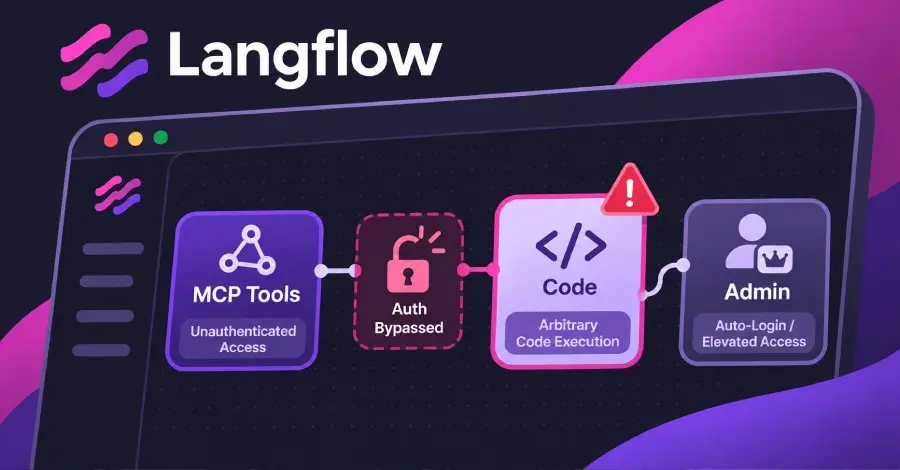
A newly disclosed series of severe security vulnerabilities affecting Langflow, an increasingly popular open-source framework used for building AI agents and workflows, poses significant risks to organizations worldwide. According to security advisories published by IBM, which handles vulnerability reporting for the project, multiple flaws allow remote attackers to completely bypass authentication mechanisms or execute arbitrary code on vulnerable servers without requiring any prior user account access.
The security bulletin details that every release of Langflow from version 1.0.0 through version 1.12.8 is impacted by these critical defects. The primary and definitive resolution issued by maintainers requires affected administrators to upgrade immediately to version 1.13.0. Although these particular flaws have not yet been integrated into the Cybersecurity and Infrastructure Security Agency (CISA) Known Exploited Vulnerabilities catalog as of its late October update, the discovery underscores the growing attack surface surrounding modern artificial intelligence tooling and agentic infrastructure.
The scope of the advisory centers around four prominent vulnerabilities identified by IBM. Among these, two stand out with the highest possible severity rating on the Common Vulnerability Scoring System scale. The first, cataloged as CVE-2026-93680, carries a CVSS score of 9.8 and allows unauthenticated remote attackers to bypass security restrictions due to improper authentication handling. The second critical issue, designated as CVE-2026-110186, also holds a 9.8 CVSS rating and enables unauthenticated remote code execution stemming from improper control over code generation processes.

Further down the severity spectrum, IBM documented two additional flaws requiring low-level access. CVE-2026-110193, rated 8.8 on the scale, requires a low-privileged account but enables an attacker to manipulate the Agentic Assistant into generating or submitting component code capable of executing operating system commands directly on the host server. Additionally, CVE-2026-110192 is a medium-severity issue rated 6.5 that allows authenticated users to extract sensitive information from insufficiently protected credentials stored within the system.
A key vector highlighted by security researchers involves unauthenticated remote code execution exploitable through model context protocol tool enumeration. Through the integration of the Model Context Protocol, Langflow possesses the functional capability to expose its internal workflows as callable tools to external artificial intelligence applications that support MCP. When improperly secured, this integration opens pathways for unauthorized entities to interact with the underlying system architecture without authenticating their identity.
Publicly available exploitation material has already begun emerging within the cybersecurity community. A module added to the widely used Metasploit Framework specifically targets CVE-2026-93680, the core authentication bypass vulnerability. This module demonstrates how an external script can connect directly to a targeted Langflow server’s MCP endpoint in the absence of valid credentials, initialize a functional session, and enumerate the various tools hosted by the server, though its initial implementation focuses primarily on reconnaissance rather than direct code execution.
The underlying mechanics of these authentication flaws are closely tied to default configuration behaviors within the platform. When automatic login features are active, Langflow automatically provisions users with superuser privileges without prompting them for standard authentication credentials. The specific configuration setting responsible for this behavior, designated as LANGFLOW_AUTO_LOGIN, was enabled by default within Langflow version 1.12.8. Source code documentation associated with this parameter explicitly warns developers that it bypasses security controls entirely and should strictly be confined to isolated development environments rather than production deployments. Security analysts testing public exploit modules successfully verified the behavior against installations running version 1.8.4 configured with auto-login enabled, while IBM noted that at least one of the reported vulnerabilities represents an incomplete remediation of previous auto-login security controls.

The release of Langflow 1.13.0 on October 22 serves as the sole remedy for these security deficiencies. Version 1.12.8, which rolled out concurrently, remains fully vulnerable to the reported issues, and package repositories list no subsequent patches under the 1.12 branch. Significantly, the newly released 1.13.0 version alters default behavior by disabling automatic login out of the box, mitigating the primary vector exploited by unauthorized actors. For enterprise environments currently unable to transition immediately to the latest version, official workarounds have not been provided by vendors, compounding the urgency for administrative action.
The disclosures regarding Langflow extend beyond the primary four vulnerabilities. In a related series of security bulletins published at the end of October, IBM released vulnerability records for 29 additional flaws affecting the platform, identifying versions 1.12.4 and 1.12.5 as historical fix points for those specific issues. Among that broader collection of defects, CVE-2026-104339 was highlighted as another critical flaw bearing a 9.8 CVSS score that similarly allowed unauthenticated remote code execution. None of the total 33 tracked CVE records indicate that version 1.13.0 is susceptible to these compounding issues, confirming that the latest software iteration successfully neutralizes the accumulated backlog of security concerns.