
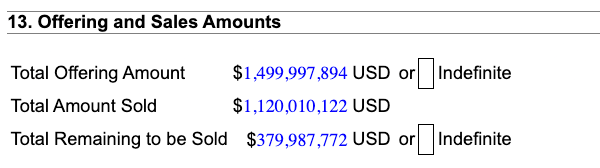
Prediction market operator Kalshi has disclosed that $1.12 billion has been sold under a massive $1.5 billion equity offering that initially commenced in April, according to a newly revealed regulatory filing with the United States Securities and Exchange Commission (SEC).
The official Form D filing, submitted to federal regulators on Tuesday, provides a detailed look into the financial scaling of the high-profile prediction platform. The document explicitly lists 71 distinct investors participating in the round and identifies April 3 as the official date of the very first sale under the offering. With $1.12 billion already secured from backers, approximately $380 million remains available to be sold under the overarching $1.5 billion target.

According to the SEC filing, the securities being issued are categorized as equity. Furthermore, the document indicates that Kalshi is relying on Rule 506(b) of Regulation D to structure the transaction. This specific federal exemption allows growing companies to raise capital by selling securities without being subjected to the comprehensive and burdensome registration process typically mandated by the SEC, provided that they strictly adhere to a distinct set of regulatory requirements, such as limitations on general solicitation and restrictions on the number of non-accredited investors.
The timing of this disclosure coincides closely with broader corporate updates from the prediction market firm. In early May, Kalshi officially announced a landmark $1 billion Series F funding round, a massive injection of capital that propelled the platform’s overall private market valuation to an eye-popping $22 billion.
A spokesperson for Kalshi subsequently confirmed to industry media that the latest SEC Form D filing is directly tied to this very same Series F funding round, cementing the platform’s towering $22 billion valuation in the eyes of institutional backers and private equity markets. Beyond confirming the alignment between the regulatory filing and the recent funding milestone, the company did not provide further public breakdowns regarding the specific identities of the 71 participating entities or the individual allocations within the syndicate.
This influx of institutional capital arrives at a critical juncture for Kalshi, as the firm simultaneously navigates an increasingly complex and hostile regulatory landscape across multiple United States jurisdictions. While the platform continues to attract massive financial backing and investor enthusiasm at the federal level, it faces significant and growing legal challenges from state-level regulators who scrutinize the intersection of prediction markets, event contracts, and traditional state gambling laws.
In mid-August, these simmering jurisdictional tensions culminated in a major courtroom setback for the company. A Washington state judge officially ordered Kalshi to immediately halt the offering of a broad range of its popular event contracts within state lines. In issuing the injunction, the court explicitly rejected Kalshi’s core legal defense, which argued that federal oversight preempts and overrides state-level gambling restrictions. The clash highlights a widening chasm between federal regulatory frameworks and state-level authorities regarding how event-based trading and speculative markets should be classified and governed.
The regulatory scrutiny is not confined to the Pacific Northwest. Across the country, local governments and consumer protection bodies are casting a suspicious eye on the aggressive marketing and operational expansion of prediction market platforms. For instance, municipal lawmakers in other major jurisdictions have begun launching formal probes into promotional tactics utilized within the sector, questioning whether certain advertising strategies cross the line into predatory behavior when targeted at everyday retail participants.

Despite these mounting legal hurdles and regional resistance efforts, Kalshi’s successful execution of its multi-billion-dollar equity offering demonstrates that institutional confidence in the structural growth of prediction markets remains remarkably robust. As the company absorbs the remaining capital from its $1.5 billion authorization and continues to scale its operations under the weight of its $22 billion valuation, it remains locked in a high-stakes battle to define the legal boundaries of event-based trading in the United States.