
Following the devastating Sept. 24 cyberattack that drained $387.5 million from cryptocurrency exchange Bitget, the stolen funds immediately began cascading across multiple blockchains. A significant portion of the illicit capital quickly made its way toward decentralized cross-chain liquidity and swap platforms, igniting an intense industry-wide debate over protocol responsibility, financial crime prevention, and the foundational ideology of decentralized finance.
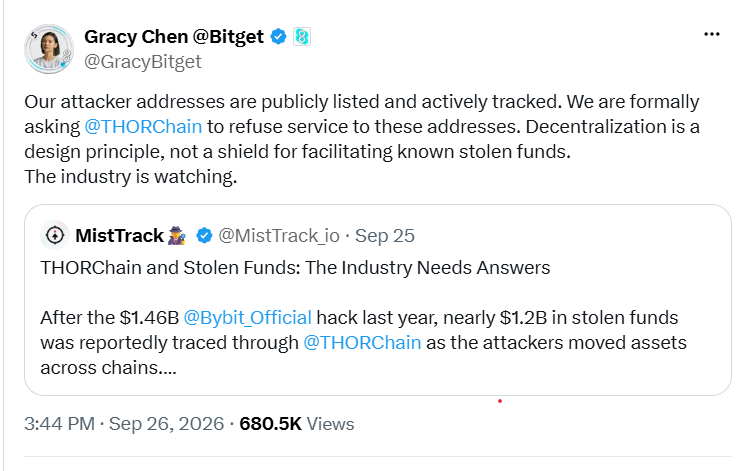
Gracy Chen, the chief executive officer of Bitget, publicly appealed to decentralized cross-chain swap platform THORChain to refuse service to addresses linked to the attackers. In a direct message shared across social media, Chen emphasized the gravity of the situation, stating plainly that “the industry is watching.”
However, THORChain outright refused the request. That refusal has since opened a deep ideological chasm between market participants who believe decentralized protocols bear a moral and practical obligation to block stolen funds, and those who hold the traditional cypherpunk ideals of permissionless, censorship-resistant technology as absolute and sacrosanct.
Having previously observed malicious actors funnel $1.2 billion through the protocol during the infamous Bybit exploit, THORChain’s stance on the matter comes as little surprise to industry watchers. Boone Wheeler, a core protocol contributor, articulated this philosophy clearly, noting that a truly permissionless system is inherently incapable of selective filtering.
“A truly permissionless protocol can do nothing when it encounters known stolen funds — it is blind to their provenance,” Wheeler explained. “If THORChain were able to block specific stolen funds, it would not be permissionless.”

Where Does Permissionlessness End?
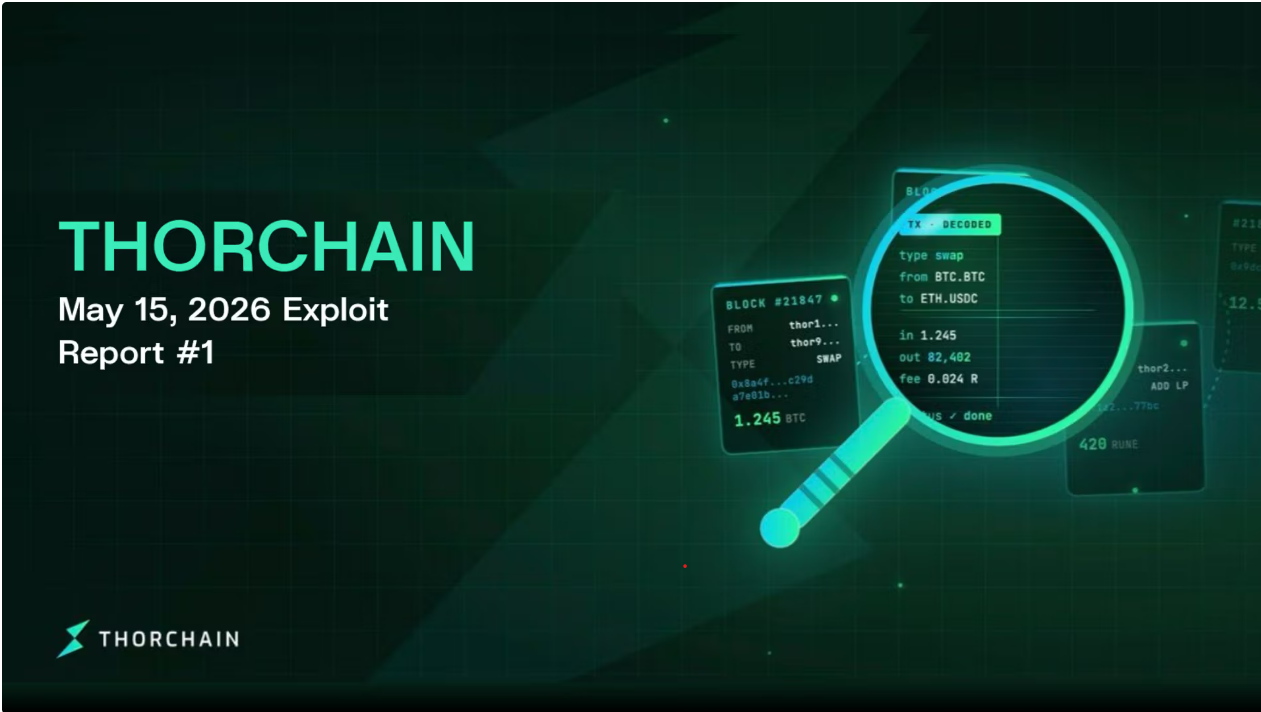
The defense of absolute permissionlessness has drawn sharp criticism from skeptics who point out that THORChain has not always adhered strictly to this ideal when its own solvency was threatened. Critics quickly noted that THORChain validators previously voted to halt the entire blockchain in May, after an automated circuit breaker triggered when an exploiter drained over $10 million from one of the network’s native vaults.
In stark contrast to THORChain’s hands-off approach, cross-chain transaction competitor NEAR Intents chose a completely different path. Its automated security and compliance layer, known as SHIELD, successfully identified more than $50 million in attempted transaction flows tied to the Bitget hack. During execution, the automated system actively blocked $503,000 worth of illicit transfers, though approximately $166,000 managed to slip through before controls engaged. Furthermore, NEAR announced it was waiving its share of Bitget’s recovery bounty to support mitigation efforts.
Alex Shevchenko, general manager of NEAR Protocol, defended the architectural design that allowed for this intervention while maintaining the network’s foundational openness.
“NEAR Protocol is permissionless: anyone can build on it, transact on it, and become a validator,” Shevchenko said, adding that while no individual requires permission to hold, transfer assets, or deploy smart contracts on NEAR, “that does not mean every application built on NEAR must process every request.”
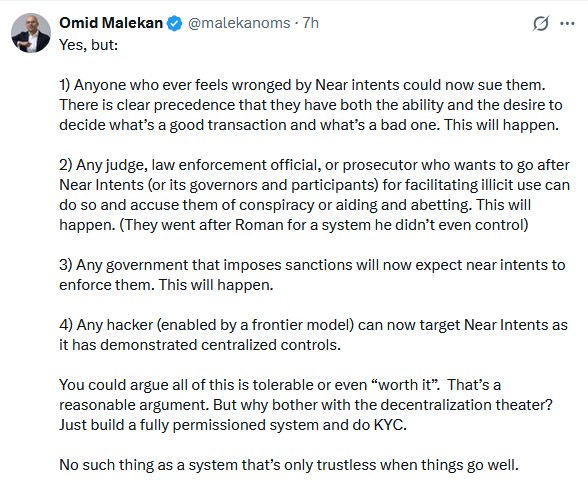
Despite these measures, NEAR Intents has faced substantial criticism from ideological purists arguing that such active filtering proves the platform is neither fully permissionless nor genuinely decentralized. Critics warn that this capability could expose the project to future demands for broader censorship. However, crypto lawyer Yuriy Brisov suggests that because SHIELD operates as an automated system rather than a manual administrative tool, it may still fall safely within the legal protections traditionally afforded to decentralized protocols.
“There is no compliance team, people who sit there and control the operation manually,” Brisov noted. “This is a smart solution, and that’s what we recommend to all the DeFi companies.”
Permissionless Does Not Necessarily Mean Neutral
Bitget CEO Gracy Chen acknowledges that different decentralized protocols operate under distinct architectural designs, governance models, and technical capabilities. Nevertheless, she maintains that a vital distinction exists between open infrastructure and actively facilitating the movement of known stolen funds. Highlighting the cooperative approach demonstrated by NEAR Intents, Chen expressed appreciation for their intervention and confirmed that Bitget would pursue appropriate legal and recovery processes for those specific assets.
Bitget’s objective, according to Chen, is to understand what remains technically and governance-wise possible when illicit assets are successfully identified, and whether the broader digital asset industry can collaboratively forge workable solutions.
“Permissionless infrastructure does not necessarily mean there can be no mechanisms for detecting and responding to known illicit flows,” Chen asserted.
Complicating THORChain’s rigid defense of neutrality is the reality that the protocol has previously demonstrated an ability to intervene during critical emergencies. Post-mortem reports detailing the May security incident explicitly noted that the network automatically halts operations when internal solvency checks flag an insolvency event. During such moments, node operators can leverage broader emergency controls to pause trading, transaction signing, and overall network activity.
Wheeler maintains that a firm consensus exists among THORChain’s decentralized network of node operators regarding the vital importance of permissionlessness. He reiterated that network halts are deployed exclusively during active technical emergencies or critical protocol failures, rather than for transaction screening. Furthermore, Wheeler emphasized that the network simply possesses “no functionality to screen individual addresses or transactions,” highlighting this limitation as an intentional design choice intended to ensure the system remains truly permissionless.
NEAR Intents Provides a Contrasting Model
While THORChain positions itself firmly at the uncompromising end of the developer-centric spectrum, the NEAR ecosystem occupies a more pragmatic middle ground. Shevchenko explains that while NEAR Intents was built to foster open participation, it incorporates integrated financial integrity safeguards. The SHIELD infrastructure was specifically engineered to apply targeted, automated controls to supported financial flows using public onchain data, internal anti-money laundering databases, and intelligence feeds provided by third-party compliance partners.
“SHIELD not only protects NEAR Intents but the whole cross-chain ecosystem it serves,” Shevchenko stated, noting that every major platform hack siphons critical capital and activity out of the broader digital economy. By actively screening for stolen funds and disrupting money laundering pipelines, he argues that platforms can help safeguard the long-term integrity of the decentralized economy.
The efficacy of this automated defense was further demonstrated when the AI-based SHIELD system successfully identified suspicious behavioral patterns behind an Omni deposit and withdrawal interaction exploit, prompting a rapid halt to vulnerable activity.
Chen argues that whenever stolen funds can be reliably identified and traced, ecosystem participants have a shared responsibility to cooperate wherever technical and legal frameworks allow. This cooperation could range from intelligence sharing and transaction refusal to asset freezing and direct support for formal law enforcement and legal recovery procedures.
The Cost of Drawing the Line
Joël Valenzuela, a prominent libertarian, cypherpunk advocate, and head of business development for Dash, strongly rejects the notion of selective protocol intervention, arguing that permissionlessness loses all meaning if exceptions are made.
“Permissionless protocols, quite frankly, should not draw the line anywhere when stolen funds are identified, because being able to do so at all makes them permissioned,” Valenzuela argued.
While acknowledging the frustration of watching stolen capital move freely across decentralized rails, Valenzuela warns that introducing the capability to censor transactions opens a dangerous Pandora’s box that could eventually enable the suppression of innocent users. Instead of pressuring decentralized liquidity protocols to police transactions, he contends that high-volume centralized exchanges bearing custody of billions of dollars must dramatically upgrade their internal security posture.
Max Shannon, a senior research associate at Bitwise Europe, suggests that younger protocols like THORChain and NEAR are still actively working to earn market trust, and that choosing to refuse the laundering of illicit hack proceeds represents a sound strategic stance. However, he anticipates that THORChain’s steadfast refusal to intervene may ultimately drive a higher volume of criminal money laundering flows away from platforms like NEAR Intents and directly toward THORChain.
“Credible neutrality at all costs is a cypherpunk ideal that a small faction of crypto users and builders still champion,” Shannon observed. “They rarely ask why it is valuable, when it is valuable, or what it costs. This is the core difference between NEAR Intents and THORChain.”