A sharp market-wide sell-off involving Bitcoin and various altcoins has triggered more than $1 billion in liquidations over a 24-hour period. The sudden downturn was compounded by reports of significant government-backed asset transfers and an influx of tens of thousands of Bitcoin sent to exchanges by short-term holders operating at a loss, introducing renewed volatility to the broader digital asset ecosystem.
Bitcoin Drop to $80,350 Fuels $1.1 Billion Liquidations
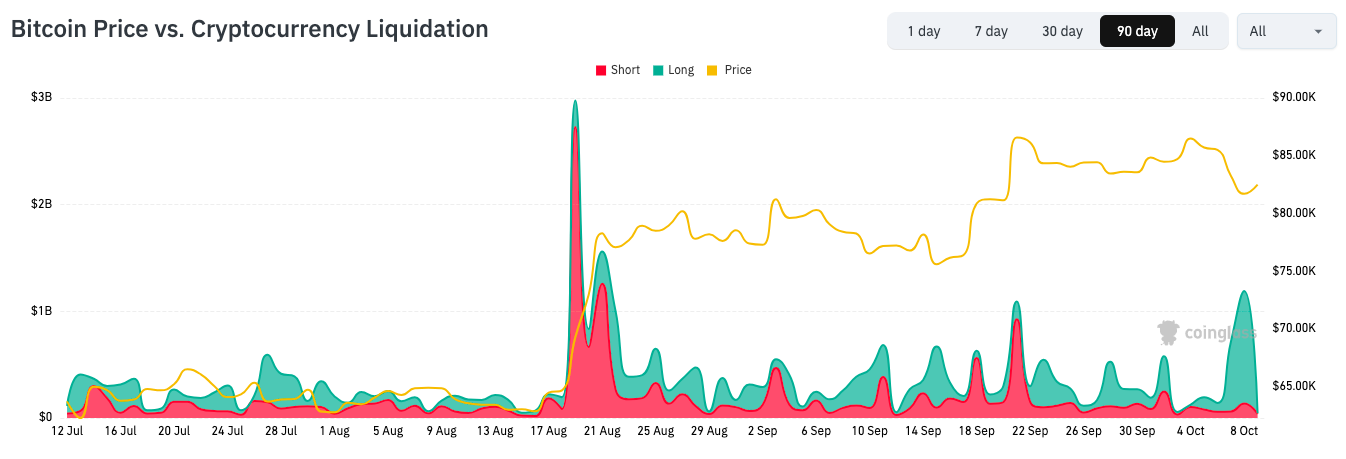
Data compiled by analytics platform CoinGlass revealed that total crypto market liquidations reached an estimated $1.09 billion during the 24-hour window leading up to 10 am UTC on Friday. This dramatic market flush represents the largest single-day liquidation tally since Aug. 21. During that earlier August event, the BTC/USD trading pair climbed rapidly from $73,000 to $79,500, hitting two-month highs and subsequently triggering $1.3 billion in short position liquidations.
The dynamics of Friday’s liquidation event starkly contrasted with the summer squeeze. Long positions bore the brunt of the market correction, accounting for $1.05 billion of the total liquidations recorded on Thursday. Leveraged traders betting on a continuation of the upward trajectory were caught off guard as sudden downward pressure swept across major centralized derivatives exchanges.
The macroeconomic and structural catalyst behind the sell-off appeared to stem from reports indicating that the United States government had moved more than 12,000 Bitcoin that had been previously confiscated through various legal proceedings. Large-scale movements of seized government assets consistently generate apprehension among retail and institutional market participants alike, as such transfers frequently precede potential liquidations on the open market, thereby dampening immediate bullish sentiment.
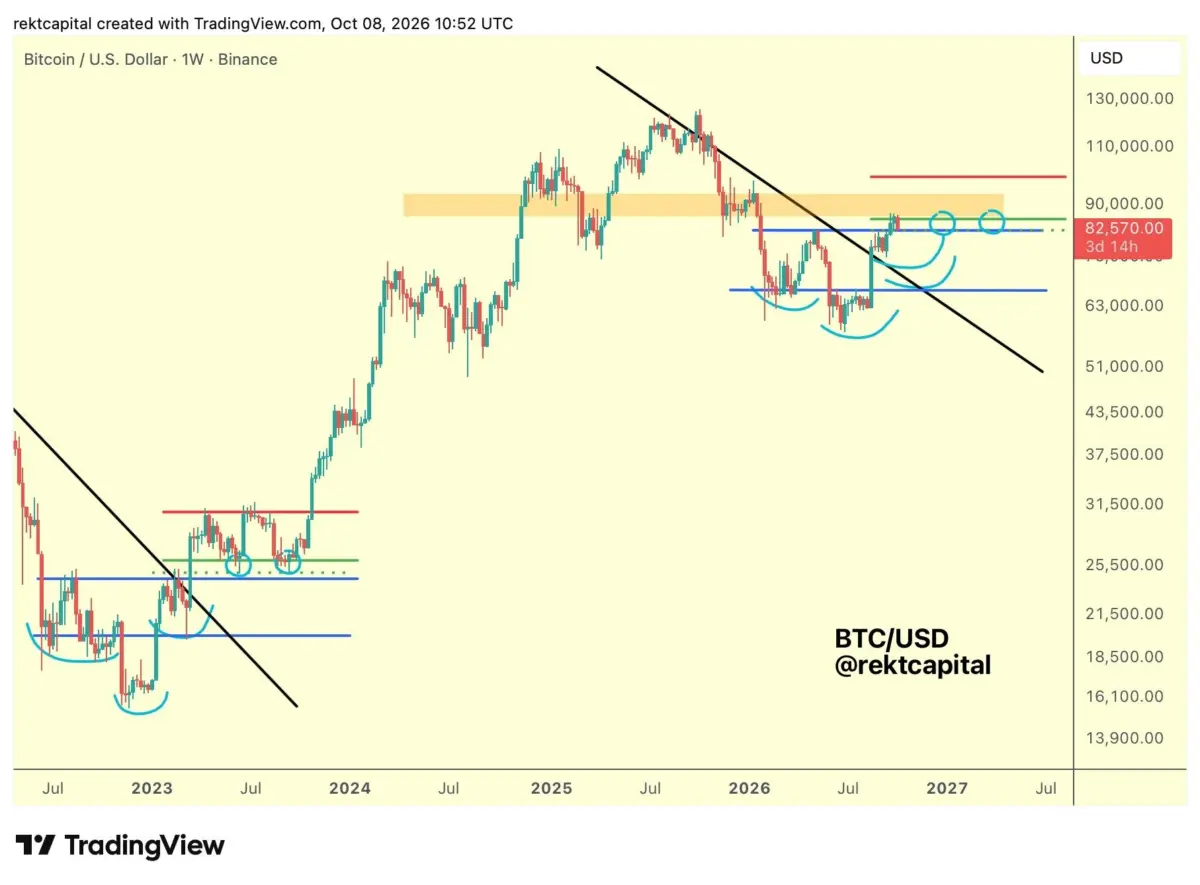
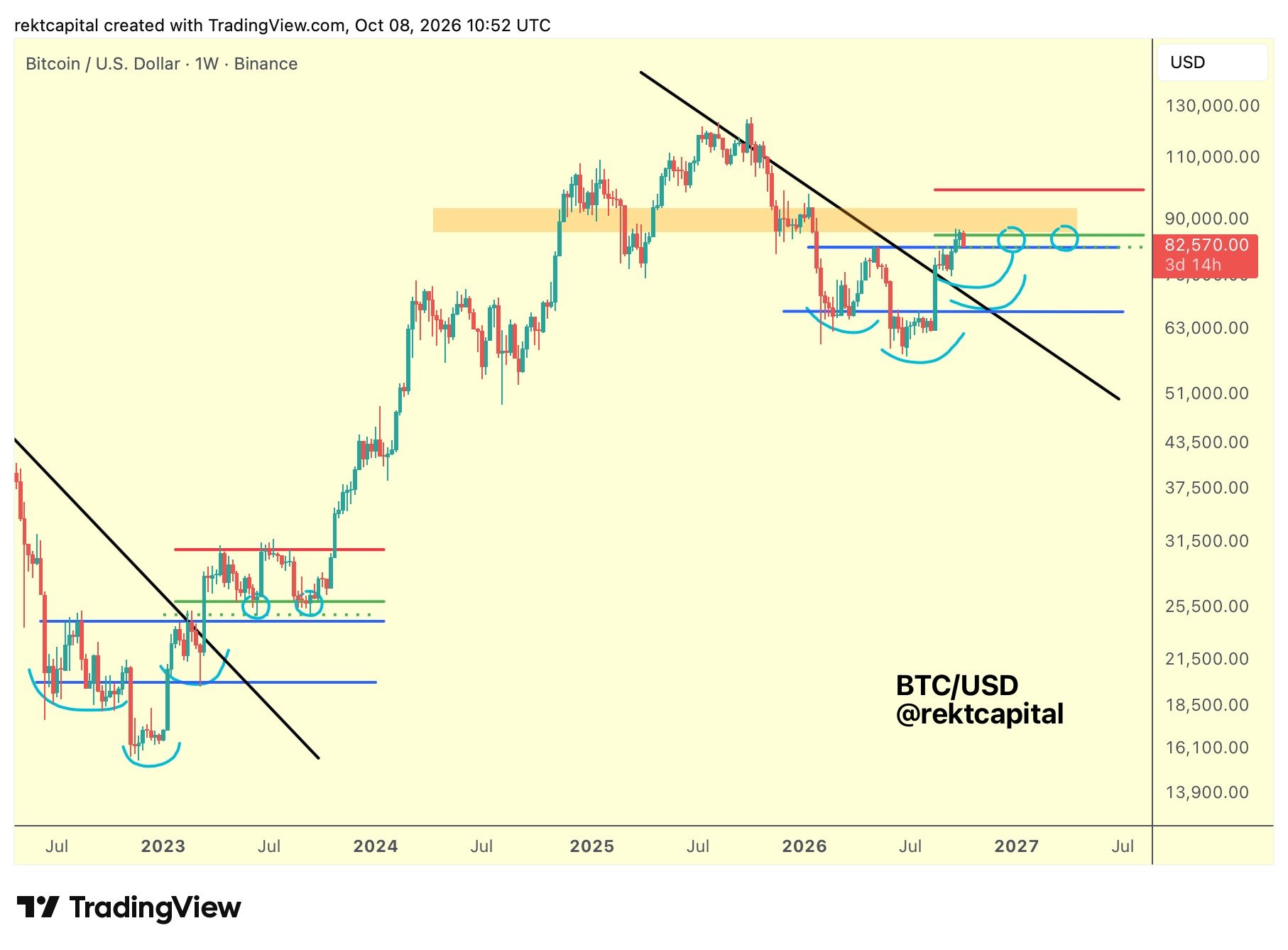
Amid this mounting selling pressure, BTC/USD plummeted to $80,350 on Bitstamp, marking its lowest price point since Sept. 18. Following the sharp descent, the premier cryptocurrency initiated a modest recovery, climbing back to trade around the $82,500 mark on Friday. This particular price threshold holds immense technical significance; it served as a critical pillar during Bitcoin’s broader market uptrend observed since early July and represented the primary breakout point for an inverse head-and-shoulders technical pattern. For the market to validate a true bullish reversal, technical analysts emphasize that Bitcoin must successfully defend this level and maintain it as a reliable support zone.
Prominent trader and cryptocurrency analyst Rekt Capital, who has been closely monitoring the evolution of this reversal pattern and drawing structural parallels to Bitcoin’s notable 2023 market recovery, pointed to the imminent weekly candle close as a decisive moment for market direction.
"Bitcoin is currently failing its retest of ~$82500," Rekt Capital noted in a post on X on Thursday. He added that a confirmed weekly close below the $82,500 threshold would effectively transform the level into resistance, pulling Bitcoin back into its established macro accumulation range.
Short-Term Holders Send 55,600 BTC to Exchanges at a Loss
Onchain data from the broader market underscored a deep sense of stress and urgency among newer participants navigating the sudden price contraction. The behavioral patterns of incoming capital have begun to mirror prior periods of macro capitulation, as market participants rush to mitigate further downside risk.
According to insights published by Amr Taha, a contributor to the blockchain analytics platform CryptoQuant, short-term holders—defined as entities that have held their Bitcoin positions for up to six months without transacting—transferred a staggering 55,600 BTC to exchanges at a loss on Thursday alone.
In onchain analytics, transactions conducted at a loss denote digital assets being moved to exchange deposit addresses at a lower valuation than when they were acquired in their preceding transaction. Such aggressive movements typically signal an impulsive psychological reaction among retail and short-term investors. Driven by fear of deeper market contractions or further capital erosion, these market participants frequently elect to liquidate their positions rather than endure prolonged sideways or downward consolidation phases.
CryptoQuant highlighted that the sheer volume of loss-driven transactions recorded on Thursday exceeded the metrics observed on June 26, an operational period during which Bitcoin dipped below the $60,000 threshold for two consecutive days. The comparative scale of the recent loss transfers relative to the June lows highlights a unique psychological dynamic within the current market cycle.
"Notably, Bitcoin was trading above $81,000, compared with $59,300 in June — a price difference exceeding 36%," the CryptoQuant contributor wrote, while noting that exchange depositors do not necessarily execute immediate market sales for the entirety of their transferred balances upon arrival.
Despite the near-term pain and the psychological friction experienced by newer market entrants, historical onchain precedents suggest that heavy capitulation events of this nature often play a foundational role in cleansing the market of excessive leverage and weak hands. Historically, aggressive loss-driven selling by short-term participants can coincide with localized capitulation phases, ultimately exhausting market sellers and establishing the necessary supply-demand equilibrium for a subsequent price recovery.