
Crypto protocols and open-source software projects are increasingly sounding the alarm over a tidal wave of low-quality, AI-generated bug bounty submissions. This influx of automated noise is overwhelming development teams, severely straining their capacity to identify and remediate genuine security threats to their infrastructure.
Bug bounty programs have long served as a cornerstone of digital security across both traditional technology and the Web3 ecosystem. These systems financially reward ethical hackers—often referred to as "white hat" hackers or "good" hackers—for discovering, documenting, and privately submitting reports about potential vulnerabilities before malicious actors can exploit them. Within the crypto and decentralized finance industries, where code is immutable and a single exploit can lead to the instantaneous loss of millions of dollars in user funds, these programs are particularly popular and vital for survival.
However, the rapid advancement and widespread accessibility of generative artificial intelligence have dramatically shifted the dynamics of vulnerability hunting. AI tools have made it exceptionally easy for individuals to scan massive codebases, parse repositories, and generate vulnerability reports at scale. Unfortunately, this technological leap has also introduced a massive volume of "AI slop," including false positives, misunderstood logic, and outright hallucinations—a phenomenon where AI models confidently assert the existence of security flaws that do not actually exist.
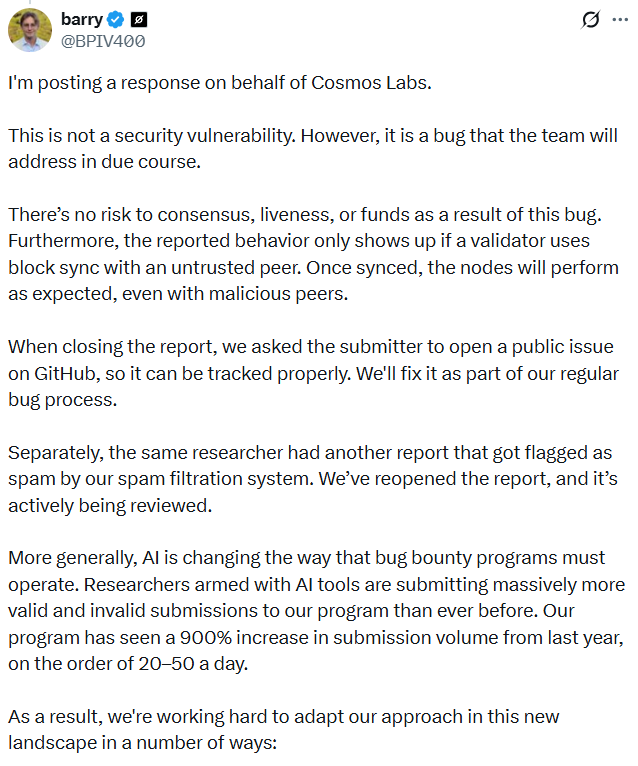
The operational friction caused by this shift is already taking a heavy toll on project maintainers. Barry Plunkett, co-CEO of Cosmos Labs, highlighted the severity of the issue on Tuesday while responding publicly to a bug bounty hunter who had accused the protocol of ignoring a vulnerability report.

Addressing the overwhelming surge in volume, Plunkett revealed that his organization’s program has experienced a staggering 900% increase in submissions compared to the previous year. Cosmos Labs is now routinely processing between 20 and 50 submissions per day, a workload that has created an immense administrative and technical burden. According to Plunkett, this explosion in volume encompasses both legitimate discoveries and an overwhelming mass of invalid, AI-generated noise, forcing projects to completely rethink how they manage security operations.
The phenomenon is not isolated to Cosmos Labs. Kadan Stadelmann, a blockchain developer and chief technology officer at the Komodo Platform, echoed these concerns in an interview with Cointelegraph, noting that he has observed a notable increase in bug bounty submissions and subsequent payout inquiries across multiple blockchain organizations.
Stadelmann pointed directly to the economics of content generation as the root cause of the trend. There has definitely been an increase in low-quality bug bounty submissions, he explained, noting that some of these filings clearly display the hallmarks of false positives derived from automated AI sourcing. One primary explanation for this surge is that generative artificial intelligence has dramatically lowered the cost and effort required to produce a formal security report, resulting in an unprecedented influx of speculative submissions from individuals hoping for a quick payout without doing the rigorous verification work.
This friction extends far beyond the borders of the Web3 sector, bleeding into foundational open-source software that underpins the entire modern internet, including blockchain infrastructure. In January, Daniel Stenberg, the creator of curl—the ubiquitous open-source data transfer tool utilized by countless applications, software systems, and network layers—made the dramatic announcement that he was shutting down his long-running bug bounty program entirely. Stenberg cited an exhaustion-inducing influx of AI-generated vulnerability reports filled with nonsense and false leads, stating that he simply no longer had the time or mental bandwidth to sift through the daily avalanche of AI slop.
The broader security industry is also tracking these changing metrics. HackerOne, one of the largest and most prominent bug bounty platforms in the world, released research data in January showing that its global network recorded 85,000 valid bounty submissions throughout 2025. While valid submissions still grew by 7% year-over-year, the raw volume of total incoming reports—including filtered and discarded submissions—has risen at a much higher and more unsustainable rate, driven largely by automated tooling.
AI could be both the cause and the solution
As the security landscape transforms under the weight of automated submissions, protocol teams are being forced to adapt their operational models to survive. Plunkett noted that Cosmos Labs has already begun modifying its approach to triage. The protocol has tightened its scoring criteria for incoming submissions, placed a heavier emphasis on prioritizing trusted researchers with a proven track record of accurate reporting, and integrated with external bug bounty providers that offer more advanced, automated filtering and triage services.
Meanwhile, Stadelmann emphasized that despite the current administrative chaos, bug bounty programs remain absolutely integral to defending complex decentralized systems against sophisticated attacks. Because human engineering teams have strict limits on their time and attention, Stadelmann argues that the industry will ultimately need to fight fire with fire by adopting defensive AI systems to manage the onslaught.
Blockchain teams will have to create AI deterrents to sift through incoming bug bounties, Stadelmann said, adding that the problem falls disproportionately on smaller development teams. The smaller the team, the bigger the problem of increased bug bounties will become, because software engineers simply won’t have the capacity to examine everything manually.
For Stadelmann and other industry veterans, this reality means that defensive AI systems designed to automatically vet, parse, and score incoming bug bounties will become crucial infrastructure for any protocol relying on crowdsourced security. Furthermore, teams that depend heavily on bug bounties will likely need to establish much stricter submission standards, friction-based gating, or bond requirements as a direct means of lowering the sheer volume of speculative, low-effort reports reaching developers’ desks.