
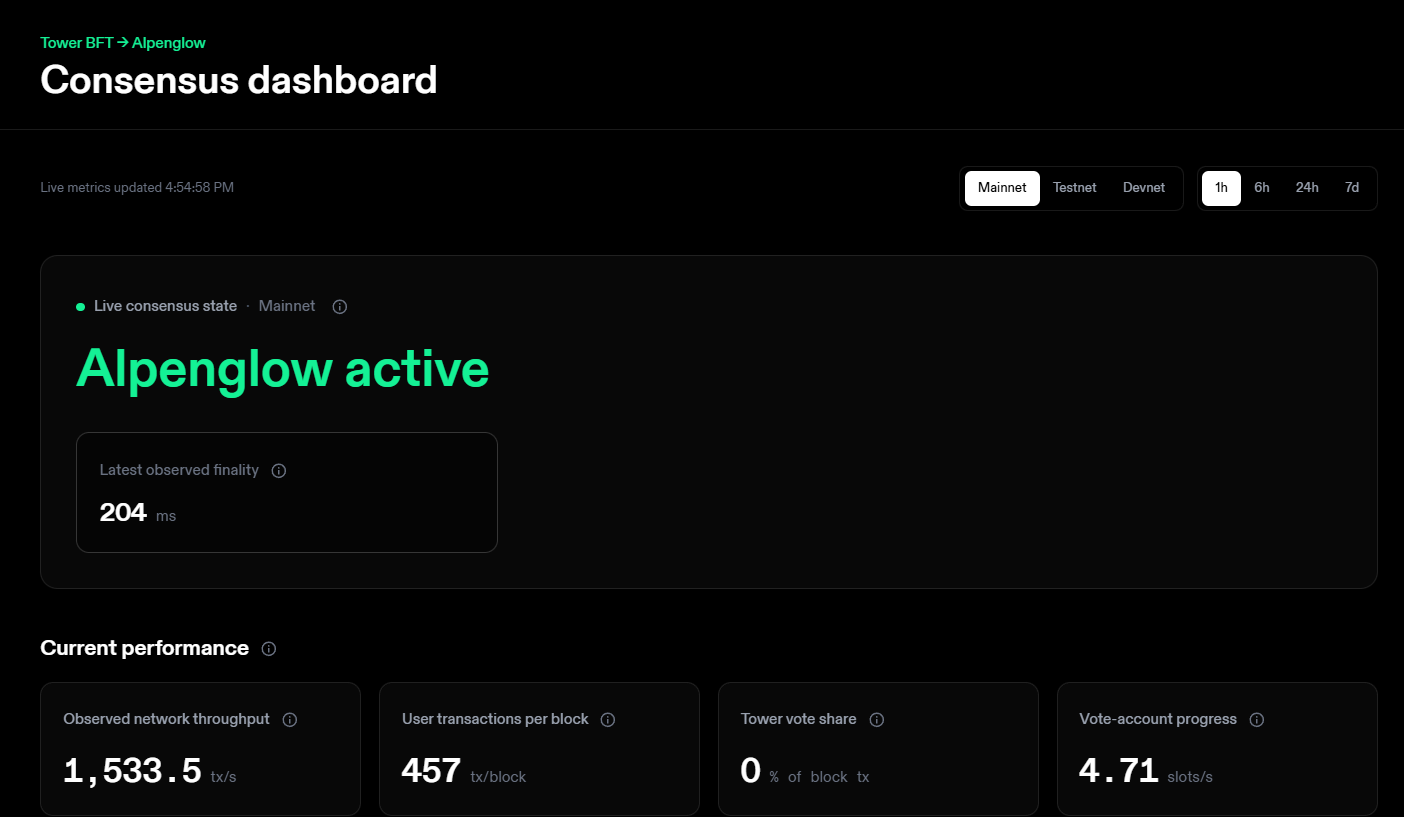
Solana has officially launched Alpenglow, marking the network’s first major consensus upgrade since its genesis. According to the Solana Foundation’s live deployment dashboard, the landmark protocol change went live on the mainnet around 1:54 pm UTC on Wednesday.
The primary objective of the Alpenglow upgrade is to dramatically reduce transaction finality by an estimated 99%. Previously hovering at roughly 12.8 seconds, the network’s target finality is slated to drop to approximately 150 milliseconds. This milestone represents a monumental shift for the high-performance blockchain, pushing its underlying infrastructure closer to the speed and responsiveness associated with traditional Web2 web applications.
A Phased Overhaul of Core Mechanics
Alpenglow is rolling out in distinct phases to overhaul how the network processes, validates, and propagates data. The first major phase introduces Votor, a brand-new component that entirely replaces Solana’s legacy voting and finalization mechanism. Votor implements direct validator voting alongside a certificate-based architecture specifically engineered to slash transaction finality times down to the targeted 150-millisecond threshold.
Subsequent development phases will introduce Rotor, an advanced block data-distribution protocol designed to replace the network’s existing Turbine system. Together, these upgrades represent the definitive retirement of TowerBFT, the consensus model that has powered Solana since its inception.

By achieving near-instantaneous transaction finality for everyday users, the network aims to unlock entirely new use cases. Faster finality translates directly to more seamless payments, instantaneous trade settlements, and highly responsive decentralized applications that can finally match the user experience of centralized financial and technological platforms. At press time, real-time data from the Alpenglow dashboard indicated that the Solana mainnet was operating with a transaction finality of roughly 6.6 seconds and maintaining a throughput of 4,721 transactions per second as the network transitions into its new operational parameters.
Alpenglow Marks the ‘Biggest Change’ for Solana’s Core Protocol
Long before its mainnet activation, core developers and researchers emphasized the sheer scale of the Alpenglow overhaul. In a comprehensive blog post published in May, researchers from Solana Labs offshoot Anza highlighted that Alpenglow would introduce the single "biggest change to Solana’s core protocol" since the network’s genesis block.
Anza researchers Quentin Kniep, Kobi Sliwinski, and Roger Wattenhofer argued that achieving a latency of just 150 milliseconds would allow Solana to directly compete with traditional Web2 infrastructure in terms of pure responsiveness. They noted that such high performance could potentially make blockchain technology viable for entirely new categories of consumer and enterprise applications that previously found distributed ledger technology too sluggish for practical deployment.
The activation of Alpenglow follows a series of aggressive optimization efforts undertaken by the broader Solana ecosystem throughout the year. In August, the network successfully reduced its slot time for the first time in its history. This move formed a core part of the Solana Foundation’s broader roadmap to halve slot times down to 200 milliseconds, a strategy aimed at systematically improving network latency and accelerating overall confirmation times. The fourth and final stage of that ambitious slot reduction initiative was successfully completed in October.
Ongoing Development and Market Response
Even as the Alpenglow upgrade goes live, core contributors and validators show no signs of slowing down their roadmap. Work is already well underway on subsequent infrastructure enhancements, most notably Agave 4.5. This upcoming protocol upgrade proposes increasing the number of accounts supported within a single versioned transaction from the current limit of 64 up to 96. According to documentation provided by the Solana Foundation, expanding account limits could enable significantly better swap routes and superior execution prices for decentralized finance traders. The Agave 4.5 upgrade is currently in active development and is broadly planned for release in December.
In the financial markets, native token SOL reacted positively to the mounting anticipation surrounding the technical milestone. The token’s price climbed by nearly 3% over the 24 hours leading up to the mainnet deployment, helping to partially offset a broader 42% downward correction experienced over the preceding year, according to data from CoinMarketCap.