As enterprises race to adopt artificial intelligence to boost productivity, a silent and potentially dangerous shift is occurring on endpoints across corporate networks. Right now, there is likely an autonomous AI agent running quietly on a laptop somewhere within your organization. It may store sensitive API keys and database passwords, possess direct access to internal corporate systems, and operate entirely without human supervision or oversight.
Nobody reviewed its access permissions, and in many cases, nobody even truly owns it. If a human employee held that level of operational reach with such a minimal degree of oversight, corporate security teams would immediately classify it as a critical insider risk. Yet, organizations continue to categorize these powerful digital assistants strictly as productivity tools, overlooking the profound security implications they introduce.
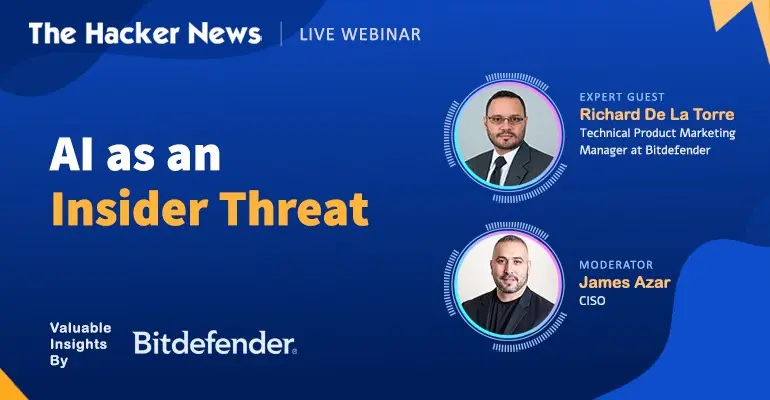
While much of the contemporary cybersecurity discourse focuses on how external threat actors leverage artificial intelligence for cyberattacks, a more insidious danger may already reside deep inside the organization. Addressing this pressing enterprise blind spot is the central focus of an upcoming industry webinar titled "AI as an Insider Threat: From Shadow AI to Governed AI," featuring expert guest Richard De La Torre, Technical Product Marketing Manager at Bitdefender. The session aims to provide organizations with a practical security playbook designed to bring unseen and unmanaged artificial intelligence under strict control.
Where AI is Hiding on Your Endpoints
The proliferation of artificial intelligence within the modern workplace extends far beyond the traditional domain of software developers and data scientists. Autonomous AI agents, sophisticated coding assistants, Model Context Protocol (MCP) servers, and various browser extensions are rapidly permeating every corner of the modern business environment.
Crucially, the vast majority of these AI-driven tools never cross the traditional network gateway in a way that legacy security tools and perimeter defenses can recognize, monitor, or evaluate. This dynamic creates a stark and hazardous irony for enterprise security architects: the artificial intelligence possessing the highest level of access to sensitive corporate infrastructure is frequently the exact AI that security teams cannot see.
Traditional perimeter security assumes that software enters the network through managed channels, downloaded by authorized personnel and vetted by IT departments. However, modern AI tools can be deployed instantly, locally, and often independently by employees seeking to streamline their daily workflows. Without a centralized inventory or visibility mechanism, these applications operate in a governance vacuum, creating a sprawling surface area for potential data exfiltration, accidental credential exposure, and unauthorized system access.
The Visibility Gap, by the Numbers
The scale of this enterprise visibility challenge is underscored by empirical data from the industry. According to Bitdefender’s 2026 Cybersecurity Assessment report, a mere 51.8 percent of organizations report having full visibility into the artificial intelligence tools actively utilized by their staff members. This leaves nearly half of all enterprises operating without a complete picture of the AI workloads running on their networks and endpoints.
This widespread blind spot carries a tangible financial and operational cost. Research conducted by IBM indicates that approximately 20 percent of organizations that suffered a data breach were compromised through vectors related to shadow AI. When unmonitored and ungoverned applications connect to corporate repositories, they introduce vulnerabilities that traditional endpoint detection and response tools may fail to contextualize properly.
These sobering statistics raise a fundamental question for Chief Information Security Officers and IT leaders: what can organizations realistically do to secure environments they cannot fully see? This dilemma forms the core of the discussion in the upcoming Bitdefender webinar, which explores actionable strategies that lean security teams can implement to identify, assess, and mitigate the risks posed by hidden artificial intelligence.
From Shadow AI to Governed AI
Recent intelligence gathered by Bitdefender Labs sheds light on the reality of what is currently executing on enterprise endpoints, drawing from analyses of real-world machines. Among the findings is the alarming discovery of a malicious agent skill captured in the wild, illustrating that threat actors are actively capitalizing on the trust placed in autonomous digital assistants.
When organizations discover unmanaged artificial intelligence within their infrastructure, the instinctive reaction is often to implement a blanket ban, attempting to block all unauthorized AI tools outright. However, industry experience demonstrates that heavy-handed prohibition rarely succeeds. Employees working under tight deadlines will frequently find workarounds to utilize tools they perceive as essential to their productivity, driving shadow AI further underground and entirely out of sight.
The sustainable alternative to outright prohibition is governed adoption. Transitioning from a state of reactive shadow AI to proactive, governed artificial intelligence requires a framework that balances innovation with security. The upcoming expert session led by Richard De La Torre aims to demonstrate what governed adoption looks like in a practical enterprise setting, moving past theoretical policies to examine real-world enforcement mechanisms.
As the deployment of autonomous systems accelerates, the artificial intelligence already running on corporate endpoints will not wait for comprehensive governance policies to be written and approved. Security leaders must confront the reality of AI as an insider threat before unmanaged tools become the source of the next major organizational breach.