According to security researcher boredhackerblog, the ongoing exploitation campaign leverages a sequence of four distinct security flaws. This combination, collectively tracked under the moniker "Plex2Shell," allows remote attackers to achieve unauthenticated remote code execution on susceptible Plex Media Server installations. The rapid transition from a public proof-of-concept to active, in-the-wild exploitation underscores the constant race between defenders and opportunistic threat actors who monitor security disclosures for immediate monetization opportunities.
The foundational vulnerabilities underlying this attack vector were originally discovered and responsibly disclosed to Plex on July 27, 2026, by independent security researcher Zach Main. Among these flaws is CVE-2026-96651, which carries a CVSS score of 7.1. Following the disclosure, Plex moved to address the security issues by releasing Plex Media Server version 1.43.3.10861 on August 3, 2026.

However, the safety window provided by software updates relies entirely on user adoption. When technical details and the Plex2Shell exploit chain went public on October 16, 2026, malicious actors quickly seized the opportunity to target lingering, unpatched servers across the internet. In-the-wild exploitation attempts were recorded just one day later, resulting in unauthorized payloads being downloaded and executed from remote infrastructure, specifically pointing to the IP address 217.60.194.116. Additional attack attempts have been logged from several other associated IP addresses as automated scanners sweep the internet for vulnerable media servers.
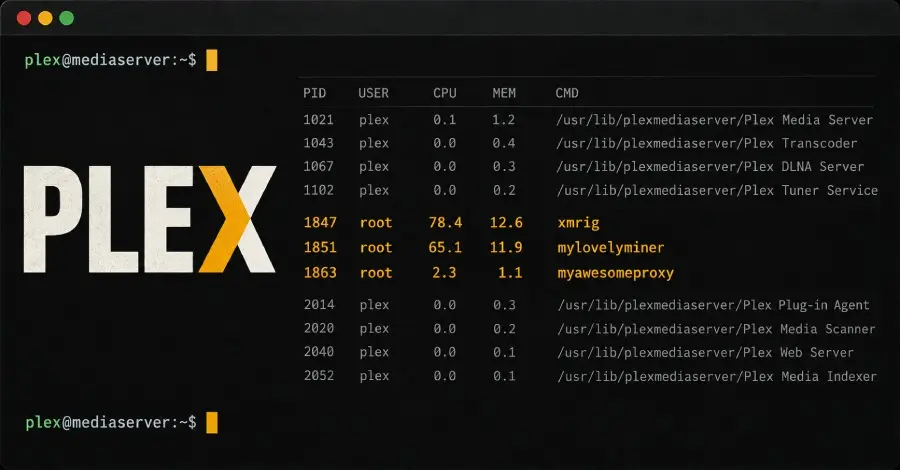
Security telemetry and analysis of the active campaigns reveal that successful compromises lead to the installation of multiple malicious artifacts. Among them is an executable named "myawesomeproxy." VirusTotal intelligence indicates that this artifact functions as a stealthy Linux backdoor and reverse proxy designed to route traffic through the compromised host. When analyzed, running the program outputs a telling warning message explicitly noting that operating the software on any device implies agreement to the potential external use of the user’s internet traffic, turning the victim’s device into an unwitting node in a broader proxy network.
Simultaneously, attackers are deploying an XMRig cryptocurrency mining process labeled "mylovelyminer." The configuration parameters for this miner direct computational output to a mining server located at ota.proxystream.st. Intriguingly, this infrastructure has broader threat intelligence connections. Another subdomain tied to the same domain infrastructure, global.relay.proxystream.st, was previously flagged by security firm Bitsight in August 2026. That prior sighting linked the domain to the AISURU distributed denial-of-service and proxyware botnet ecosystem, suggesting potential overlaps or shared infrastructure among cybercriminal groups operating commodity malware campaigns.

The impact of these campaigns is already rippling through the community. Recent posts on online forums such as Reddit indicate that multiple Plex users have reported finding their media servers compromised by the exact same "mylovelyminer" payload. While investigators are still working to determine whether every single instance of this specific miner deployment stems directly from the exploitation of the Plex2Shell vulnerability chain or other legacy security gaps, the sheer volume of reports highlights the precarious security posture of exposed media servers.
This wave of attacks arrives more than a month after Plex issued urgent advisories encouraging users to update their software installations to the latest versions in response to multiple security flaws. While it remains officially unclear whether the specific vulnerabilities highlighted in the Plex2Shell chain were explicitly detailed in those prior alerts, the timing reinforces the critical importance of maintaining rigorous patch management routines.
Cybersecurity experts continue to urge all administrators and users running Plex Media Server to verify their software versions and apply available updates immediately. Ensuring that media servers are running version 1.43.3.10861 or later remains the most effective defense against the Plex2Shell exploit chain, closing the window of opportunity for automated threat actors scanning the web for vulnerable targets.