
The corporate adoption of digital currencies is rapidly transitioning from an experimental fringe strategy to a mainstream operational reality. According to a comprehensive new report released by payments infrastructure firm Cybrid, business utilization of stablecoins is poised to experience a massive surge over the next 12 months. Driven by the pursuit of dramatic cost efficiencies, faster settlement times, and evolving regulatory frameworks, companies across multiple sectors are increasingly bypassing legacy financial systems in favor of blockchain-backed digital dollars.
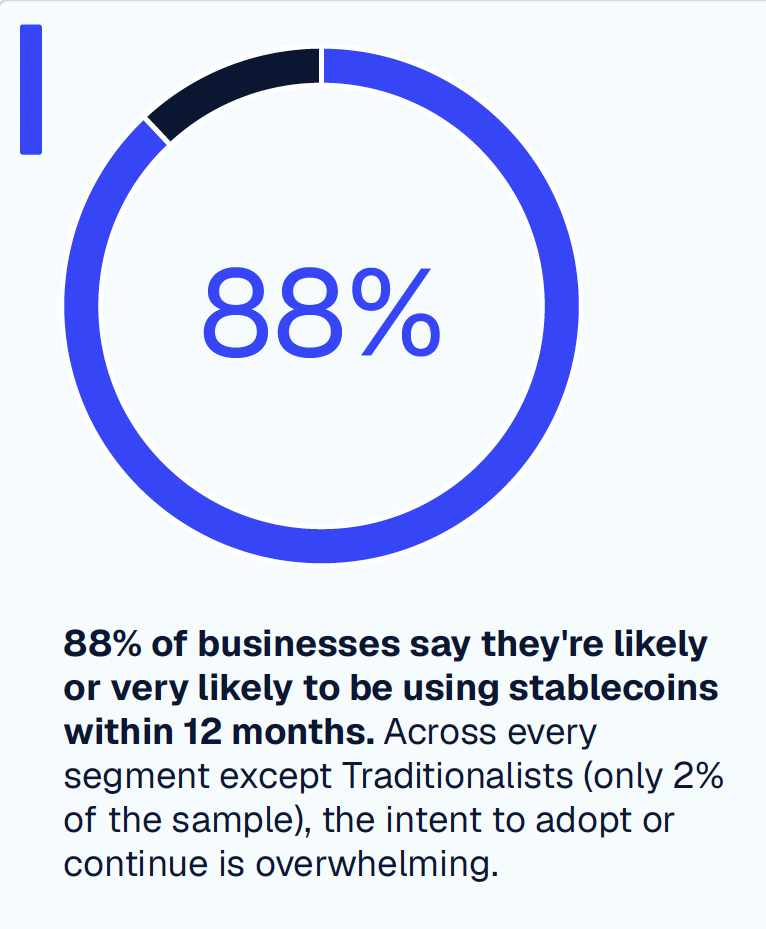
The survey data underpinning the report reveals that 42% of businesses currently utilize stablecoins for cross-border payments. Furthermore, an overwhelming 88% of respondents indicated that they are either likely or very likely to integrate stablecoins into their financial workflows within the coming year. Perhaps most telling of the shifting paradigm is that only 2% of the surveyed executives identified themselves as committed users of traditional payment rails, signaling a profound vote of no confidence in legacy banking infrastructure for international transactions.
For organizations navigating the complexities of global commerce, the financial incentives for making the switch are difficult to ignore. Businesses already leveraging stablecoins reported average cross-border payment cost savings of 35%. For high-volume enterprises processing more than $100 million in monthly payment volume, the financial relief is even more pronounced, with average savings climbing up to 47%. These figures highlight why corporate treasuries are rethinking their liquidity strategies and looking toward decentralized financial architecture to optimize their bottom lines.
The broader macroeconomic environment reflects this surging momentum. According to data from CoinGecko, the global stablecoin market capitalization has expanded significantly, sitting at $307.64 billion. This ecosystem continues to be dominated by Tether’s USDT, which commands a market cap of $184.7 billion, and Circle’s USDC, holding $73.51 billion. At the same time, the regulatory landscape has begun to catch up with market demand. Fueled by recent legislative milestones, stablecoins compliant with the GENIUS Act have surpassed a market cap of $76 billion, establishing the first federal regulatory framework specifically designed for payment stablecoins in the United States.

The Cybrid report gathers insights from a carefully targeted survey of 468 executives and business leaders conducted between April 28 and May 4. The respondents represented prominent sectors including technology, financial services, and e-commerce across the United States, Canada, and the United Kingdom. The participant pool comprised C-suite executives, finance and treasury managers, and operational leaders responsible for overseeing corporate payments and liquidity management.
Varied Users Look for Regulatory Clarity to Gain Confidence
As businesses find innovative ways to integrate blockchain-based digital assets into their daily operations, the use cases for stablecoins have expanded significantly. According to the survey data, payroll and contractor payments emerged as the most common stablecoin use case among corporate respondents. This was followed closely by supplier payments, customer transactions, investment and yield generation strategies, vendor disbursements, and overarching treasury and liquidity management.
Despite the enthusiasm and clear financial advantages, corporate decision-makers remain attentive to the broader legal and regulatory environment. When asked what factors would most significantly increase their confidence in expanding stablecoin deployment, regulatory clarity topped the list. A decisive 71% of respondents identified clearer regulations as more critical to their long-term planning than trusted infrastructure providers or seamless integration with existing enterprise software systems. This underscores the reality that while the technology is ready for prime time, corporate boards and risk management committees want formalized legal certainty before committing deeper capital.
The geographic and sectoral diversity of the surveyed executives—spanning tech hubs, financial institutions, and digital storefronts in North America and the UK—suggests that the demand for stablecoin infrastructure is not isolated to crypto-native companies. Instead, mainstream businesses are systematically evaluating how blockchain rails can solve long-standing friction points in international trade and payroll distribution.
Companies Expand Infrastructure for Stablecoin Payments
The findings from the Cybrid study are heavily reinforced by separate industry data pointing toward the same structural shift. In June, digital payments infrastructure provider Paybis reported that business customers accounted for nearly 98% of the total stablecoin payout volume processed through its platform during the first four months of 2026. This represents a dramatic acceleration from 2023, when business payouts accounted for just 36% of Paybis’s volume.
Paybis also highlighted independent research from McKinsey, which estimated that business-to-business transactions accounted for roughly 60% of the $390 billion in global stablecoin payment volume recorded throughout 2025. These figures demonstrate that the growth of stablecoins is no longer being driven primarily by retail crypto traders speculating on exchanges, but rather by commercial enterprises moving real-world capital to settle invoices, pay global talent, and manage working capital.
To meet this rapidly expanding institutional demand, financial technology firms and traditional banking institutions are aggressively scaling up their infrastructure. In May, Falcon Finance debuted its dollar-backed stablecoin, fUSD, through Anchorage Digital Bank’s federally regulated issuance platform. The product was specifically engineered to target institutional trading, collateral management, and corporate treasury workflows.
Traditional banking giants are also integrating these digital assets into their core offerings. BNY expanded its digital asset custody platform to provide direct support for Circle’s USDC. This integration allows institutional clients to store, transfer, mint, and redeem the stablecoin directly through the bank, bridging the gap between traditional institutional custody and the blockchain economy. As regulatory frameworks continue to solidify and institutional-grade infrastructure matures, the integration of stablecoins into the daily operations of global commerce appears increasingly inevitable.