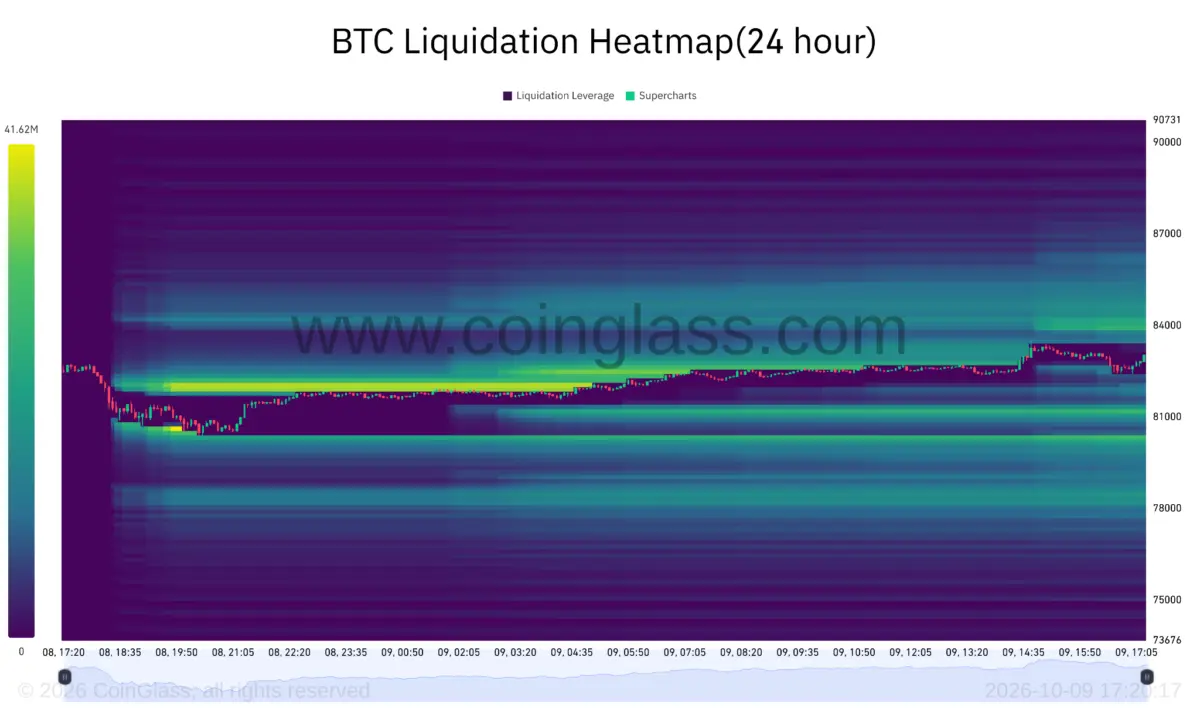
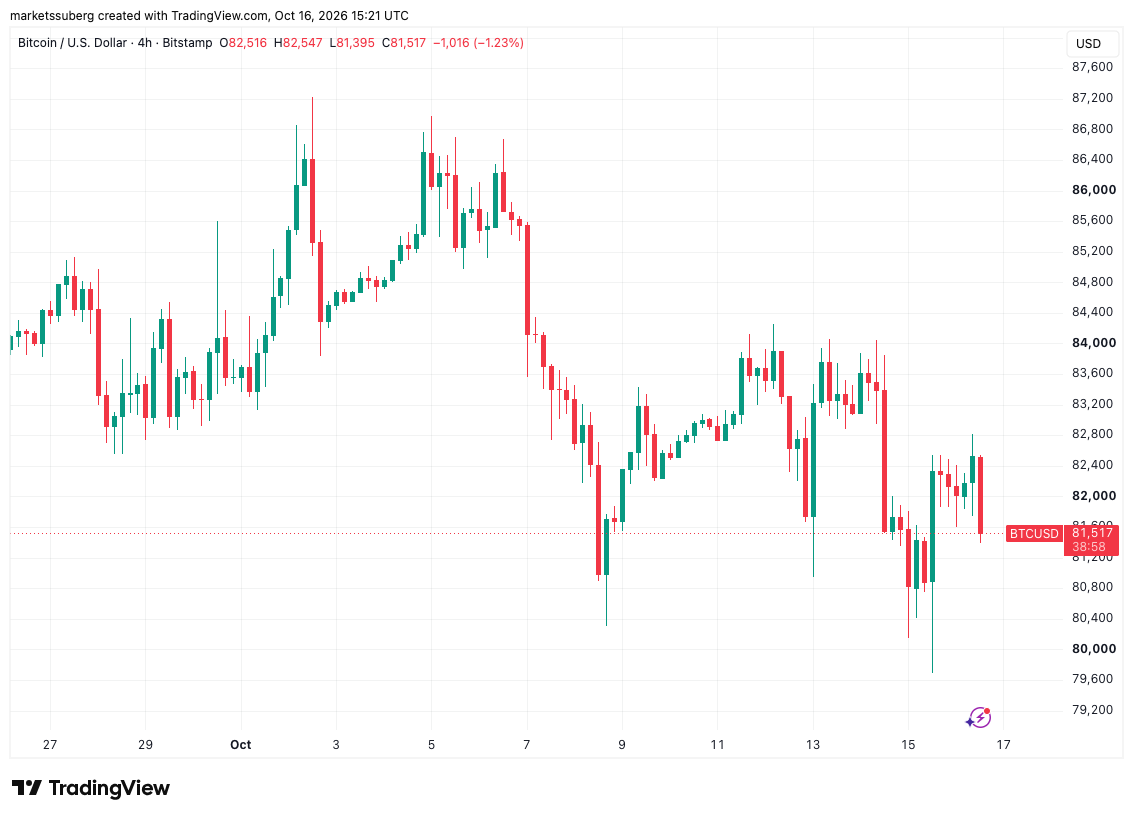
Bitcoin (BTC) traded near the $82,000 threshold around Friday’s Wall Street opening bell, finding stability alongside a broader recovery in South Korean equities and a shifting macroeconomic landscape. The leading cryptocurrency successfully held onto the majority of its reclaimed ground after staging a sharp technical bounce from the $80,000 support level earlier in the week.
Data from TradingView highlighted that the BTC/USD pair absorbed previous downward pressures, maintaining its position in the low-$82,000 range as traders digested fresh comments from Federal Reserve officials and monitored international market developments. The cryptocurrency’s resilience came after a turbulent week defined by a sharp sell-off in Asian technology sectors and persistent macroeconomic anxieties surrounding inflation and central bank monetary policy.
Traders See Dovish Edge to Warsh Comments
The recent relief in crypto and traditional markets was partially attributed to comments from Federal Reserve Chair Kevin Warsh. During a high-profile discussion with International Monetary Fund (IMF) Managing Director Kristalina Georgieva, Warsh avoided signaling any commitment to aggressive, near-term interest rate hikes, striking a tone that many investors interpreted as notably dovish.

When questioned about the path of monetary policy for the remainder of the year, Warsh adopted a flexible stance. "I don’t prejudge meetings. I don’t believe in saying now what I might do at the meetings that we have in the balance of this year," he stated during the IMF event.
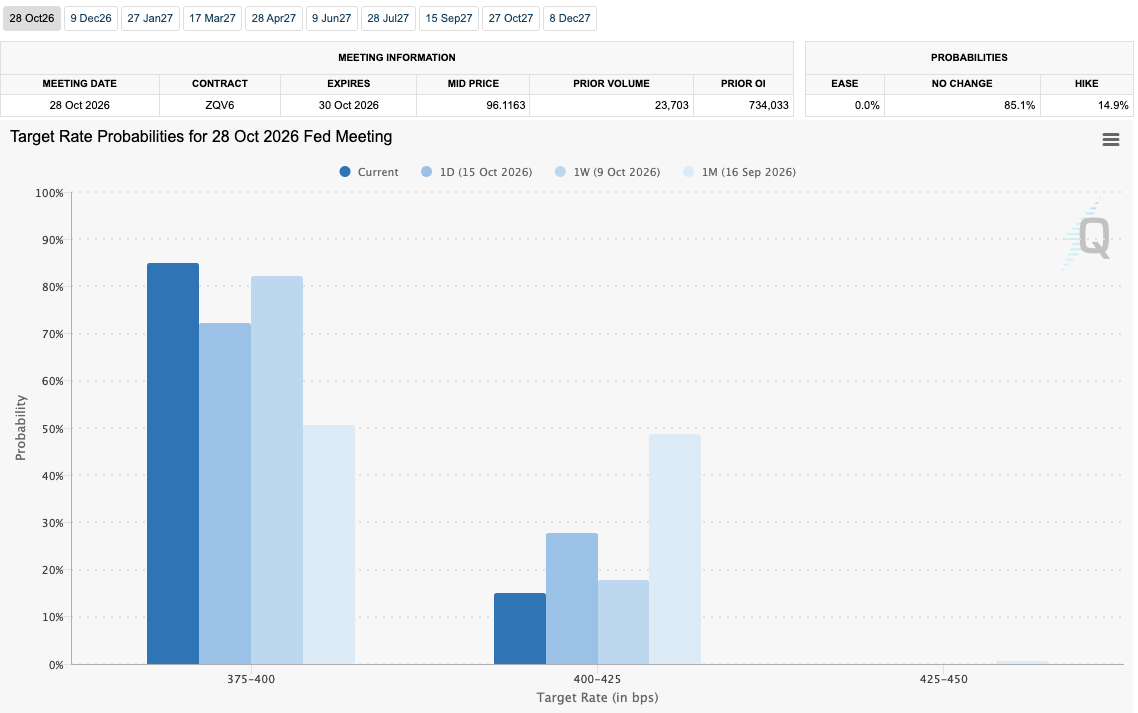
Financial markets quickly reacted to the Fed chair’s measured approach. Data from CME Group’s FedWatch Tool indicated a noticeable shift in market expectations, with the probability of a 25-basis-point rate hike at the upcoming October Federal Open Market Committee (FOMC) meeting tumbling to 15%, down sharply from 27% just a day prior.
Prominent economist Robin Brooks weighed in on the shifting sentiment, suggesting that brewing stress within the artificial intelligence sector—which had heavily influenced the recent sell-off in South Korean tech shares—might be encouraging central bankers to tread more carefully.
"Warsh gave no indication the Fed’s in any hurry to hike, so the October meeting is now pretty much off the table in terms of a hike," Brooks wrote in a digital commentary. He added that broader anxieties regarding potential corrections in high-flying technology sectors were inadvertently assisting the Federal Reserve by making financial markets far more receptive to a dovish communication strategy.
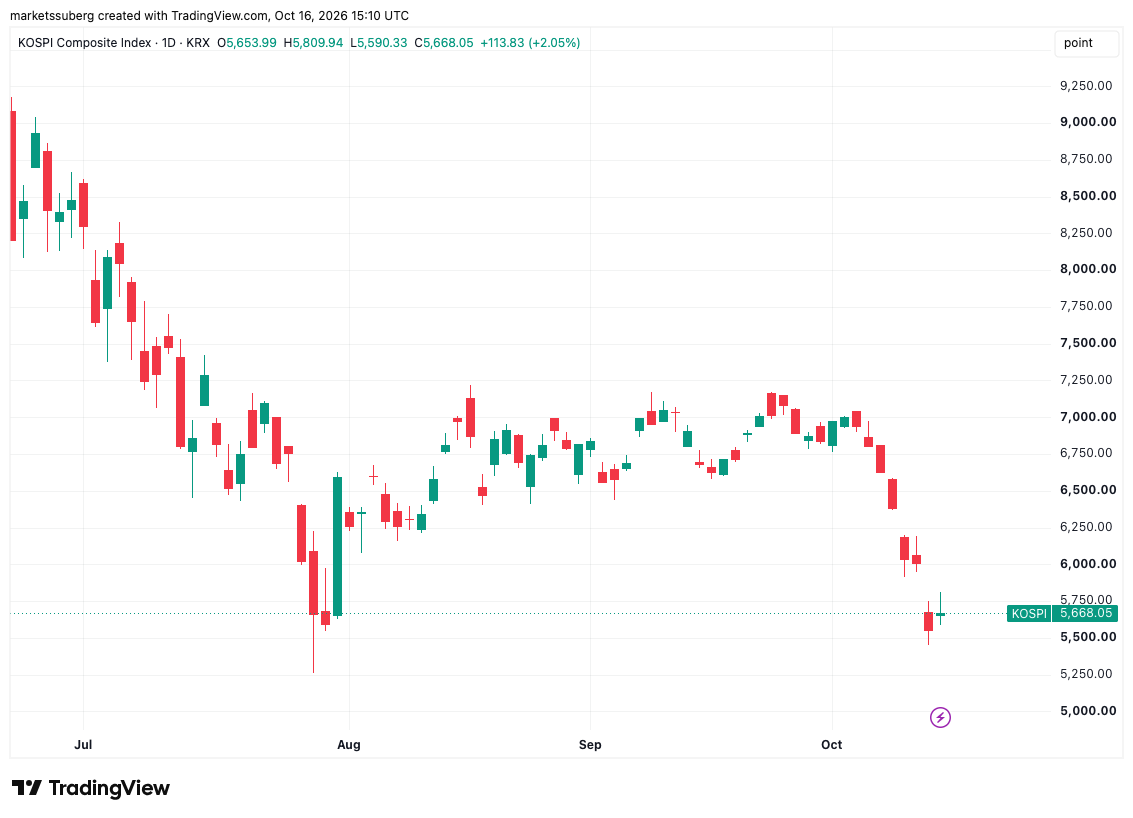
The initial cryptocurrency downturn earlier in the week had been heavily linked to a brutal, weeklong liquidation cycle in South Korean technology stocks. However, Friday’s Asian trading session injected a dose of optimism into the region. The KOSPI Composite Index staged a notable intraday recovery, closing the session up 2% at 5,668. Despite the single-day rebound, the index still closed the week down roughly 8.3%, underscoring the underlying fragility that had briefly spilled over into global digital asset markets.
Meanwhile, US equities experienced a mixed performance on Friday as Wall Street opened. While the broader market largely avoided the severe contagion seen in Asian tech stocks, the major indexes diverged. The tech-heavy Nasdaq Composite Index slipped 0.5%, while the benchmark S&P 500 managed a modest gain of 0.5%, reflecting cautious optimism among institutional investors as they evaluated the evolving monetary policy outlook.
US Bond Yields Eye Rebound as Stocks Halt Upside
While risk assets found temporary sanctuary in the Fed’s perceived dovish pivot, fixed-income markets presented a more complex picture. US bond yields began climbing as equities steadied, reigniting discussions among financial analysts regarding the delicate balancing act facing the US Treasury and the Federal Reserve. Observers noted that policymakers may eventually be forced to choose between actively taming a relentless bond market sell-off and maintaining upward momentum in the stock market.
The US 10-year Treasury yield hovered around 5.07% on Friday, having earlier attempted a more aggressive upward push toward the 5.13% mark.
Market commentary from the widely followed analytical publication The Kobeissi Letter highlighted that equity market weakness had served as the primary catalyst for bond yield corrections since August. In a detailed social media analysis published earlier in the week, the commentary suggested that major stock indices might be trapped in a paradoxical "bull-bear" market environment.
The analysis argued that without external geopolitical pressures, such as the ongoing conflict involving the US and Iran, traditional equity markets would likely be trading significantly higher. Instead, persistent inflation has continued to compel investors to seek hard asset exposure and inflation hedges—including cryptocurrencies—even as the central bank navigates a complex interest rate cycle.
"Even as the S&P 500 hits year number five of its bull market, we believe a steep discount is currently priced into equities," the analysis stated. It characterized this valuation gap as a "stealth" bear market that has quietly suppressed equity valuations among some of the world’s largest and fastest-growing corporations. "This backdrop has the ability to catalyze a violent rally in the S&P 500 if and when it is ultimately priced-out."
As the trading week drew to a close, Bitcoin’s ability to defend the $80,000 floor and rebound toward $82,000 demonstrated that digital asset bulls retained control of the near-term technical trend, provided macroeconomic indicators and central bank rhetoric continued to lean away from aggressive monetary tightening. Market participants now look ahead to upcoming economic data releases and further commentary from Federal Reserve officials to determine whether the current stabilization across global equities and cryptocurrencies can develop into a sustained recovery.