While the golden rule of "HODLing" has long been touted across the digital asset ecosystem as a foolproof method for building generational wealth, reality tells a more complicated story for holders of certain legacy cryptocurrencies.
Take XRP, the payments-focused digital asset native to the XRP Ledger and currently the world’s fifth-largest cryptocurrency by market capitalization. Nearly nine years after the cryptocurrency market experienced its first major mainstream explosion, XRP finds itself in a peculiar and frustrating position for long-term investors: it is still trading well below its historic cycle high from the winter of 2017-2018, a time when crypto first broke into the mainstream consciousness and pulled in a massive wave of retail participants.
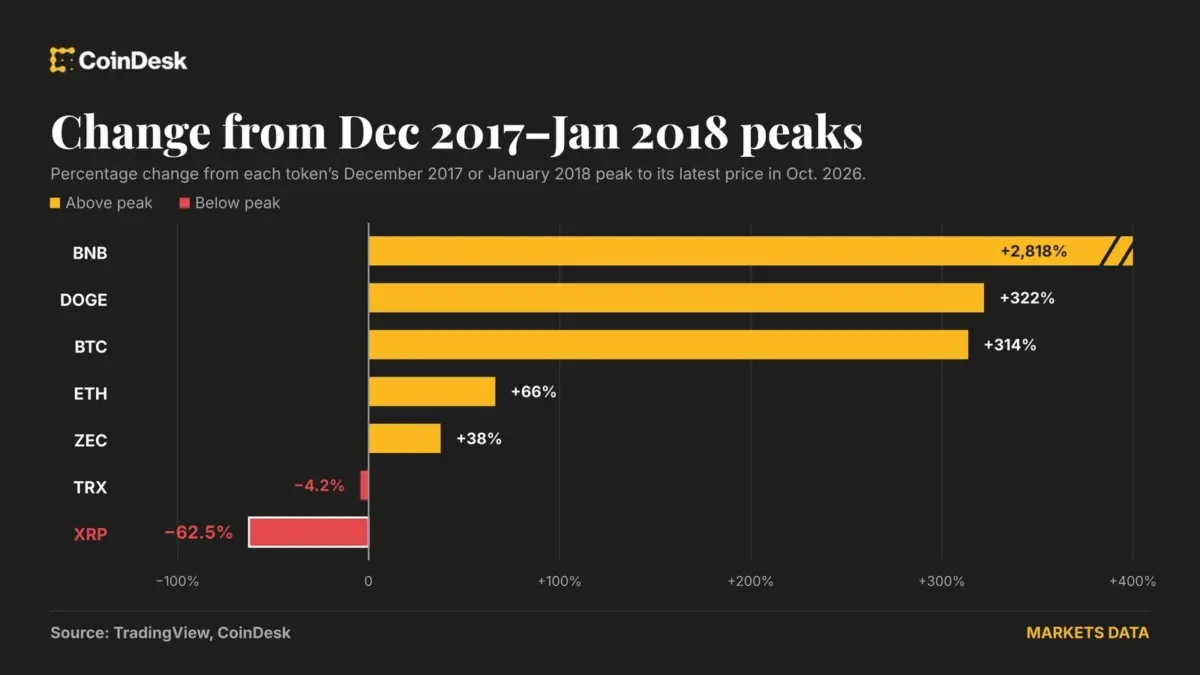
While major tokens like Bitcoin, Ether, and Binance Coin have shattered their previous milestones and enriched patient holders, XRP has lagged remarkably behind. Currently changing hands at around $1.33, XRP is down approximately 62.5% from its early January 2018 peak of $3.55. This means that an investor who purchased XRP at the absolute height of the 2017 frenzy remains deep underwater nearly a decade later. While the token did manage to briefly eclipse its old high—reaching $3.66 in July 2025 before suffering a sharp correction—that fleeting rally failed to establish a sustained new baseline.
In stark contrast, other foundational assets from that same era have delivered exponential gains. Bitcoin is up a staggering 314% from its December 2017 peak of $19,804, currently hovering near $80,955. Dogecoin has climbed 322% from its January 2018 high, trading at $0.082, while BNB has experienced a monumental surge of about 2,800% to reach $729. Even smart-contract pioneer Ether is up 66% from its 2017 cycle peak at $2,442, and privacy coin Zcash has eked out a 38% gain. Meanwhile, Tron sits roughly 4% below its historical peak, and newer Layer-1 networks like Solana, which launched in 2020, have entirely rewritten market dynamics.
Even though Bitcoin, Ether, and many other prominent tokens have experienced significant pullbacks from their own exuberant 2025 peaks, they remain comfortably and far above their respective 2017 highs—leaving XRP as a notable outlier in the upper echelons of the crypto economy.
The Dilution of Supply and Market Value
To understand why XRP’s price performance has diverged so starkly from its peers, market analysts point first to the mechanics of its circulating supply.
"Circulating supply grew 63%, from 38.7 billion in 2017 to 63.1 billion, while XRP’s total market value fell only about 3%," explains Nicolai Sondergaard, a senior research analyst at crypto analytics firm Nansen. "More XRP in circulation means each token represents a smaller share of roughly the same total value."
In the digital asset markets, circulating supply represents the total number of coins that are actively floating in public markets and available for trading. As that supply expands through scheduled releases—such as those managed via Ripple’s traditional escrow mechanisms—each individual coin naturally dilutes in value unless matched by an equivalent or greater surge in total capital inflows.
Oliver Carding, head of marketing at institutional digital asset management firm Tesseract Group, suggests that XRP presents a very different picture when viewed through the lens of total market capitalization rather than nominal token price. Tesseract currently manages over $500 million in digital assets under management.
"On value, XRP recovered," Carding notes. "About 63% more XRP is in circulation than at that peak, so the same circulating market capitalization would mean a price roughly 39% lower."
Weaker Institutional Demand and ETF Inflows
Beyond token supply dynamics, market experts highlight a stark disparity in institutional demand. The recent era of the cryptocurrency market has been profoundly shaped by the advent of U.S.-listed spot exchange-traded funds (ETFs), which have opened the floodgates for traditional institutional capital to gain exposure to digital assets with regulatory compliance and ease.
While Bitcoin and Ether investment funds have successfully pulled in tens of billions of dollars, driving structural price appreciation, equivalents for XRP have lagged far behind.
"ETF uptake has also been muted relative to BTC and ETH," says Paul Howard, senior director at prominent market-making firm Wincent.
Data from source SoSoValue indicates that XRP-focused investment funds have attracted a modest $1.80 billion in total investor capital since debuting nearly a year ago. By comparison, prominent Bitcoin ETFs routinely capture over $1 billion in net inflows during a single trading day, illustrating a profound chasm in institutional appetite between the market leader and alternative layer assets.
Furthermore, on-chain and trading data compiled by Nansen underscores a broader cooling of retail and speculative engagement. XRP spot trading volume has dropped by 53.5%, perpetual futures volume has declined by 44%, and active wallet addresses interacting with the network have fallen by 10.7%.
Ripple’s Strategic Focus
Another critical factor influencing XRP’s relative performance involves the corporate strategy of Ripple, the financial technology company closely associated with the asset. While major competing networks have aggressively expanded into burgeoning sectors like decentralized finance (DeFi), artificial intelligence (AI) integration, and the wildly popular memecoin economy—all of which have served as massive magnets for capital and retail speculation—Ripple has maintained a singular focus.
The company has poured its energy into building robust cross-border payment infrastructure, developing its RLUSD stablecoin, and engineering trade financing products designed to leverage the underlying XRP Ledger and its native coin.
"Ripple, meanwhile, has been working hard to build payment infrastructure, RLUSD and trade financing products around the usage of the ledger and coin, and this has taken focus from just core XRP," Howard explains, noting that investors today have an unprecedented menu of alternative choices.
"The role of DeFi for investment into ETH, SOL and HYPE has also been a new narrative which XRP has not focused on," he adds.
The Long Shadow of the SEC Case
Perhaps the most formidable headwind keeping XRP grounded over the past several years has been its protracted, high-stakes legal battle with U.S. regulatory authorities.
In December 2020, the U.S. Securities and Exchange Commission (SEC) filed a landmark lawsuit against Ripple and two of its top executives, alleging that the firm had raised approximately $1.3 billion through an unregistered securities offering by selling XRP to investors. The lawsuit immediately sent shockwaves through the industry, prompting major cryptocurrency exchanges—most notably Coinbase—to suspend trading of the token, effectively cutting off vital liquidity and retail access in the United States.
The legal saga dragged on for years, creating a thick cloud of regulatory uncertainty that many analysts believe crippled XRP’s ability to participate fully in the massive 2021 bull market.
A monumental, albeit split, legal turning point arrived in 2023 when a federal judge ruled that programmatic sales of XRP on public exchanges did not constitute unregistered securities offerings, though simultaneous sales directed at institutional investors did. By 2024, Ripple was ordered to pay a $125 million civil penalty. The multi-year legal battle finally reached an official conclusion in August 2025, when both Ripple and the SEC formally dropped their respective appeals. At the time of the resolution, XRP was trading above the $3 threshold.
However, the aftermath of the legal closure has seen the asset drift lower alongside broader market shifts. "Since then, XRP is down about 59%, against 32% for Bitcoin and 44% for Ether, and its circulating market capitalisation is down about 56%," Carding points out.
Not the Only Laggard
Despite its unique struggles, XRP is far from the only veteran digital asset that has failed to recapture the dizzying heights of the late-2017 retail craze.
"On price, six of the other nine assets in the January 2018 top ten are further below their levels of that week," Carding observes, underscoring the brutal Darwinian nature of cryptocurrency market cycles, where early pioneers frequently get displaced by newer technologies and shifting narratives.
For market participants closely monitoring XRP’s trajectory moving forward, industry veterans advise keeping a close eye on specific macroeconomic and technical indicators.
"What I would watch is XRP against Bitcoin, alongside net monthly distribution after re-escrow and changes in fund holdings," Carding suggests. "Relative weakness that persists as distribution slows would point to weaker demand."
In practical terms, this means tracking whether XRP continues to underperform Bitcoin even as the rate of newly minted tokens entering the circulating supply slows down through Ripple’s scheduled escrow releases. If supply growth decelerates while XRP still fails to keep pace with Bitcoin, it would serve as a clear signal that broader investor demand and market appetite for the asset are genuinely softening.