
The corporate adoption of stablecoins is poised for a dramatic acceleration over the next twelve months as digital currencies transition firmly into the mainstream financial ecosystem, according to a comprehensive new report released by payments infrastructure firm Cybrid.
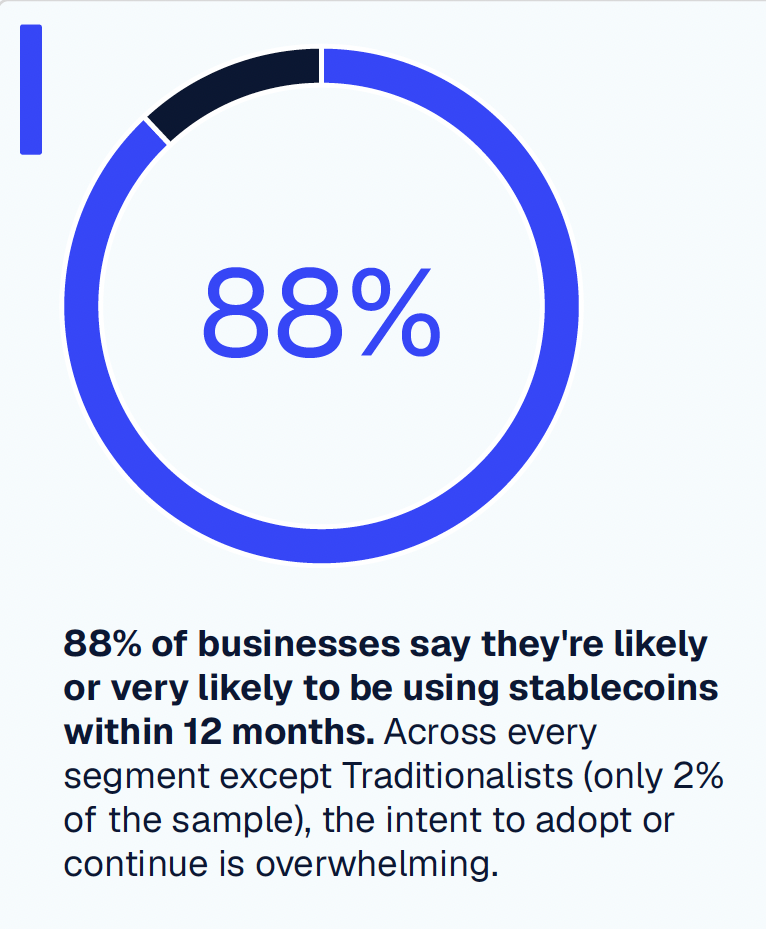
The findings indicate that digital currencies are no longer solely the domain of crypto-native enterprises or speculative retail traders. Instead, they are rapidly becoming vital operational tools for traditional corporate finance, cross-border commerce, and treasury management. According to the survey data, 42% of businesses polled are already actively utilizing stablecoins to execute cross-border payments. Furthermore, an overwhelming 88% of respondents reported that they are either likely or very likely to integrate stablecoins into their financial workflows within the coming year. In a stark reflection of the shifting landscape, only 2% of surveyed executives identified as committed users of traditional payment rails, highlighting a profound erosion of confidence in legacy banking infrastructure for international settlements.
The primary driver behind this rapid corporate migration is economic efficiency. Businesses that have already adopted stablecoins reported average cross-border payment cost savings of 35%. For larger enterprises operating at scale—specifically those processing more than $100 million in monthly payment volume—the financial advantages are even more pronounced, with companies reporting average cost savings of up to 47%. These substantial reductions in overhead expenses stem from bypassing legacy correspondent banking networks, eliminating hidden foreign exchange fees, and settling transactions nearly instantaneously rather than waiting days for wire transfers to clear.
The broader market dynamics underscore this structural shift. The global stablecoin market capitalization currently stands at $307.64 billion, anchored heavily by market leaders Tether’s USDT, which commands $184.7 billion, and Circle’s USDC, sitting at $73.51 billion. At the same time, the regulatory landscape has begun to catch up with commercial demand. Fueled by recent legislative milestones, GENIUS Act-compliant stablecoins have surpassed a market capitalization of $76 billion. This legislative framework has established the first official federal regulatory framework for payment stablecoins in the United States, providing a clearer legal foundation for risk-averse corporate treasurers.

The Cybrid report is built upon comprehensive survey data gathered from 468 executives and business leaders during a polling window between April 28 and May 4. The respondents represented a diverse cross-section of industries, including technology, financial services, and e-commerce, spanning the United States, Canada, and the United Kingdom. The participants included high-level decision-makers, ranging from C-suite executives and finance and treasury managers to payments and operations leaders.
Varied Users Look for Regulatory Clarity to Gain Confidence
As corporations explore the utility of digital currencies, their operational applications have diversified significantly. According to the survey, payroll and contractor payments emerged as the most common stablecoin use case among respondents. This was followed closely by supplier payments, customer payments, investment and yield generation, vendor payments, and treasury and liquidity management.
Despite the enthusiasm surrounding cost savings and operational velocity, corporate leaders remain attentive to external risk factors. Regulatory clarity was identified as the single most critical factor that would increase executive confidence in expanding stablecoin deployment. An impressive 71% of respondents ranked regulatory certainty as more important than partnering with trusted infrastructure providers or achieving seamless integration with existing enterprise resource planning systems. As regulatory bodies around the world grapple with how to supervise digital assets, clear legal guidelines remain the linchpin for widespread institutional adoption.
The demographic makeup of the survey highlights that this trend is not confined to niche fintech startups. C-suite leaders and operations heads from major economic hubs in North America and the UK are actively evaluating how digital dollars can optimize their balance sheets. This widespread corporate interest aligns with broader market observations across the financial sector.
Companies Expand Infrastructure for Stablecoin Payments
Separate industry data reinforces the narrative of a market undergoing a fundamental structural transformation. In June, digital payments infrastructure provider Paybis reported that business customers accounted for nearly 98% of the stablecoin payout volume processed through its platform during the first four months of the year, representing a massive leap from just 36% in 2023. Paybis also cited extensive research from McKinsey estimating that business-to-business transactions accounted for roughly 60% of the $390 billion in global stablecoin payment volume recorded in 2025.
To meet this escalating demand, financial institutions and technology providers have continued to expand their underlying infrastructure. In May, Falcon Finance debuted its dollar-backed stablecoin, fUSD, utilizing Anchorage Digital Bank’s federally regulated issuance platform. The product was specifically engineered to target institutional trading, collateral management, and complex treasury workflows.
Traditional banking institutions are also moving swiftly to accommodate the shift toward digital assets. Major financial institutions are expanding their digital asset custody platforms to support leading stablecoins like Circle’s USDC. Such integration allows institutional clients to securely store, transfer, mint, and redeem the digital currency directly through trusted bank custody frameworks, bridging the gap between traditional finance and decentralized blockchain networks.