The decentralized autonomous organization (DAO) behind Lido, the leading liquid staking protocol on Ethereum, is currently engaged in a rigorous debate regarding how its upcoming 2027 grant budget should interact with automated market purchases of its native LDO governance token.
The discussion, which kicked off via a governance proposal on Oct. 7, focuses on two distinct mechanistic adjustments to the protocol’s token-purchasing engine, known as NEST. Specifically, community members are weighing whether to directly link NEST’s underlying revenue threshold to approved protocol spending, or alternatively, to periodically clear the buyback engine’s negative spending counter to alter how capital is deployed.
As of mid-October, the state of the NEST allocator highlights the friction built into the current rules. When checked on Oct. 13, the NEST allocator had executed no purchases funded directly by its primary mechanism. The core dilemma facing the community is that genuine cost-cutting measures within the DAO could theoretically leave more net income available for acquiring tokens. Conversely, resetting the spending counter would merely erase past financial constraints without addressing the fundamental profitability of protocol operations.
The governance debate was initiated by contributor Kuzmich on Oct. 7, who proposed linking the budget model directly to automated purchasing parameters. This was followed on Oct. 9 by a response from Jenya_K, who expressed support for considering the model in the 2027 grant request, while emphasizing that any proposed funding amounts must originate from rigorous bottom-up planning rather than top-down assumptions. Kuzmich later followed up on Oct. 11 with a revised analysis that corrected how staking rebates are treated and tested potential profits without factoring in speculative treasury income.
What the Counter Measures
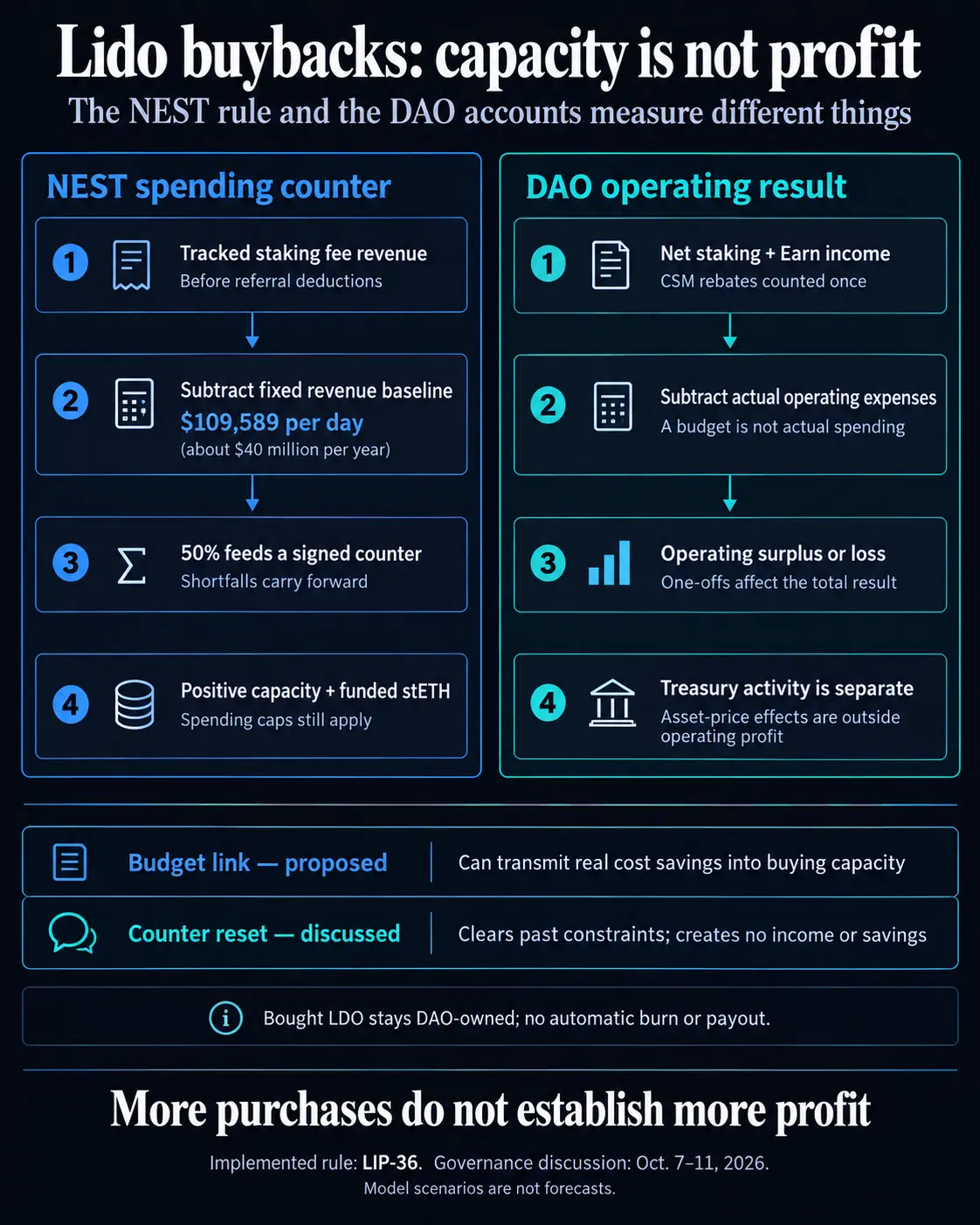
Under Lido’s currently implemented specifications, the NEST mechanism operates by continuously comparing measured staking revenue against a fixed daily baseline of $109,589, which amounts to approximately $40 million annually. Under this system, half of the difference between actual revenue and the baseline feeds directly into a running spending counter.
When protocol revenue falls below the established baseline, the shortfall is subtracted from that running counter. Consequently, stronger revenue periods must first completely repair any accumulated shortfall before the system can initiate automated token purchases. Because of this dynamic, the DAO’s treasury can hold various assets while the counter remains in negative territory, and conversely, a positive counter reading does not by itself establish a traditional accounting profit.
The latest captured checkpoint data from Oct. 13 recorded a negative counter balance of $564,230.96, which resulted in a skipped allocation cycle. Separately, block explorer data showed that the allocator held approximately 41.12 stETH when checked on the same day. The indexed transfer history for the address revealed a single 41-stETH top-up transaction executed on Aug. 28, with no outgoing transfers recorded.
Any future spending executed by the protocol must satisfy both sufficient counter capacity and adequately funded stETH balances. Furthermore, the system remains subject to strict programmatic guardrails, including a $50,000 daily spending cap, a $10 million ceiling over fixed 365-day rolling windows, and a $1,000 minimum allocation threshold.
Lido’s separate discretionary stETH-to-LDO acquisitions operate as an entirely distinct program, and community reconstructions have identified an August trade simply as a route-testing procedure. Furthermore, the NEST mechanism does not currently capture monthly Community Staking Module (CSM) rebates or Earn protocol income. Jenya_K pointed out that CSM rebates are already integrated into standard financial reporting, meaning that adding them directly to reported net revenue would result in double-counting.
Financial reports from Lido’s unaudited accounts for the first half of the year outline a complex financial picture. The figures show $15.7 million in net staking revenue alongside $230,000 from Earn products, culminating in $15.9 million in total net DAO revenue. However, foundation expenses amounting to $14.3 million left a modest operating surplus of $1.6 million. A subsequent $6 million Kelp-related one-off adjustment ultimately turned the total financial result into a $4.4 million net loss for the period.
Separately, the financial report logs $1.4 million of treasury income and a $60.9 million asset-price effect within its treasury bridge, placing these items strictly outside the traditional profit-and-loss statement. Jenya_K cautioned the community that standard treasury operations can routinely involve losses as well as gains. Meanwhile, the 2026 grant request presented a baseline of $43.8 million, while the first-half report references a $41 million figure and projects full-year expenses of $37.7 million. The cited materials do not explicitly reconcile these differing baseline labels, and none of them are interchangeable with NEST’s rigid $40 million revenue threshold.
The Budget Model Needs an Expense Correction
Kuzmich’s follow-up analytical model, published on Oct. 11, simulates 1,000 Ethereum price paths over a 12-month period beginning Oct. 1. The simulation starts with an ETH price of $2,679.84, factoring in 61% annualized volatility and assuming no expected arithmetic price drift. These simulated purchase frequencies are intended for analytical exploration rather than serving as measured probabilities of future market events.

In simulations published earlier in October under the existing rules, mean token purchases hovered around $2.3 million, though the median outcome sat firmly at zero. Stronger Ethereum price trajectories elevate the overall average even when more than half of all simulated paths result in zero purchases being made.
Lowering the budget-linked thresholds produces larger purchase volumes within the model. However, community reviews revealed a consequential mismatch in the profit comparison: while forum discussions maintained that actual expenses match the approved budget, the underlying code scales a forecasted expense curve by dividing each budget scenario by $43.8 million. That specific curve implies approximately $39.8 million in expenses across the modeled year before scaling is applied, and only $27.3 million in the row labeled for a $30 million budget.
When holding the published revenue paths and purchase rules constant while setting actual expenses equal to each respective threshold, the economic picture shifts. Under a $40 million threshold and actual expenses, mean modeled purchases stand at $2.32 million with a median of zero, resulting in a mean modeled loss before purchases of $1.92 million. Adjusting the threshold and actual expenses down to $35 million yields mean purchases of $3.35 million, a median of $1.26 million, and a mean profit before purchases of $3.08 million. At a $30 million level, mean purchases reach $4.71 million with a median of $3.18 million, and mean profit before purchases expands to $8.08 million.
This expense correction leaves the calculated purchase amounts unchanged because this particular iteration of NEST executes buys purely against the revenue threshold without auditing actual operational expenses. At a $30 million actual expense level, mean modeled profit excluding treasury income falls from a previously published $10.7 million down to $8 million. Furthermore, among the specific price paths that do result in purchases, the fraction of scenarios ending in an overall loss increases from 12.6% to 22.2%.
A separate sensitivity analysis starting on Oct. 13—which assumed continued funding, utilized the refreshed counter and explorer ETH quotes, but kept September fee volumes and first-half deduction and Earn assumptions unchanged—produced a $2.1 million median for the $30 million scenario. The overarching economic direction remains clear within the boundaries of these assumptions: real operational spending cuts improve the modeled profit balance. Conversely, lowering the contract’s threshold in isolation permits additional token buying even when the broader DAO operations ultimately finish the period at a net loss.
A Reset Loosens the Spending Brake
Another option debated by the community involves implementing an annual reset, which would systematically discard any accumulated negative counter at a calendar-year boundary while retaining positive capacity.
A careful recalculation of the reset comparison corrects a period overlap present in the originally published research script, where whole-month purchase totals counted September 2028 across two adjacent 365-day profit periods. That recalculation indicates average spending of about $2.6 million per modeled 365-day period under the standard carry-forward rule, compared to roughly $2.8 million when applying annual resets, representing an approximate 8% increase in spending activity. Utilizing quarterly resets increases average spending further to about $2.9 million.
When treasury income is excluded from the calculations, periods ending in a net loss account for roughly 19.5% of purchase-making periods under the standard carry-forward mechanism, compared to 30.0% under annual resets. However, their respective shares of total purchase dollars remain much smaller, at approximately 3.5% and 4.4% respectively.
This data supports a limited conclusion within the community: a reset mechanism cannot inherently make the DAO more profitable, and its modeled impact on total spending is smaller than adjustments made directly to the budget thresholds. Furthermore, the existing allocator smart contract features no direct, automated reset function. Because the voting-controlled threshold setters preserve the accumulated counter and apply changes strictly on a prospective basis, establishing any recurring reset protocol would require alternative code implementation or modified governance arrangements.
The upcoming 2027 grant allocation process will face the challenge of establishing a realistic spending budget alongside a corresponding revenue threshold, accurately accounting for additional revenue sources without inducing double-counting, and securing adequate funding for any permitted token purchases.
Because the current treasury-only design returns all purchased LDO tokens directly to the DAO’s treasury with no automated token burn or direct holder payout mechanism, the long-term utility of the acquired tokens remains an open question. Jenya_K reported that no specific operational plans have been finalized for the acquired LDO, token burns remain strictly a discussion proposal, and enabling active liquidity modes would require a separate, formal DAO vote.
Lido’s financial reporting treats these token acquisitions as asset swaps or purchases without an immediate profit-and-loss effect, keeping LDO explicitly excluded from headline treasury asset valuations. Consequently, accelerated token buying can alter the compositional asset mix of the treasury without necessarily establishing stronger ongoing earnings, guaranteed market price support, or improved Ethereum staking returns.
This leaves the upcoming grant request facing a fundamental economic test: the DAO must determine whether net income genuinely improves after accounting for actual operational costs, and whether the chosen acquisition policy successfully preserves those financial gains over the long term.