
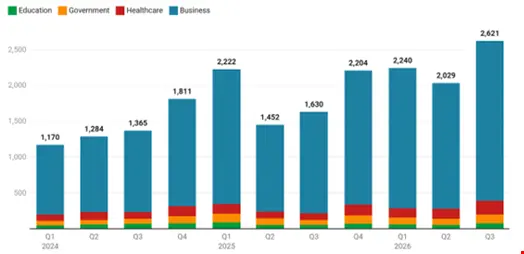
The global cybersecurity landscape faced an unprecedented onslaught in the third quarter of 2026, as ransomware activity reached its highest volume on record. According to a comprehensive analysis published by Comparitech, the period between July and September 2026 saw a staggering 2,627 claimed ransomware attacks. This figure represents not only a peak for the year but a significant escalation in the threat environment, marking a 27% increase over the second quarter of 2026 and a 61% surge compared to the same period in 2025.
The data underscores a disturbing trend where ransomware has transitioned from a sporadic nuisance into a systemic, high-frequency threat across nearly every industry. While the raw number of claims by threat actors totaled over 2,600, Comparitech researchers were able to confirm 247 of these incidents directly with the affected entities. This discrepancy between claimed and confirmed attacks remains a characteristic of the current threat landscape, where victims are often reluctant to disclose breaches, yet the sheer volume of claims indicates a massive, sustained campaign by criminal syndicates.
Rebecca Moody, head of data research at Comparitech, characterized these findings as highly unusual and a cause for significant alarm among security professionals. Historically, ransomware activity has been known to fluctuate, with specific sectors experiencing temporary spikes followed by periods of relative calm. However, the third quarter of 2026 defied these traditional patterns. According to Moody, the current surge is not localized to one or two vulnerable industries; rather, it represents a widespread, aggressive expansion across all major sectors, suggesting a fundamental shift in the operational scale of ransomware groups.
A Surge Across Critical Infrastructure
The impact of this wave of attacks was felt most acutely in the finance and technology sectors, which saw the most dramatic increases in incidents compared to the previous quarter. The finance sector experienced a 72% rise in activity, while the technology sector followed closely with a 70% increase. These industries, which form the backbone of the modern digital economy, appear to be primary targets due to the sensitivity of the data they hold and their reliance on constant uptime.
The threat, however, was not confined to corporate boardrooms. Critical infrastructure and public services also bore the brunt of this escalation. Education institutions reported a 50% increase in attacks, while healthcare providers saw a 39% rise. Government agencies and utility providers—sectors traditionally protected by more robust security postures—faced increases of 36% and 32%, respectively. This broad-spectrum targeting suggests that ransomware actors are no longer strictly focused on high-profit private enterprises but are actively probing the resilience of societal foundations.
The driving force behind this rapid increase remains a subject of intense analysis by cybersecurity experts. While the motivations of these groups remain largely financial, the tools at their disposal have evolved significantly. Industry analysts point to the rapid adoption of artificial intelligence as a primary factor enabling this surge. AI-driven tools are allowing attackers to automate reconnaissance, craft more convincing phishing lures at scale, and accelerate the speed at which they can navigate networks, encrypt data, and exfiltrate information.
This transition into the era of "intelligent" ransomware was highlighted in July 2026, when researchers identified the JadePuffer campaign. This operation is widely believed to be the world’s first ransomware attack entirely driven by AI. The ability of such campaigns to operate with minimal human intervention allows threat actors to scale their efforts exponentially, conducting multiple high-level attacks simultaneously with greater efficiency than ever before.
The Rise of Triple Extortion Tactics
Beyond the increase in volume, the nature of the attacks has become increasingly predatory. The report highlights a growing reliance on "triple extortion" tactics. In a traditional ransomware scenario, attackers encrypt systems and demand a payment for the decryption key. In "double extortion," they also exfiltrate sensitive data, threatening to leak it if the ransom is not paid. Triple extortion, however, adds a third layer of pressure by targeting the individuals—such as clients, employees, or customers—whose data was compromised during the breach.
This tactic effectively turns the victim organization into a host for the attackers’ ongoing harassment of third parties. A stark example of this evolution occurred in June 2026, when the ransomware group known as "The Gentlemen" targeted MIP Holdings, a South African technology firm. Although the company paid the demanded ransom under the assumption that their stolen data would be deleted, the attackers reneged on their agreement. In the weeks following the payment, The Gentlemen began contacting MIP’s clients directly, adding them to a data leak site to solicit separate ransom payments from the third-party firms.
This case serves as a sobering reminder that paying a ransom provides no guarantee of security or data destruction. According to Moody, the tactic demonstrates a chilling disregard for ethical codes among criminal groups, as they are now willing to pursue multiple avenues of revenue from a single breach, regardless of the victim’s previous cooperation.
The financial toll of these incidents remains substantial. The average ransomware demand in the third quarter of 2026 stood at $602,400. However, the extremes are far higher. The most significant demand recorded during this period was a $12.3 million ransom issued by the Everest group against the Swiss-based railway manufacturer Stadler Rail. Demonstrating a growing trend of corporate resistance, Stadler Rail refused to pay. In retaliation, Everest leaked 201 gigabytes of stolen internal data.
Similarly, the State of Berlin was targeted by the Rhysida group, which demanded $2.3 million. After the state government publicly refused to pay the ransom, the group published 5.7 terabytes of stolen data, including the personal information of numerous citizens. These cases underscore the difficult trade-offs facing organizations today: paying the ransom offers no certainty of protection, while refusing to pay often results in the public exposure of sensitive information.

Market Leaders in Criminal Activity
The criminal ecosystem is currently dominated by a handful of highly prolific groups. Qilin and The Gentlemen were identified as the most active syndicates in Q3, responsible for 357 and 342 claimed attacks, respectively. Both groups saw significant increases in their output compared to the second quarter, signaling a consolidation of power among the most sophisticated operators.
The landscape is also marked by extreme volatility, as smaller or newer groups rapidly scale their operations. The Clop ransomware gang, for instance, saw a massive 4,700% increase in activity, moving from a single claimed attack in the second quarter to 48 in the third. Meanwhile, the Direwolf group saw an even more dramatic rise of 1,450% in the same timeframe. Such figures indicate that the barriers to entry for ransomware operators are lowering, likely due to the availability of "Ransomware-as-a-Service" (RaaS) models, where established groups provide the infrastructure and malware to less experienced affiliates.
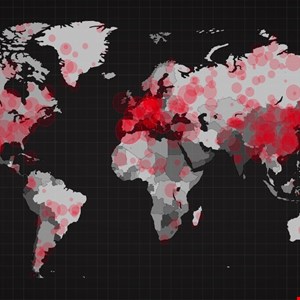
Geographically, the United States remains the primary target for ransomware operators, accounting for 1,066 of the total claimed attacks, or 41% of the global total. This represents a 34% increase from the previous quarter, indicating that the U.S. remains the most lucrative and accessible market for cybercriminals. Germany followed with 121 attacks, a 22% increase. Meanwhile, Argentina and India saw the most rapid growth in targeting, with incidents in those countries rising by 150% and 116%, respectively, over the previous quarter.
As the third quarter of 2026 draws to a close, the data from Comparitech provides a clear, if troubling, picture of a digital environment under siege. With the combination of AI-accelerated attack cycles and the normalization of triple extortion, organizations across the globe are finding it increasingly difficult to defend against a threat that is evolving in both sophistication and scope. As these groups continue to refine their methods, the focus for both the public and private sectors must necessarily shift toward more resilient infrastructure and a more coordinated international response to combat what has become a persistent global crisis.