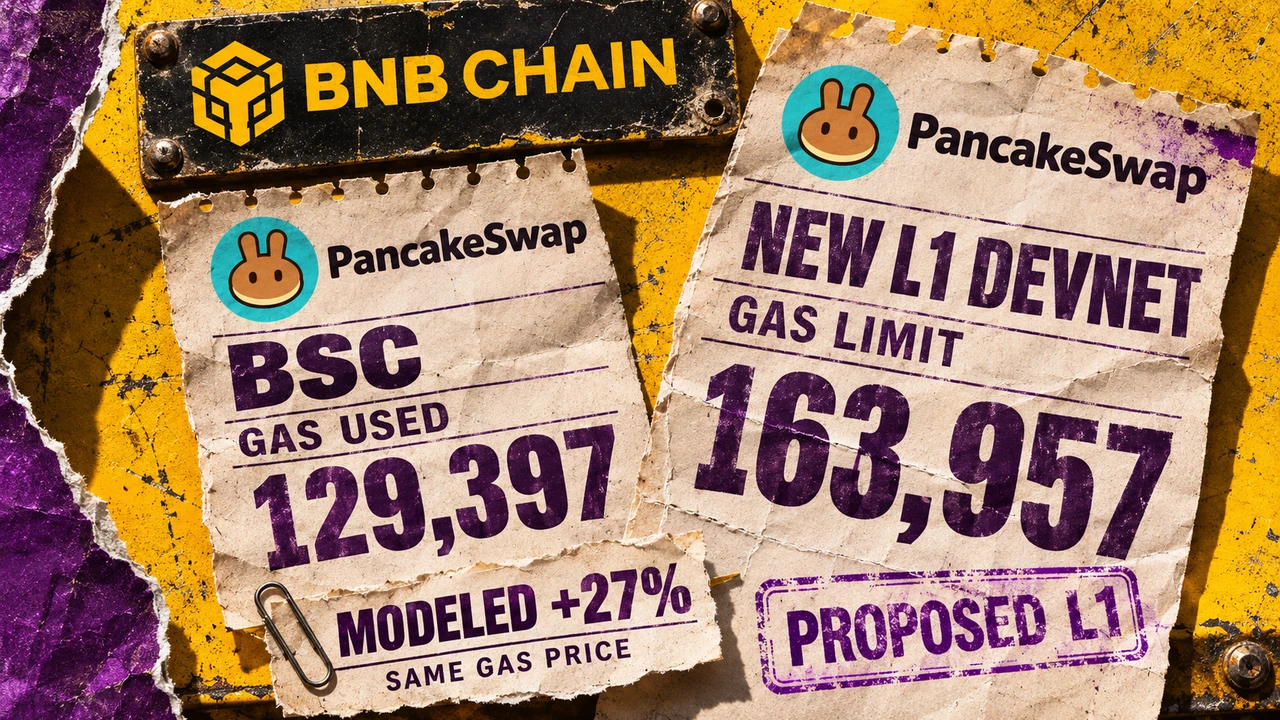
BNB Chain’s recently proposed layer-1 network introduces a fundamental shift in how computing resources are billed, requiring traders to pay for all the computing capacity a swap reserves rather than just what is ultimately consumed. According to network economic models and data from historical transactions, applying this new rule to a standard PancakeSwap trade on the BNB Smart Chain would elevate network fees by approximately 27% under baseline conditions, even when maintaining the exact same gas price.
The proposed architecture was officially unveiled on Nov. 26 when BNB Chain published its new layer-1 litepaper. The document describes a separate, high-performance network currently being developed to run alongside the existing BNB Smart Chain (BSC). While the design retains BNB as the native gas token to power transactions, the network introduces alternative mechanics for block space allocation and execution order, with a public testnet currently in preparation for broader community evaluation.
For decentralized trading applications and high-frequency market participants, the proposed framework attempts to pair early feedback regarding where a transaction might land in a block with reserved capacity for eligible activity. However, unlike traditional account-based execution models where users pay strictly for the computational units consumed during processing, the development network’s billing mechanism charges ordinary transactions for the entire block room they request and secure upfront.
Pricing the Same Swap on the New BNB Chain Network
In standard blockchain environments, a gas limit represents the maximum amount of computing work a transaction is allowed to utilize. On the BNB Smart Chain, the final network fee reflects the exact amount of gas the transaction actually consumes upon execution, leaving any unused gas uncharged.
The architecture of the new devnet takes a different approach by ordering transactions prior to execution and using the declared gas limit to allocate room within the block. Under these parameters, an ordinary transaction featuring a valid sequence number and sufficient funds at the time of execution is billed for the full declared amount, regardless of whether it finishes processing with computational capacity to spare.
To understand the economic impact of this shift, analysts can examine historical network data. On June 26, a successful swap routed through PancakeSwap’s version 3 router consumed 129,397 units of gas. Executed at a gas price of 0.05 gwei per unit, the transaction incurred a total fee of 0.00000646985 BNB on the standard BNB Smart Chain.
If that exact same swap were processed under the new devnet rules using the same gas price and a declared limit matching its historical ceiling of 163,957 gas, the financial outcome changes. The 34,560 units of unused capacity that would have previously gone unbilled would add 0.000001728 BNB to the transaction, bringing the total fee to 0.00000819785 BNB—representing a roughly 27% increase.
Running financial models with varying gas limits further illustrates the sensitivity of the proposed fee structure. At a modeled gas limit of 150,000, the fee would reach 0.0000075 BNB, which is approximately 16% higher than the observed BSC fee. If a developer sets the limit to 200,000 gas to ensure complex routing does not fail, the fee climbs to 0.00001 BNB, marking a 55% increase over standard operational costs.
While liquidity routers and developers can theoretically lower their declared gas limits to save on transactions that happen to fit within tighter parameters, doing so introduces the risk of running out of gas mid-execution whenever a trade route encounters higher computational complexity than anticipated.
Under the devnet fee rules, any included transaction that meets the required validation conditions must still pay the full declared limit if it ultimately reverts or runs out of gas during processing. Conversely, transactions featuring an invalid sequence number incur no gas charge at execution, while accounts with insufficient funds may limit the total amount the network can successfully collect.
The network also incorporates protected lanes, which effectively reserve a distinct portion of total block capacity exclusively for transactions sent to governance-approved contract addresses. A decentralized exchange swap sent to an unregistered router cannot leverage the reservation capabilities of a contract called by that specific router. Because a transaction’s declared gas limit counts directly against a lane’s established quota, maintaining a larger safety buffer leaves less room for other eligible transactions, forcing valid network activity to continually compete for space within constrained lanes.
Documentation concerning the devnet’s preconfirmation mechanism outlines a rapid timeline, listing roughly 20 milliseconds for the block producer to stream a signed update demonstrating a transaction’s intended position. Despite this speed, true transaction finality is only achieved after execution is officially committed and the block carrying that commitment reaches finality on the canonical chain. Applications and automated trading systems seeking to settle trades safely must obtain a successful execution receipt and verify that the corresponding block sits at or below the execution-finalized height.
When the Extra Fee Could Pay Off
The introduction of higher baseline costs through unrefunded gas capacity raises important questions about economic efficiency for high-volume traders and decentralized finance participants. To justify the additional expenditure, the network mechanics must offer tangible operational advantages that offset the recurring charge for unused computational room.
For instance, institutional market makers and sophisticated arbitrage desks often rely on rapid visibility into order flow. By observing that a pending swap is likely to alter reference prices and securing provisional placement in a block, a market maker might delay an automated quote update to avoid adverse selection. If the early placement signal prevents costly stale quotes or toxic fills often enough over a trading period, the resulting savings could easily cover the recurring costs associated with paying for unused gas.
However, if such market signals are unexpectedly withdrawn or prove unreliable, market participants are forced to reassess their operational strategies. Furthermore, decentralized exchange routers that strictly require the final outcome of a swap before determining their next directional move must still wait for full execution to complete, limiting the utility of advance positioning.
The broader viability of these economic tradeoffs will depend heavily on real-world adoption and sustained volume. DefiLlama data captured BNB Smart Chain generating $484.13 million in 24-hour decentralized exchange volume, highlighting the massive scale of liquidity that flows through the ecosystem daily. For this level of financial activity to successfully migrate to or interact with the proposed network, the economic architecture must prove sustainable for everyday traders under actual market gas prices.
As public testing draws closer, developers and validators will gain clearer visibility into how protected lanes perform under load, how frequently block placement signals are modified or withdrawn, and how much spare gas different smart contract routes genuinely require to operate without disruption.