
Bug bounty programs have long served as a cornerstone of digital security, operating as an incentive structure to reward ethical hackers—often referred to as "good" hackers—for discovering and responsibly disclosing potential vulnerabilities. In the cryptocurrency and decentralized finance (DeFi) industries, where code is law and security flaws can result in catastrophic financial losses running into the billions of dollars, these programs are particularly vital. However, the widespread availability of generative AI models has dramatically shifted the operational landscape. Because AI systems make it remarkably easy to sift through large volumes of code to flag possible bugs, they are also frequently prone to severe hallucinations, generating plausible-sounding but entirely fictitious security flaws that security teams must manually investigate.
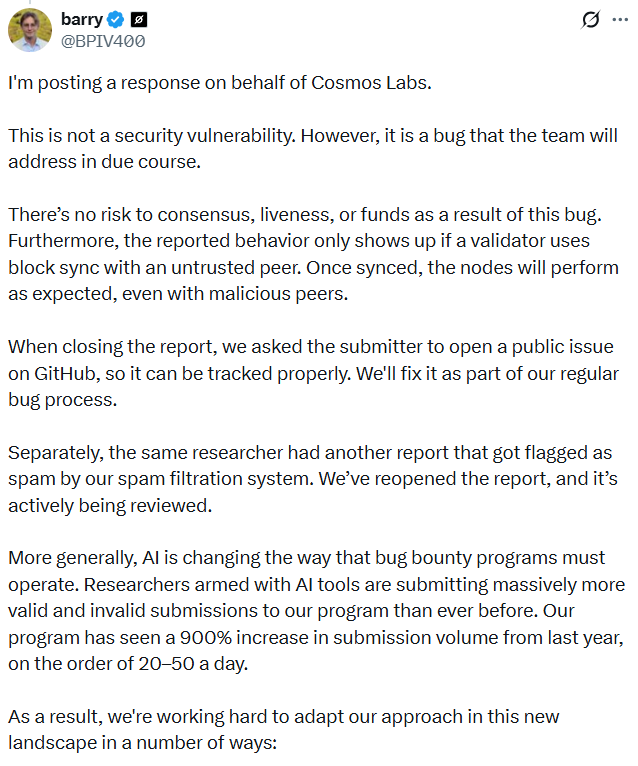
The impact of this technological shift is being felt acutely across the blockchain space. Barry Plunkett, co-CEO of Cosmos Labs, highlighted the administrative burden on Tuesday while responding on social media to a bug bounty hunter who had accused the protocol of ignoring a vulnerability report. According to Plunkett, AI is fundamentally altering how bug bounty programs must function to survive the deluge of incoming data.
"Our program has seen a 900% increase in submission volume from last year, on the order of 20-50 per day," Plunkett said, noting that the exponential growth has triggered a massive surge in both valid and invalid reports alike, creating an immense administrative bottleneck for internal security engineers.

This sentiment is echoed across the broader Web3 ecosystem. Kadan Stadelmann, a blockchain developer and chief technology officer at Komodo Platform, noted that organizations throughout the industry are observing a striking uptick in low-quality bug bounty submissions and subsequent payout requests.
"There has definitely been an increase in low-quality bug bounty submissions, some of which have been false positives, potentially suggesting AI sourcing," Stadelmann said in an interview. "One potential explanation is that AI has caused a decrease in the cost to produce a report, resulting in an influx of submissions."
The strain caused by AI-assisted vulnerability reporting is not restricted to the crypto sector alone, highlighting a systemic vulnerability across the broader software development landscape. In January, Daniel Stenberg, the creator of curl—a widely used open-source data transfer tool that underpins countless applications, including essential blockchain infrastructure—announced that he was permanently shutting down his project’s bug bounty program. Stenberg cited an exhausting influx of what he termed "AI slop in vulnerability reports," explaining that he simply no longer had the time or energy to sift through mountains of automated, low-grade noise to find legitimate security concerns.
The broader cybersecurity industry is witnessing similar trends on a global scale. HackerOne, one of the world’s largest crowdsourced security and bug bounty platforms, published research in January noting that while it recorded 85,000 valid bounty submissions in 2025—representing a 7% increase from the previous year—the sheer volume of overall submissions, including unfiltered and automated noise, has created unprecedented operational friction for triage teams.
AI could be both the cause and the solution
Faced with mounting backlogs and exhausted engineering teams, protocol maintainers are being forced to rethink their defensive strategies. Plunkett noted that Cosmos Labs has already initiated changes to its operational workflow to cope with the influx. The project is tightening its internal scoring criteria for incoming submissions, placing higher priority on trusted security researchers with established, verifiable track records, and partnering with external bug bounty providers that offer more sophisticated automated triage and filtering mechanisms.
At the same time, industry experts emphasize that abandoning bug bounty programs entirely is not a viable option for decentralized systems, which rely heavily on external scrutiny to maintain integrity. Stadelmann argues that while AI created the current crisis, specialized artificial intelligence systems may ultimately provide the necessary antidote.
"Blockchain teams will have to create AI deterrents to sift through incoming bug bounties," Stadelmann explained. "The smaller the team, the bigger the problem of increased bug bounties will become. Software engineers won’t have the capacity to examine everything."
As the volume of automated reports continues to scale, the burden falls disproportionately on lean development teams that lack dedicated security operations centers. To protect themselves, projects are expected to implement defensive AI mechanisms designed to automatically reject low-quality or hallucinated submissions before they ever reach human reviewers. Furthermore, industry stakeholders suggest that protocols will need to establish much stricter guidelines and entry barriers for their bug bounty programs to discourage low-effort submissions while continuing to attract high-tier, human-verified security expertise.