
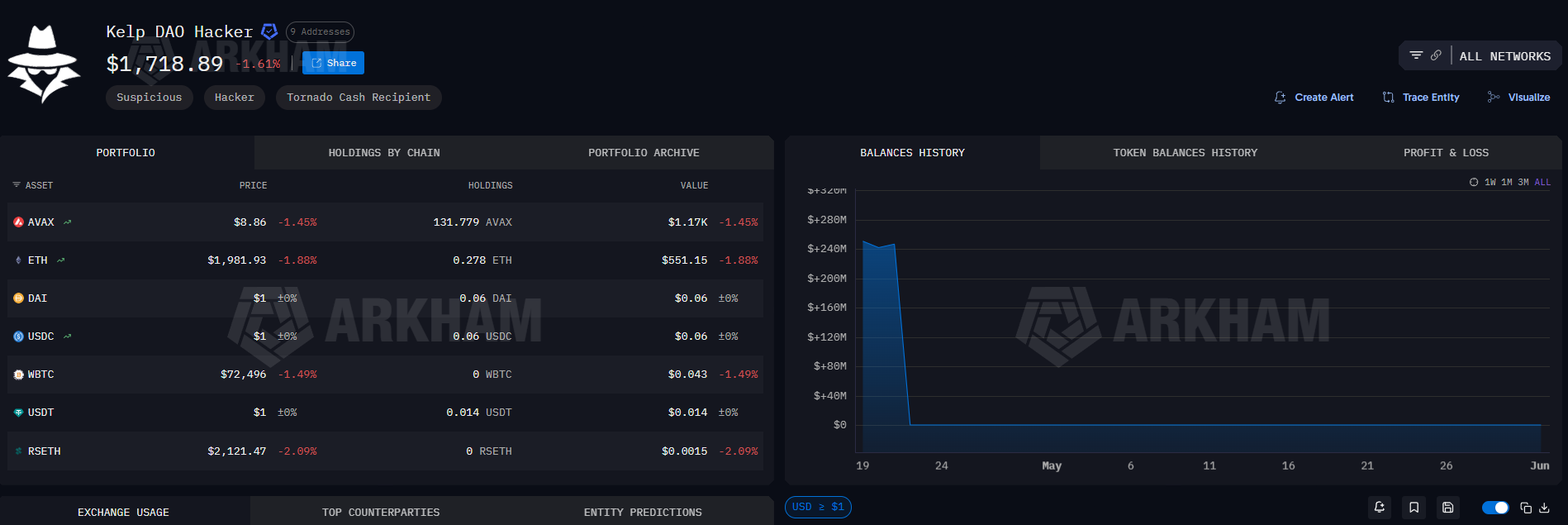
The malicious actor behind the massive $293 million exploit of the Kelp DAO restaking platform has successfully laundered nearly all of the unfrozen stolen assets, totaling approximately $220 million, in a span of just six weeks. According to data provided by blockchain intelligence platform Arkham and various onchain analysts, the hacker-tagged wallet has liquidated and moved the vast majority of the pilfered funds, leaving a mere $1.7 million still traceable within the primary address.
The devastating incident occurred on April 18, when the attacker managed to drain a staggering 116,500 Kelp DAO restaked Ether (rsETH) tokens from the protocol. This single security breach single-handedly inflated the total amount of funds lost to crypto hacks across the entire industry to $630 million for the month of April, marking one of the most destructive months for decentralized finance security in recent history.
According to detailed breakdowns provided by onchain analyst Specter, the sophisticated money laundering operation was executed in distinct operational layers designed to obfuscate the trail of the stolen capital. First, the hacker bridged the digital assets to Bitcoin using the privacy-focused crypto mixer Wasabi. Following this cross-chain obfuscation, the funds were routed back to the Ethereum network before being systematically withdrawn and deposited through the mixing protocol Tornado Cash. Security experts note that this multi-layered laundering strategy has drastically reduced the probability of recovering the remaining unfrozen portion of the stolen cryptocurrency.
Despite the near-total loss of the unfrozen assets, authorities and decentralized autonomous organizations have managed to secure a portion of the stolen capital. Just days after the breach, on April 21, an additional $71 million in Ether connected to the Kelp DAO exploit was successfully frozen by the Arbitrum Security Council. This defensive action was backed by a formal governance proposal and a United States court order, which previously authorized the transfer of the frozen funds into an Aave-controlled multi-signature wallet designated specifically for the ongoing rsETH recovery and remediation efforts. Legal battles regarding ownership claims to these frozen assets continue to unfold, with a crucial court hearing scheduled in New York.
The latest laundering developments follow a period of intense operational recovery for the protocol itself. Exactly one week prior to the disclosure of the wallet liquidation, Kelp DAO announced that it had successfully restored its restaked Ether token supply. This milestone was achieved following a rigorous five-week recovery initiative that culminated when the final tranche of 20,373.7 rsETH tokens was transmitted back to the LayerZero smart contract. This specific smart contract governs the locking, minting, burning, and releasing mechanisms utilized during cross-chain token transfers.
Crypto Hacks Decrease by 90% in May, but DeFi Security Concerns Persist
While the aftermath of the Kelp DAO exploit continues to reverberate across the blockchain sector, broader industry statistics indicate a sharp month-over-month decline in total exploit losses. Cryptocurrency hacks logged a significant contraction during the month of May, offering a brief respite to an industry on high alert, though it ultimately proved insufficient to quell growing anxiety regarding the foundational security standards of the decentralized finance ecosystem.
According to data compiled by blockchain security platform CertiK, total losses resulting from cryptocurrency exploits plummeted to $68.3 million in May. This figure represents a dramatic nearly 90% decrease compared to the massive financial damages sustained during April. A breakdown of the May security incidents shows that approximately $2.6 million of the total losses stemmed from targeted phishing attacks, while security teams and protocol administrators successfully recovered or negotiated the return of roughly $9.4 million.
Nevertheless, the unprecedented scale of the $293 million Kelp DAO exploit has permanently altered risk management perspectives within the sector, triggering a widespread reassessment of how decentralized finance protocols select and integrate their oracle and infrastructure providers. In the wake of the security breach, multiple protocols moved swiftly to overhaul their underlying architecture to mitigate systemic vulnerabilities.
Within just three weeks of the attack, Bitcoin DeFi platform Solv Protocol and liquidity protocol Tydro independently announced their migration to Chainlink’s Cross-Chain Interoperability Protocol (CCIP), actively seeking out more robust and battle-tested oracle and cross-chain communication providers. Kelp DAO itself undertook a major infrastructural pivot, migrating its native rsETH token to Chainlink CCIP and formally abandoning its previous LayerZero-powered bridge setup after attributing the initial exploit to structural weaknesses in that cross-chain configuration.
The architectural blame game following the incident highlighted deep divisions regarding responsibility in cross-chain development. LayerZero publicly countered these claims on April 20, asserting that the exploit was not an inherent failure of its core technology, but rather the result of a single point of failure introduced directly through Kelp DAO’s custom implementation. Specifically, LayerZero stated that the protocol relied on a single Decentralized Verifier Network (DVN) as its sole verified path, bypassing recommended security redundancies despite prior technical warnings against deploying such a configuration. As legal teams, developers, and affected users continue to navigate the fallout, the incident remains a watershed moment for cross-chain security standards in decentralized finance.