
Business utilization
of stablecoins is poised for a dramatic acceleration over the next twelve months, as the integration of digital currencies moves firmly into the mainstream commercial ecosystem. According to a comprehensive new report released by payments infrastructure firm Cybrid, corporate reliance on blockchain-based digital dollars is rapidly transforming international commerce, propelled by substantial cost reductions, burgeoning infrastructure development, and the arrival of long-awaited regulatory frameworks.
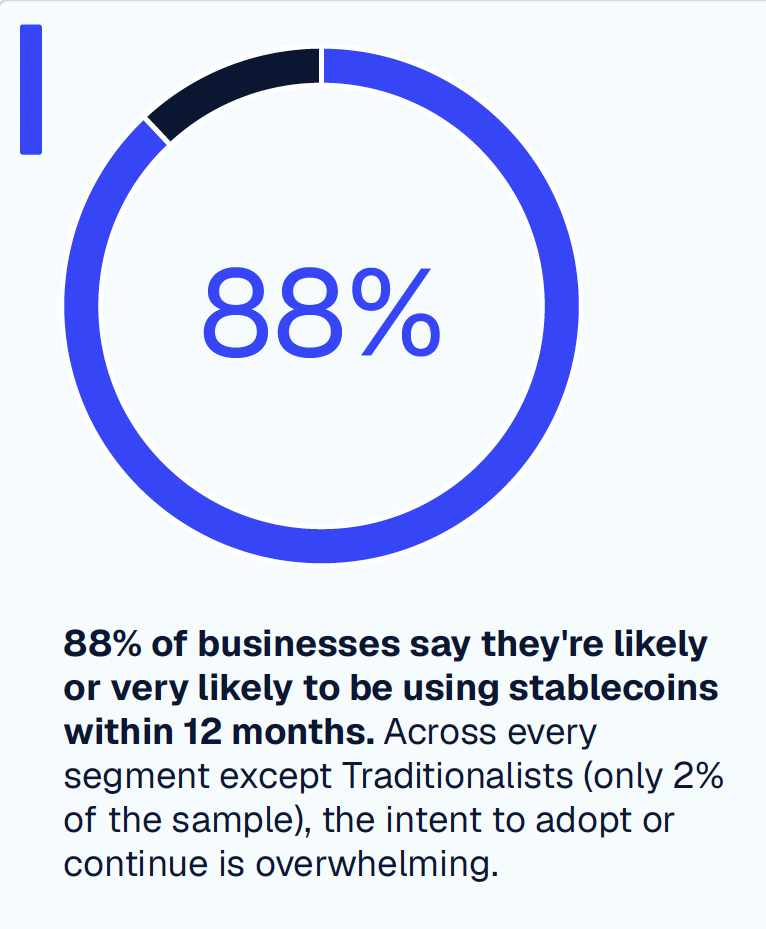
The Cybrid report reveals that an impressive 42% of businesses surveyed are already actively utilizing stablecoins for cross-border payments. Furthermore, an overwhelming 88% of respondents indicated that they are either likely or very likely to incorporate stablecoins into their financial operations within the coming year. In stark contrast to the rapid ascent of digital assets, traditional payment rails are seeing a sharp decline in exclusive corporate loyalty, with only 2% of survey participants identifying as committed users of legacy payment systems.
The financial incentives driving this structural shift are substantial. Businesses currently leveraging stablecoins reported average cross-border payment cost savings of 35%. Even more striking, larger enterprises processing upwards of $100 million in monthly payment volume reported average cost reductions of up to 47%. These efficiency gains highlight why corporate treasuries are increasingly looking past traditional banking networks to settle international transactions instantly and at a fraction of the cost.
Underpinning this corporate momentum is a rapidly expanding global market. Coingecko data places the total global stablecoin market capitalization at $307.64 billion. The market continues to be dominated by Tether’s USDT, which commands a market cap of $184.7 billion, followed by Circle’s USDC at $73.51 billion. Meanwhile, recent legislative developments have catalyzed unprecedented growth in compliant digital assets. Stablecoins compliant with the GENIUS Act have surpassed a market cap of $76 billion, effectively establishing the first comprehensive federal regulatory framework for payment stablecoins in the United States and providing corporations with the legal certainty required to deploy capital at scale.

The Cybrid findings are derived from a detailed survey of 468 executives and business leaders conducted between April 28 and May 4. The participant pool included C-suite executives, finance and treasury managers, and payments and operations leaders hailing from the technology, financial services, and e-commerce sectors across the United States, Canada, and the United Kingdom.
Varied Users Look for Regulatory Clarity to Gain Confidence
As businesses integrate stablecoins into a wider array of financial workflows, payroll and contractor disbursements have emerged as the single most common use case among survey respondents. This initial adoption in workforce payments is closely followed by supplier transactions, customer-facing payment gateways, investment and yield generation, vendor settlements, and overarching treasury and liquidity management.
Despite the enthusiasm surrounding these operational use cases, corporate leaders emphasize that external guardrails remain vital for sustained growth. Regulatory clarity emerged as the absolute top factor that respondents said would increase their confidence in expanding stablecoin deployment. Specifically, 71% of surveyed executives identified clear regulatory guidelines as more critical to their operational strategy than trusted infrastructure providers or the seamless integration of stablecoins with existing enterprise resource planning systems.
This emphasis on regulation reflects the cautious optimism of institutional decision-makers who must navigate complex global compliance obligations. As policymakers in major jurisdictions continue to flesh out digital asset rules, businesses are carefully evaluating how to scale their blockchain operations without running afoul of evolving legal standards.
Companies Expand Infrastructure for Stablecoin Payments
Independent industry data from across the broader financial ecosystem strongly corroborates the trends highlighted in the Cybrid research. In June, digital asset payments infrastructure provider Paybis reported that business customers accounted for nearly 98% of the stablecoin payout volume processed through its platform during the first four months of 2026. This represents a monumental leap from 2023, when business payouts comprised just 36% of Paybis’s total volume.
Paybis also pointed to comprehensive research from McKinsey, which estimated that business-to-business transactions accounted for roughly 60% of the staggering $390 billion in global stablecoin payment volume recorded throughout 2025. These figures demonstrate that the growth of stablecoins is not merely driven by retail speculation or crypto-native enterprises, but is instead being heavily fueled by traditional commercial trade and corporate treasury operations.
Responding directly to this surging enterprise demand, major financial institutions and infrastructure providers have aggressively expanded their product offerings to support stablecoin transactions. In May, Anchorage Digital Bank facilitated the debut of fUSD, a dollar-backed stablecoin issued by Falcon Finance through its federally regulated issuance platform. The product is specifically engineered to target institutional trading, collateral management, and advanced treasury workflows.
Building on this institutional momentum, BNY announced an expansion of its digital asset custody platform to provide full support for Circle’s USDC. The development allows institutional clients of the bank to securely store, transfer, mint, and redeem USDC directly within an established banking environment, bridging the gap between traditional custody services and blockchain-based liquidity.