Suspected China-linked threat actors have leveraged autonomous artificial intelligence agents to successfully discover a previously unknown zero-day vulnerability in MONAI Label, an open-source medical imaging server, subsequently gaining root access to a targeted university server, according to findings published this week by Amazon Threat Intelligence.
The critical security flaw, which has since been assigned the identifier CVE-2026-133968 with a maximum severity rating of 9.8 out of 10, enables an unauthenticated attacker to write files outside of the server’s designated storage directory. The vulnerability impacts versions 0.8.5 and earlier of MONAI Label when operating under its default configuration, which notably features authentication disabled out of the box.
Although maintainers of the open-source project have successfully merged a source code patch to address the issue, a formally compiled and packaged version ready for installation has not yet been released to the public.
MONAI Label functions as a specialized server utilized by medical research teams worldwide to annotate diagnostic scans and train complex machine learning imaging models. It operates as a distinct software component separate from the broader MONAI framework. The underlying weakness stems from a classic path-traversal vulnerability located within the specific modules of the server responsible for handling uploaded medical images and annotation labels.
During typical operations, a file identifier supplied directly by an API caller is appended to the local storage directory and written straight to disk without adequate validation to ensure that the resulting file path remains securely contained within the approved directory bounds. Because the server process executes with the operational privileges of the user account under which it was launched, an attacker cannot arbitrarily write files to any location across the entire machine. However, if the service account possesses write permissions over application code or system configuration locations, the flaw provides a viable pathway toward executing arbitrary code.

Furthermore, because authentication is inactive by default, any remote client capable of establishing a network connection with the server can trigger the vulnerable file-writing mechanism. Versions 0.8.5 and earlier remain exposed to this risk.
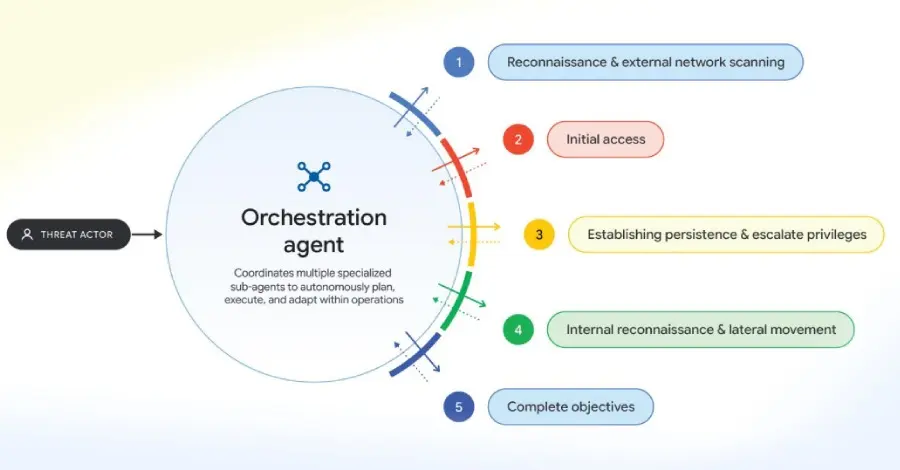
Amazon Threat Intelligence reconstructed the timeline and mechanics of the intrusion after discovering an unsecured, password-free Cairn control panel exposed directly to the public internet by the malicious operators. Cairn is an open-source framework specifically designed to orchestrate autonomous AI agents intended to function as automated penetration-testing systems. The discovery of the unauthenticated administrative panel afforded researchers unprecedented visibility into the attackers’ operational infrastructure, revealing detailed task configurations, specific prompt engineering parameters, and extensive run histories.
According to Amazon’s detailed incident report, the autonomous agents mapped the target application’s interface and successfully escalated their capabilities to the point of writing unauthorized files to the server in roughly 11 minutes, operating across a period of approximately 48 hours in September. The deployment was notable for its high degree of autonomy; the human operator provided broad strategic direction by establishing the primary objective of obtaining shell access and designating the targets, while the underlying AI agents independently selected their tactical methodologies and execution steps.
Investigators analyzing the recovered telemetry tied the espionage campaign to a China-linked threat actor with moderate confidence. This assessment was based heavily on contextual indicators discovered within the exposed control panel, including Simplified Chinese language prompts, system configurations set to China Standard Time, and the selection of targets that align closely with regional intelligence interests of the People’s Republic of China. Nonetheless, researchers emphasized that the work has not been attributed to a specific named threat group, nor has any definitive connection to a state-sponsored entity been formally established.
The escalation from initial file-write capabilities to a full root shell occurred during a subsequent operational session rather than within the initial 11-minute reconnaissance window. Leveraging the same path-traversal vulnerability, the AI agents planted a malicious file designed to be executed automatically by the Python interpreter during startup routines. The agents then triggered a machine learning training feature built into the application, which initiated a fresh Python process. This process automatically loaded the malicious startup file, successfully establishing a reverse connection back to the attacker with complete root privileges.
This successful root compromise was isolated to a single university server. Security analysts noted that whether a similar MONAI Label deployment would yield identical results depends entirely on local environment variables, including how the service was deployed and the specific operational permissions granted to the underlying service account. In a subsequent operational session observed by Amazon, the human operator provided the AI agents with an active network tunnel granting access to a second university network running the identical vulnerable software stack. While Amazon researchers believe the second network was breached via the same methodology, that subsequent compromise has not been independently confirmed.

Project maintainers responded to the disclosure by confirming the vulnerability and merging a source-level fix into the official GitHub repository on October 19. The patch forces all file uploads to properly resolve within authorized storage directories while explicitly rejecting empty filenames or strings beginning with a dot.
Despite the code-level fix, the project’s security advisory published earlier this week notes that a patched software package remains unavailable, indicating that the correction will be bundled into a future version. The most recent release listing on the Python Package Index remains version 0.8.5, which was originally published in 2024. Security experts remind administrators that a merged fix in a source repository is distinct from an installable software package.
The vulnerability is now formally documented under CVE-2026-133968. Although the project’s advisory page initially lagged behind in reflecting the assigned CVE identifier, the discrepancy represented a documentation delay rather than the existence of a secondary, unrelated flaw.
Given the current absence of a patched software release, security analysts advise administrators to take immediate defensive measures by restricting network exposure, disabling default configurations where authentication is absent, and strictly limiting the operational privileges and network reach of the service accounts running medical imaging servers.
Amazon’s published account remains based entirely on its own internal reconstruction of the forensic evidence and has not been independently verified by external agencies. Current telemetry does not indicate that patient scans or confidential medical records were exfiltrated, that broader clinical systems were impacted, or that the attackers successfully moved laterally beyond the specific university targets identified in the report. Furthermore, researchers noted that the campaign encountered multiple failed operations during its execution, reinforcing the conclusion that the successful root compromise achieved on one server does not represent a universal outcome for all MONAI Label deployments.