
For a long time, the prevailing wisdom surrounding onchain foreign exchange (FX) dictated that the evolution of the market would begin at the very top. Under this traditional thesis, major global banks would eventually tokenize sovereign currencies, large financial institutions would migrate their institutional FX operations onto blockchain rails, and retail or institutional liquidity would follow as a natural byproduct.
The ultimate end result of this top-down vision would be a blockchain-based foreign exchange ecosystem that eventually grew large enough to closely resemble its multi-trillion-dollar traditional counterpart. However, according to Michael Egorov, the founder of decentralized finance protocols Curve Finance and Yield Basis, that is not necessarily how the market is going to materialize.
Instead, growing signals from across the decentralized economy suggest that onchain foreign exchange is developing in the exact opposite direction—starting from the bottom up. Rather than waiting for legacy financial giants to overhaul their legacy infrastructure and migrate to public blockchains, real-world users and decentralized finance participants are building practical FX solutions to meet immediate, everyday economic needs.
Regional stablecoins—such as the Brazilian Digital token (BRZ) or Monerium’s euro-backed stablecoin (EURe)—illustrate this grassroots
shift. These digital assets can be rapidly minted and redeemed onchain, allowing users to move seamlessly between digital wallets and traditional bank accounts. Crucially, they generate robust and consistent trading activity as decentralized finance participants actively swap them within automated decentralized exchange (DEX) liquidity pools.
Markets of this nature are developing in real time around a deeply practical user requirement: the necessity to move funds directly and efficiently between digital currencies and traditional fiat money. While this phenomenon remains an early-stage example of a broader financial transition, the underlying use cases and economic demands are entirely real.
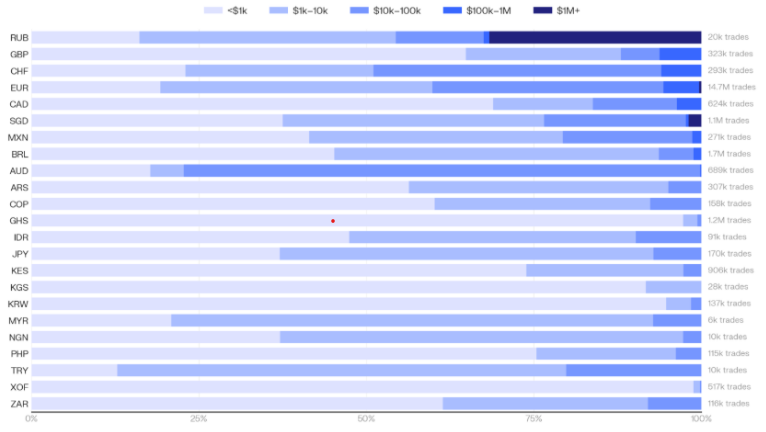
Data compiled by digital asset market maker Keyrock indicates that the vast majority of onchain stablecoin trades tied to emerging market currencies typically fall within the $1,000 to $10,000 range. While these sums are undeniably modest when compared directly against multi-million-dollar institutional scales, that modest size is precisely the point. It demonstrates how the market is organically building toward onchain foreign exchange to solve practical, ground-level payment needs rather than merely serving massive, speculative institutional traders.
‘Small’ Does Not Mean ‘Useless’
Individuals and modern businesses constantly need to move their capital across international borders and between different sovereign currencies. Clearly, these economic actors are no longer content to sit idly by and wait for legacy traditional finance institutions to slowly modernize their aging foreign exchange operations onto efficient blockchain rails.
A common assumption persists within traditional financial circles that an onchain foreign exchange market must command immense, deep pools of liquidity before it can ever be considered genuinely useful. In actual practice, however, that traditional assumption is entirely false.

If there is genuine economic demand from a user who urgently needs to exchange United States dollars into euros, Swiss francs, or any other sovereign currency, even a relatively smaller liquidity pool can successfully process those transactions and serve a very real economic purpose. Onchain foreign exchange does not need to become massive before it achieves utility; rather, it can grow organically precisely because everyday people are actually utilizing it for daily commerce.
As a matter of historical fact, this evolutionary trajectory mirrors the exact path taken by stablecoins themselves. They initially began as a relatively niche, crypto-native mechanism primarily used by traders inside digital asset exchanges, and yet today they form a critical part of a much broader global financial infrastructure.
Data shared recently by blockchain analytics firm Chainalysis shows that cross-border stablecoin activity surged dramatically to over $220 billion by mid-2026. This massive figure represents nearly 80% growth over the course of just a single year, proving definitively that real-world demand and transactional activity are constantly on the rise. There is no fundamental economic reason why onchain foreign exchange cannot follow a remarkably similar path of organic adoption.
The User Does Not Care How Big the Market Is
This aspect highlights the most practical side of the entire debate. Onchain foreign exchange will obviously not be in a position to directly compete with the entirety of the traditional global foreign exchange market anytime soon; achieving that level of dominance is still years away. Yet the much more interesting question centers on what immediate, pressing problems onchain FX can solve for a user who already holds capital natively on a blockchain.
In the modern financial landscape, an individual can easily exchange a US dollar stablecoin into a euro stablecoin, or another alternative asset, directly onchain and utilize those funds for international payments with remarkably little friction. Operating in this manner is frequently faster and significantly less expensive than relying on classic, bureaucratic international bank wire transfers.
The exact same underlying logic applies seamlessly to onchain foreign exchange applications. A modern financial technology firm or crypto-native debit card issuer does not need to recreate the entire institutional FX market from scratch; what they fundamentally require is a reliable way to move their customers’ funds efficiently across different currency denominations.
When a consumer attempts to purchase goods or services in a foreign currency using a traditional payment rail, currency conversion invariably adds substantial costs to the transaction. These operations typically involve major legacy credit card networks like Visa or Mastercard, which frequently levy processing fees of around 1% or more on cross-border transactions.
Onchain exchanges present a vastly superior alternative for these use cases. When user funds already reside securely on blockchain rails, swapping US dollar stablecoins into euro stablecoins can be executed directly, completely bypassing unnecessary financial intermediaries. This peer-to-peer approach is both faster and dramatically less costly for the end consumer.
Traditional commercial banks will most likely remain vital entry and exit points where digital money must interact with the physical, legacy banking world. Issuing and redeeming local fiat currencies, maintaining traditional bank accounts, and navigating complex regulatory compliance frameworks represent areas where legacy financial institutions will naturally continue to take the lead.
However, once capital is successfully brought onchain, many of the traditional, expensive in-between steps can be safely eliminated to achieve unprecedented financial efficiency. From the perspective of an everyday user who simply wants to conduct a cross-border financial transfer with minimal complications, this shift represents a profoundly positive improvement. In this context, the absolute size of the broader global FX market matters very little.
Demand is Only Half the Problem
Realizing this potential does not come without distinct hurdles. While genuine economic demand is a crucial ingredient, it does not magically solve the persistent structural problem of liquidity. The primary challenge facing developers is not merely creating a euro-to-dollar or franc-to-dollar liquidity pool, but rather figuring out how to make those pools economically sustainable over the long term.
This is precisely where automated market makers can make a profound difference. Traditional, human-operated market-making firms may not find it economically attractive to provide dedicated liquidity for a smaller, nascent foreign exchange market. In many cases, there simply may not be enough trading volume to justify the substantial operational costs and capital lockups required.
Automated liquidity models fundamentally change that economic equation. Advanced software can provide continuous, programmatic liquidity without requiring a centralized market-making firm to manually manage every individual trade or adjust spreads by hand.
Consider two prominent dollar stablecoins, such as USDC and Tether. From the narrow perspective of a traditional exchange desk, moving capital from one dollar-pegged stablecoin into another might appear to be a remarkably boring and unprofitable business. Because both assets are designed to maintain a stable value of roughly one dollar, there is very little price volatility for traditional speculators to trade around.
Yet if a persistent, real-world need remains for individuals and businesses to seamlessly switch between different stablecoins, an automated market maker can easily establish a specialized liquidity pool where users can execute those swaps directly. Every completed trade generates a modest fee for the liquidity providers backing the pool, and when a sufficient number of users require the exact same currency conversion, a viable market can thrive even if it does not look particularly lucrative to a legacy market-making desk.
This style of adoption may not qualify as explosive overnight growth, but there is nothing fundamentally flawed with slow, organic development. Emerging financial markets frequently require only a small, dedicated core group of users who share a persistent economic problem that existing legacy infrastructure fails to solve adequately. If those active users can make the underlying market economically viable, native liquidity can steadily expand from there.
Michael Egorov is the founder of Curve Finance and Yield Basis. He is also a physicist, entrepreneur, and cryptocurrency advocate. Egorov transitioned from the scientific research sector into the digital asset industry, holding a bronze medal from the International Physics Olympiad and a PhD in ultracold atoms.