
Cryptocurrency protocols and open-source software projects are facing an unprecedented operational bottleneck as the proliferation of artificial intelligence tools leads to a massive surge in bogus vulnerability submissions. Security and development teams worldwide report that they are drowning in low-quality reports and false positives, severely straining their ability to identify and patch legitimate threats to decentralized networks and digital infrastructure.
Bug bounty programs have long served as a cornerstone of digital security in both traditional software engineering and the crypto industry. These systems reward ethical hackers—often referred to as "good" hackers or white-hat researchers—for independently discovering and responsibly disclosing potential vulnerabilities before malicious actors can exploit them. Historically, finding these complex code flaws required specialized human expertise, deep analytical skills, and substantial time spent reviewing extensive codebases.
However, the rapid advancement of artificial intelligence has fundamentally altered that landscape. Modern large language models and specialized coding assistants make it significantly easier and faster for individuals to scan massive volumes of source code for potential vulnerabilities. While this technological leap has empowered legitimate researchers to scale their operations, it has also drastically lowered the barrier to entry, enabling opportunistic individuals to generate and submit superficial reports at an industrial scale. Compounding the issue, AI models are notoriously prone to hallucinations and misinterpretations, frequently flagging benign code patterns as critical security risks.
The consequences of this automated influx are already reverberating across the digital asset ecosystem and the broader tech industry. Barry Plunkett, the co-CEO of Cosmos Labs, highlighted the severity of the crisis in a public statement responding to a bug bounty hunter who had accused the protocol of ignoring a vulnerability report.
"AI is changing the way that bug bounty programs must operate," Plunkett said on Tuesday. Providing a stark look at the sheer volume of incoming reports, he revealed that Cosmos Labs has experienced a staggering 900% increase in submission volume compared to the previous year, receiving between 20 and 50 reports every single day. This exponential growth, he noted, has created a massive administrative burden, encompassing a vast number of both valid and entirely invalid submissions that demand human review.

This sentiment is echoed widely throughout the blockchain development community. Kadan Stadelmann, a blockchain developer and the chief technology officer at Komodo Platform, shared similar observations regarding the shifting dynamics of vulnerability reporting across various organizations in the sector.
"There has definitely been an increase in low-quality bug bounty submissions, some of which have been false positives, potentially suggesting AI sourcing," Stadelmann told Cointelegraph. "One potential explanation is that AI has caused a decrease in the cost to produce a report, resulting in an influx of submissions."
The strain is not limited to crypto-native protocols. The broader software ecosystem, upon which much of the digital economy relies, is experiencing identical pressures. In January, Daniel Stenberg, the creator of the widely used open-source data transfer tool curl, made the difficult decision to formally end his project’s bug bounty program. Used extensively across countless applications and foundational blockchain infrastructure, curl became a primary target for automated noise. Stenberg cited an overwhelming influx of what he termed "AI slop in vulnerability reports" as the driving factor behind his decision, explaining that he was simply exhausted from spending valuable time sifting through endless streams of fabricated or nonsensical findings.
Industry-wide metrics further illustrate the changing nature of security research. HackerOne, one of the largest and most prominent bug bounty platforms globally, released research data in January showing that the platform processed 85,000 valid bounty submissions in 2025. While this represented a 7% increase from the previous year, the raw volume of total submissions—including discarded, invalid, and AI-generated noise—grew at an even more dramatic pace, consuming disproportionate amounts of time for both platform administrators and project security teams.
AI Could Be Both the Cause and the Solution
Facing an unsustainable daily volume of reports, crypto protocols and development teams are actively rethinking how they manage vulnerability disclosures to protect their systems without alienating legitimate security researchers.
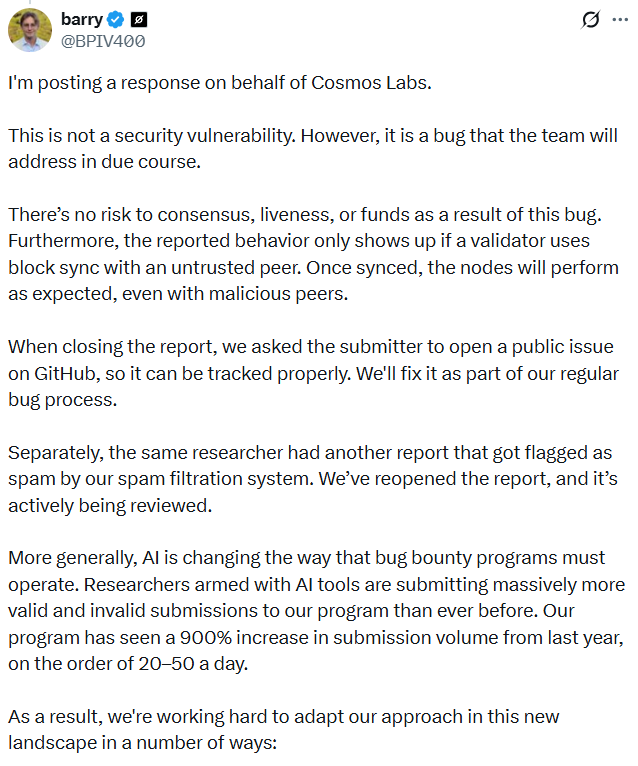
Plunkett noted that Cosmos Labs has already begun adapting its operational strategy to cope with the surge. The protocol has tightened its internal scoring mechanisms for submissions, placed a higher priority on trusted researchers with established, verifiable track records, and begun collaborating with specialized bug bounty providers that offer more advanced automated triage capabilities to filter out obvious noise before it reaches engineering teams.
For protocols that depend entirely on decentralized architectures and continuous community auditing, abandoning bug bounty programs is rarely an option. Stadelmann emphasized that these programs remain integral to defending decentralized systems against increasingly sophisticated cyber threats. Instead of shutting down programs, he argued that the industry must turn to technology to combat a problem created by technology, suggesting that adopting defensive AI tools to automatically sift through incoming reports will become a necessity.
"Blockchain teams will have to create AI deterrents to sift through incoming bug bounties. The smaller the team, the bigger the problem of increased bug bounties will become. Software engineers won’t have the capacity to examine everything," Stadelmann said.
As the digital asset space continues to grapple with historical security challenges—including billions of dollars lost to hacks and exploits over the past decade—protecting the pipeline of legitimate vulnerability reporting is more critical than ever. According to industry experts, teams that rely heavily on external researchers will ultimately need to develop much stricter compliance standards and automated filtering pipelines to lower the volume of incoming reports, ensuring that human ingenuity is reserved for addressing real threats rather than sorting through artificial noise.