An unknown threat actor has launched sophisticated cyberattacks against unpatched Check Point Security Gateways, exploiting vulnerabilities to secure initial access and escalate privileges in order to deploy advanced backdoors and destructive malware. The campaign leverages the known PHP2Shell exploits alongside a previously undisclosed local privilege escalation flaw affecting the Gaia operating system.
Security researchers at Check Point detailed the malicious activity, which unfolded in two primary waves. The initial wave began on October 30, 2026, specifically targeting Israeli organizations. This was followed by a broader, more indiscriminate follow-up wave on November 2, 2026, which impacted organizations across multiple countries and industry sectors. Notably, several organizations targeted during the first wave also experienced severe, destructive follow-up actions, including the deployment of wiper malware.
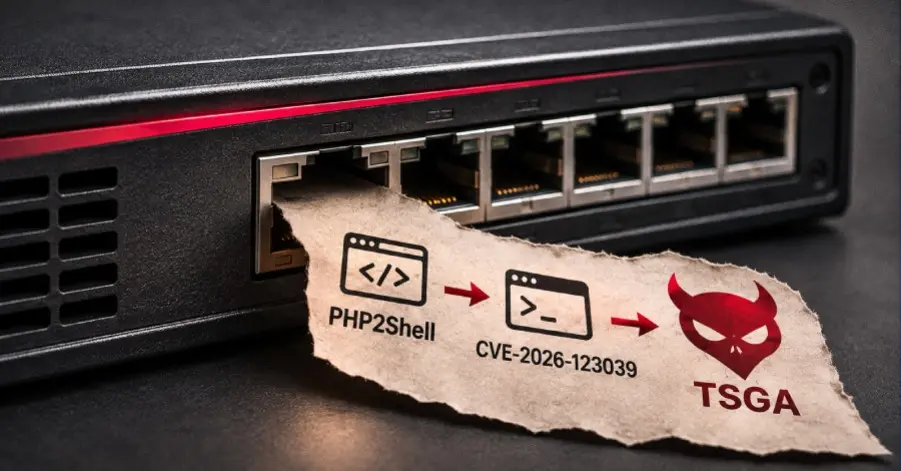
According to Check Point’s technical analysis, the attackers utilized PHP2Shell vulnerabilities for initial entry into vulnerable systems. Once inside, they executed privilege escalation through the appliance’s DynamicCLI interface, a vulnerability officially tracked as CVE-2026-123039. Following successful privilege escalation, the operators deployed PHP web shells, the persistent TSGA backdoor, and an embedded networking component known as TSProxy.
In some of the most severe instances observed during the campaign, the attackers pivoted beyond the gateway itself, moving from the compromised network device to a VMware ESXi host over Secure Shell (SSH). Once on the hypervisor, they deployed a wiper tool designated as destroy_v6 and left politically themed text notes reading DREAM_ANNEXATION.txt to mark the destructive stage of the intrusion.

The core vulnerability enabling the privilege escalation phase, CVE-2026-123039, carries a CVSS severity score of 7.8. It is categorized as a missing authorization flaw residing within the DynamicCLI process of Gaia OS. This security gap allows any authenticated local user to achieve root-level privilege escalation by writing a single request directly to the local socket, thereby bypassing standard authorization checks and running arbitrary commands.
Check Point emphasized that the vulnerability functions specifically as a local privilege escalation vector. Consequently, it requires an attacker to already possess some form of local code execution capability on the appliance before it can be successfully weaponized. Despite this prerequisite, researchers observed active exploitation of the flaw against a couple of dozen customer appliances globally. The affected software spans multiple versions—including R82.20, R82.10, R82, R81.20, R81.10, and R81—across various Check Point product lines.
The operational timeline shared by the cybersecurity firm highlights how quickly threat actors moved after security patches were made available. In late October 2026, roughly one week after a software fix was officially released, suspicious activity originating from the external IP address 130.94.19.204 began targeting Israeli organizations through vulnerable Mobile Access portals on Check Point Security Gateways. Evidence gathered from these incidents pointed clearly to successful compromises driven by PHP2Shell exploitation vectors, specifically aligning with vulnerabilities CVE-2026-109618 and CVE-2026-109619.
Following initial entry via the portal service account, the unidentified hacking group weaponized CVE-2026-123039 to elevate their operational privileges to root. They then laid down PHP web shells to ensure persistent access, with the web shells featuring built-in command execution and file upload capabilities.

While the October wave focused tightly on select organizations in Israel, the subsequent November 2 wave adopted a much broader posture. It struck some of the same Israeli entities while simultaneously reaching into organizations worldwide without demonstrating any obvious preference for specific geographic regions or market sectors, pointing toward opportunistic initial-access operations.
The foothold established via the web shells paved the way for the deployment of TSGA, a standalone passive backdoor packaged alongside a secondary component called TSProxy. Operating under the guise of slot_CPconfigdaemon, TSGA functions as a specialized Linux gateway implant tailored specifically for Check Point architectures. It grants attackers encrypted remote access, facilitates configuration theft, enables backup and snapshot persistence, allows process injection, and supports binary firewall-log tampering to hide malicious activity.
The companion component, TSProxy, handles specialized networking duties. According to Check Point, TSProxy’s injection code loads a custom library into selected appliance processes. There, it intercepts internal networking functions to process specially marked attacker connections while seamlessly allowing ordinary network traffic to continue uninterrupted. This design successfully marries a persistent standalone backdoor with concealed access operating quietly through existing appliance services.
Post-exploitation artifacts recovered from the incidents indicate that both TSGA and TSProxy are Check Point-specific modules belonging to a broader threat toolkit known as PhiliKit. This toolkit was first documented by security researchers at ESET in June 2026, at which time it was attributed to a China-nexus cyber espionage group tracked under the moniker Armory Castle, formerly identified as UNC5221.

Additional operational indicators have fueled speculation regarding the involvement of a China-aligned threat actor. These include the use of LightNode Virtual Private Server infrastructure and the timing of the active scanning operations, which were heavily concentrated between 12:00 UTC and 09:00 UTC—a window that neatly aligns with standard working hours in China.
Despite these circumstantial overlaps, Check Point stated that current evidence falls short of providing high-confidence attribution to Armory Castle or any other specific Chinese state-sponsored group. The security firm noted that several alternative scenarios remain entirely plausible. It is possible that the identified threat actor executed the entire campaign independently, operated strictly as an initial access broker selling or handing off access to others, or participated in a deliberate false-flag operation designed to mislead investigators. Furthermore, researchers acknowledged the distinct possibility that the destructive wiper activity was introduced primarily as a smoke screen to obscure the true intelligence-gathering objectives of the campaign.
In response to the escalating threat landscape surrounding these vulnerabilities, the U.S. Cybersecurity and Infrastructure Security Agency took swift regulatory action. On November 13, 2026, CISA formally added CVE-2026-123039 to its Known Exploited Vulnerabilities catalog. This federal directive mandates that civilian government agencies apply the necessary patches and mitigations by November 16, 2026, to protect federal networks from active exploitation.