
Crypto protocols and open-source software projects are increasingly sounding the alarm over a surging wave of low-quality and bogus bug bounty submissions driven by the proliferation of artificial intelligence. While AI tools have empowered developers and
security researchers to analyze complex codebases more efficiently, they have simultaneously lowered the barrier to entry for generating automated vulnerability reports. This shift has resulted in a massive influx of false positives and poorly verified claims, placing an unprecedented operational burden on development teams tasked with safeguarding decentralized networks and critical digital infrastructure.
Bug bounty programs have long served as a cornerstone of cybersecurity in the digital asset sector. By offering financial rewards to ethical hackers—often referred to as "white hat" hackers—for discovering and responsibly disclosing potential vulnerabilities before malicious actors can exploit them, crypto protocols have cultivated a collaborative defense mechanism. These initiatives are deeply popular across the blockchain ecosystem, where a single undiscovered flaw can lead to catastrophic financial losses through smart contract exploits or private key compromises. However, the accessibility of modern generative AI models and automated code-scanning agents has fundamentally disrupted this delicate ecosystem. By making it trivial to rapidly parse large volumes of source code and automatically generate standardized vulnerability reports—even when the underlying tool is prone to well-documented AI hallucinations—the cost of producing a submission has plummeted nearly to zero.

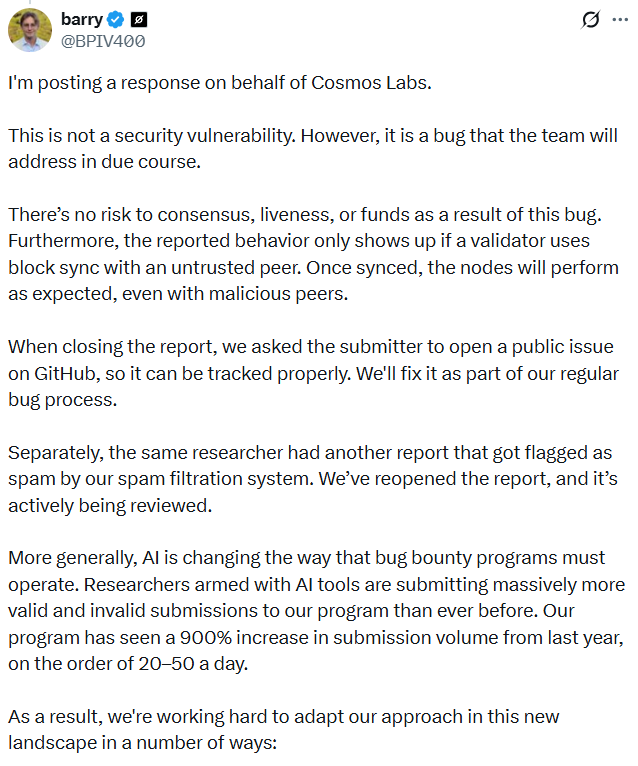
The impact of this automation boom has been felt acutely across the blockchain space. Barry Plunkett, co-CEO of Cosmos Labs, highlighted the sheer scale of the disruption on Tuesday while responding on social media to a frustrated bug bounty hunter who had accused the protocol of ignoring a vulnerability report. Plunkett revealed that Cosmos Labs has experienced a staggering 900% increase in submission volume compared to the previous year, receiving between 20 and 50 reports every single day. This exponential growth, he noted, has created an overwhelming surge in both valid discoveries and entirely invalid, AI-generated noise that security teams must manually sort through.
Echoing these concerns, Kadan Stadelmann, a blockchain developer and chief technology officer at Komodo Platform, observed a similar pattern of heightened activity across various decentralized organizations. Stadelmann noted that the influx is characterized by a noticeable drop in the overall quality of submissions, with many containing false positives that strongly point to automated AI sourcing. According to Stadelmann, the near-zero cost of generating reports via AI tools has triggered a tidal wave of submissions from individuals who may lack the deep technical understanding required to verify whether a reported vulnerability poses an actual threat to a production-grade system.
The strain is not limited strictly to the cryptocurrency sector; it is a growing crisis across the broader software development landscape. In January, Daniel Stenberg, the creator of curl—a widely utilized open-source data transfer tool embedded in countless applications, including essential blockchain infrastructure—announced that he was permanently shutting down his long-running bug bounty program. Stenberg cited an exhausting influx of "AI slop in vulnerability reports" as the primary reason for his decision, explaining that he simply no longer had the time or energy to sift through mountains of fabricated or thoroughly misguided submissions to find legitimate security concerns.
Data from major industry platforms further underscores the broader trends in vulnerability disclosure. HackerOne, one of the largest and most prominent bug bounty platforms in the world, released research in January indicating that it handled 85,000 valid bounty submissions throughout 2025. While this represented a modest 7% increase in valid findings from the previous year, the raw volume of unfiltered, low-quality, and automated submissions attempting to enter the pipeline has grown at a vastly higher multiplier, exacerbating the administrative bottlenecks for triage teams.
AI could be both the cause and the solution
Faced with an unsustainable volume of incoming reports, crypto protocols and security architects are being forced to rethink how bug bounty programs are structured, managed, and filtered. Plunkett noted that Cosmos Labs has already begun adapting its operational strategy to cope with the influx. The protocol has tightened its scoring criteria for evaluating submissions, placed a heavier emphasis on prioritizing trusted researchers with established, verifiable track records, and initiated partnerships with specialized bug bounty providers that offer more advanced, automated triage capabilities to filter out obvious falsehoods before they reach core developers.
Meanwhile, Stadelmann emphasized that despite the current administrative chaos, bug bounty programs remain absolutely integral to defending complex, decentralized systems against sophisticated attacks. Because smaller blockchain projects often operate with lean engineering teams, the burden of managing an unfiltered flood of reports hits them hardest. Software engineers simply do not possess the human capacity to manually examine every single claim that crosses their desk, making technological adaptation a matter of survival for many protocols.
This operational reality points toward a future where defensive artificial intelligence tools become a standard requirement for managing open-source and decentralized security pipelines. Stadelmann suggested that blockchain teams will increasingly need to deploy AI-driven deterrents and automated filtering systems designed specifically to intercept and evaluate incoming bug reports before human eyes ever see them. Furthermore, as protocols look to curb the overwhelming tide of low-effort submissions, organizations that depend heavily on community-sourced security will likely need to establish much stricter guidelines, higher submission standards, and more rigorous verification requirements for their bug bounty initiatives.