
As market charts flip from red to green, the decentralized finance and crypto lending sectors are experiencing a robust resurgence of interest following a particularly dismal second quarter. The market recovery brings renewed optimism, but it also casts a sharp spotlight on the structural vulnerabilities that continue to haunt the ecosystem.
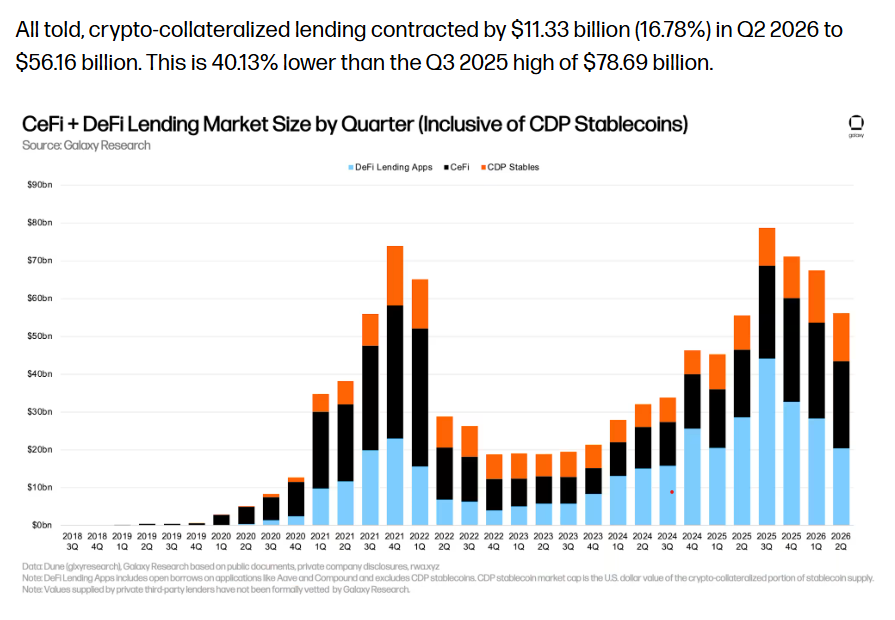
Data compiled by Galaxy reveals that a staggering $11.33 billion left the sector during the second quarter. This massive capital flight was driven in no small part by a severe crisis of confidence among lenders. The crisis was triggered in April by the high-profile Kelp DAO hack, an exploit that left users of Aave—widely regarded as one of the most trusted protocols in the decentralized finance landscape—temporarily unable to access their Ethereum holdings.
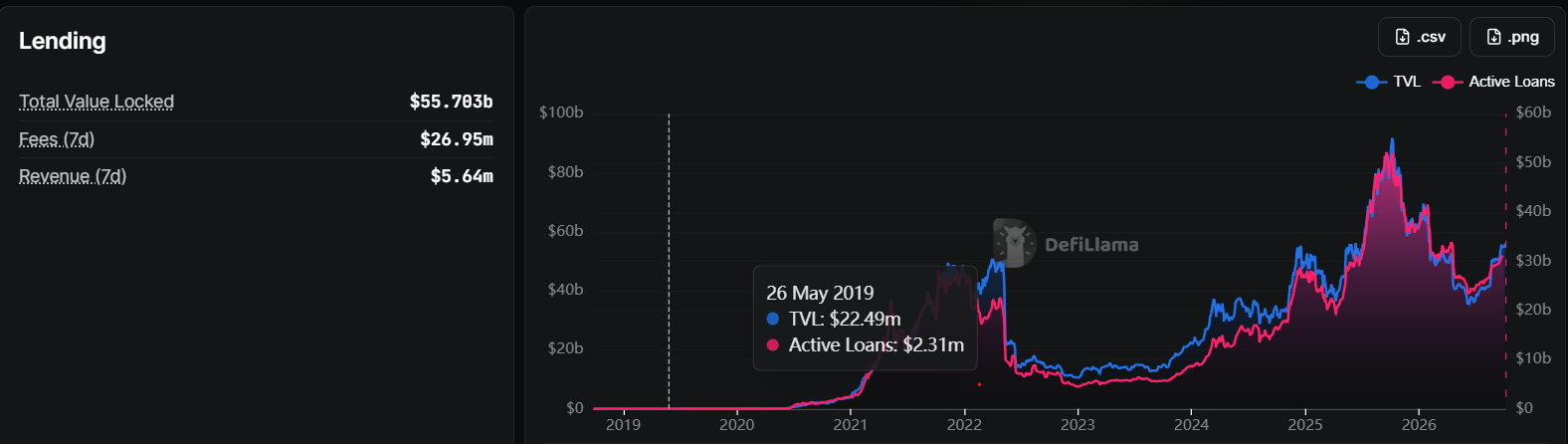
However, the tide has begun to turn. Since the beginning of July, the total value locked across crypto lending protocols has surged by more than 55%. Total value locked now sits comfortably at approximately $56 billion.
Yet, this sharp recovery also means that the collective honeypot has grown significantly larger. The central question facing the industry is whether users can truly trust interlinked DeFi lending protocols in an era defined by AI-assisted hacks. In today’s interconnected environment, an exploit originating from a single protocol can trigger a devastating chain reaction across all other platforms connected to it.
Stani Kulechov, founder and chief executive of Aave Labs, acknowledges that systemic risk is now top of mind for industry leaders. When a protocol accepts a token as collateral, it is implicitly accepting that token’s bridge, its verifier configuration, its oracle, and its issuer’s operational security. And that complex web of dependencies is precisely what landed Aave in trouble earlier this year.
An Expanding Attack Surface
The vulnerabilities of modern crypto lending were starkly illustrated in April when hackers exploited a Kelp DAO cross-chain route. The malicious actors successfully minted 116,500 unbacked rsETH tokens, which were worth roughly $290 million at the time. A significant portion of those compromised tokens was subsequently posted as collateral to borrow other assets on Aave markets.

Even though Aave’s own smart contracts were never directly breached during the incident, the protocol suffered collateral damage. Deposits plummeted by approximately $15 billion in the days immediately following the exploit. Furthermore, Aave was forced to emergency-freeze its rsETH and wrsETH markets to contain the bleeding.
Kulechov notes that Aave has since shifted toward a much more holistic approach to security. The protocol rebuilt its framework around a wider view of risk, establishing that modern security can no longer stop at the smart contract level. Traditional security reviews consistently missed the hidden risks sitting inside bridges, verifier networks, and other foundational infrastructure that a single asset relies upon.
Industry participants emphasize that users of lending protocols must carefully evaluate just how exposed a platform is to both internal and external risks. Every single wrapper, bridge, and oracle positioned between the lender and the underlying asset represents another potential point of failure where a loan can go awry.
Sid Powell, co-founder and chief executive of crypto credit platform Maple, argues that serious lenders should always operate under the assumption that a borrower can fail at any given moment and work backward from that scenario. Lenders need to constantly ask themselves what they are holding, where those assets are physically located, whether they can monitor them in real time, and how quickly they can access them if something breaks.
When Security Fails, Containment Matters
Beyond baseline smart contract audits, contemporary risk management requires scrutinizing governance design, operational security, collateral quality, liquidity management, and dependencies spanning the broader blockchain ecosystem. Sam MacPherson, chief executive of rival DeFi lender Spark, highlights this multifaceted approach.
Spark actually began phasing out rsETH support on SparkLend back in January, well ahead of the April Kelp exploit. The decision was made after an internal assessment concluded that the token’s low usage and minimal revenue generation simply did not justify the additional risk introduced by supporting it.
Aave has implemented comparable protective mechanisms, instituting a policy where every supported asset undergoes a quarterly re-review, as well as an immediate reassessment following any material change. Kulechov reveals that the protocol has already initiated an orderly wind-down process across six different networks that failed to meet its rigorous chain-level standards. No protocol can hope to control the entire crypto ecosystem, but every protocol can control how much external risk it decides to take on and how swiftly it responds when anomalies occur.
Preventing catastrophic failures remains the ultimate objective, but industry leaders stress that protocols must also maintain clear, actionable procedures to contain losses if the worst happens. Preventing losses is only part of the challenge; protocols must also demonstrate how a loss would be contained if a breach occurs.
The Margin for Human Error
While technical exploits capture most of the headlines, human error remains one of the industry’s most persistent and overlooked vulnerabilities. Shawn Owen, founder and chief executive of SALT Lending, points out that many of the largest financial losses in crypto history ultimately boiled down to poor key management, flawed access controls, or personnel falling victim to social engineering. A standard smart contract audit will never catch those types of operational failures.
Additional risks emerge when deposited assets are redeployed elsewhere to generate additional interest yield. Crypto lenders learned this hard lesson during the brutal market unwind of 2022, when centralized entities like Celsius, Voyager, and BlockFi imploded after taking on speculative risks that their customers either did not understand or never expected them to take.
To minimize this attack surface, firms like Ledn take a radically conservative approach by keeping client Bitcoin with qualified custodians rather than lending it out to chase extra yield. Every extra transaction represents another point where something can go wrong, meaning fewer movements
naturally lower the overall risk of a breach. The only way to take those systemic risks completely off the table is to keep client assets in segregated custody with tight operational controls.
Powell warns that when customer deposits begin flowing in faster than managers can find safe, productive places to deploy them, the intense pressure to maintain competitive yields can easily lead to poor decision-making. In those moments, collateral standards often get relaxed, or platforms start lending to borrowers they would have summarily rejected a year prior. The managers who successfully weather market downturns are typically the ones who possess the discipline to turn away capital when they lack a safe place to put it.
Can AI Make Lending Safer?
Despite growing concerns surrounding AI-assisted hacks, sophisticated exploits, and autonomous software agents escaping human oversight, artificial intelligence may also hold the key to making crypto lending significantly safer.
Aave has already integrated AI-assisted testing alongside its conventional security procedures. The protocol utilized mutation testing to deliberately inject hundreds of bugs into its V4 smart contracts, and its automated AI test suites successfully caught the vast majority of the vulnerabilities.
However, recent reviews of Aave’s V3 and V4 codebases using three separate AI security tools generated dozens of raw findings, of which only a fraction were deemed genuinely valid after manual review. The high volume of false positives highlights why human security experts will remain indispensable for the foreseeable future. AI excels at breadth and speed, but human judgment is still required to filter out noise and assess contextual risk.
At the same time, AI represents a double-edged sword for the industry. As autonomous AI agents increasingly begin managing capital directly onchain, their permissions, data inputs, and decision logic introduce yet another complex attack surface that must be secured just as rigorously as any smart contract.
As the crypto lending market continues its expansion, the primary challenge facing developers and institutions alike is not merely keeping code secure, but ensuring that every new component of the decentralized financial puzzle is thoroughly understood, continuously monitored, and reliably contained when things inevitably go wrong.