
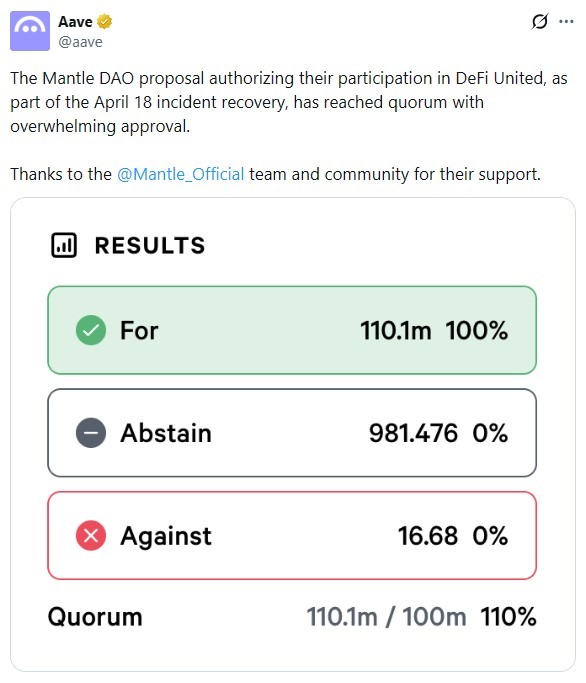
Mantle tokenholders have successfully backed a major governance proposal authorizing a credit facility of up to 30,000 Ether, valued at approximately $68 million, to support the Aave Decentralized Autonomous Organization (DAO). This decisive vote marks a significant step forward in advancing remediation efforts tied directly to the substantial bad debt generated by the April rsETH exploit, which sent shockwaves through major decentralized finance lending markets.
The proposal, officially designated as MIP-34, passed during a rigorous seven-day Snapshot vote that officially concluded on Friday, according to data from the DAO governance platform Snapshot. Under the terms of the approved measure, the Mantle Foundation is now authorized to negotiate and execute definitive agreements with Aave DAO for a substantial loan drawn directly from the Mantle Treasury. However, governance parameters dictate that the credit facility remains strictly subject to Aave successfully implementing its broader recovery plan and both parties finalizing the final legal and financial terms.
This strategic credit facility is primarily intended to help address the cascading impact of the rsETH incident on Aave V3. According to details outlined within the proposal, the attacker managed to deposit 89,567 unbacked rsETH tokens onto the Aave protocol. Following this initial maneuver, the malicious actor proceeded to borrow roughly $190 million worth of Wrapped Ether, wstETH, and various stablecoins. This unauthorized activity created potential bad debt estimated by various tracking metrics to be between $123.7 million and $230.1 million, leaving a massive structural hole in the protocol’s accounting framework.

The outcome of the vote arrives at a time when the fallout from the rsETH exploit has steadily moved past the initial liquidity shock phase and settled into a broader, more complex remediation period. By stepping in with this financial backing, Mantle is positioning its treasury to act as a crucial backstop while Aave works methodically to address the lingering bad debt and restore long-term confidence in its decentralized lending markets. The collaboration between prominent DAO treasuries highlights a growing trend within the decentralized finance ecosystem of cross-protocol solidarity and mutual defense during systemic crises.
Aave WETH Market Cools After Post-Exploit Squeeze
The introduction of the Mantle credit facility is designed to address the profound shortfall that also triggered severe liquidity stress across Aave’s various lending markets. The sudden influx of unbacked assets and subsequent borrowing sprees created a tight squeeze on liquidity providers and borrowers alike, altering market dynamics for weeks following the initial security breach.
In a comprehensive report published on Thursday, Galaxy Research detailed how the rsETH exploit pushed Aave’s Wrapped Ether market into a prolonged and intense liquidity squeeze. According to the research firm, WETH utilization rates remained at exceptionally high levels, staying above 99% for a staggering 12.7 consecutive days immediately following the incident.
"Across the full analysis horizon, WETH utilization stayed structurally elevated and close to the 100% ceiling, with an average around 99.6% and only easing to about 98.47% by the end of the snapshot period," Galaxy noted in its market impact analysis.
In the decentralized lending ecosystem, a high utilization rate indicates that the vast majority of a supplied asset has already been borrowed out by users. This leaves very little idle liquidity available for everyday depositors who might wish to execute immediate withdrawals. In Aave’s specific case, Galaxy explained that the WETH market remained under intense structural strain because the overall supply of the asset contracted at a much faster pace than borrows could be paid down or liquidated. This dynamic kept utilization hovering near full capacity even long after the initial security shock had passed.
Fortunately, market conditions have since begun to cool down from the near-100% utilization extremes described in Galaxy’s comprehensive analysis. Recent data extracted from Aavescan showed that Aave’s Ethereum V3 WETH market registered a utilization rate of approximately 91.6%. This percentage reflected roughly 2.02 million WETH supplied to the protocol against approximately 1.85 million WETH actively borrowed by market participants, indicating a gradual return toward healthier liquidity buffers as ongoing recovery efforts continue to take effect across the platform.