As organizations worldwide race to integrate artificial intelligence into their daily workflows, a silent security crisis is unfolding on the laptops and desktops sitting on desks inside corporate networks. Right now, there is a strong probability that an AI agent is running unattended on an endpoint somewhere within your corporate perimeter, holding sensitive API keys, database passwords, and possessing deep access to internal systems without anyone actively watching.
Nobody reviewed its access permissions, and in many cases, nobody even truly owns it. If a human employee were granted that level of structural reach with so little oversight, corporate security teams would instantly categorize it as a severe insider risk. Yet, organizations continue to treat these autonomous entities merely as productivity tools, overlooking the profound structural vulnerabilities they introduce.
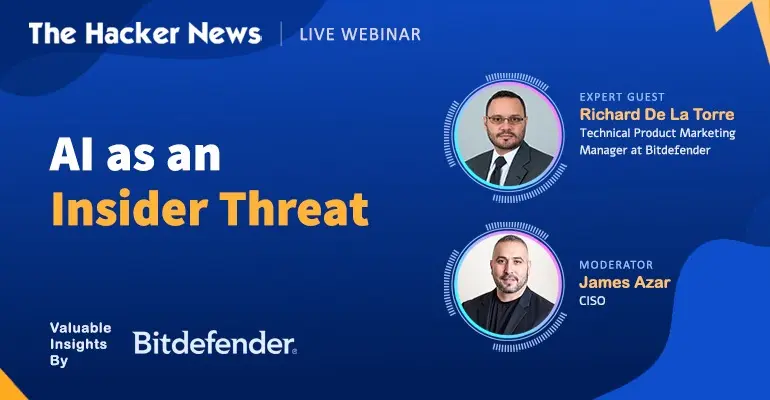
While much of the contemporary discourse surrounding artificial intelligence security focuses heavily on external threat actors and what malicious entities are doing with generative models, the more immediate and insidious threat may already be operating unchecked inside the organization. Addressing this pressing shift in the threat landscape is the core focus of an upcoming industry webinar titled "AI as an Insider Threat: From Shadow AI to Governed AI," featuring expert guest Richard De La Torre, Technical Product Marketing Manager at Bitdefender. The session aims to provide security leaders with a practical playbook on bringing unseen artificial intelligence deployments under organizational control.
Where AI is hiding on your endpoints
The challenge of unmanaged artificial intelligence extends far beyond the software developers and data scientists who traditionally experiment with emerging technologies. Today, AI agents, specialized coding assistants, Model Context Protocol (MCP) servers, and various browser extensions are quietly proliferating across every department of modern businesses.
Crucially, most of these tools and extensions never cross the traditional network gateway in a way that legacy security tools and perimeter defense systems would readily recognize. They slip past traditional monitoring apparatuses because they operate locally, interact directly through encrypted web sessions, or integrate seamlessly into existing development environments and productivity suites.
The result is a stark and dangerous irony within modern enterprise architecture: the artificial intelligence tools that possess the deepest access to sensitive corporate infrastructure are frequently the exact ones that security operations centers cannot see. This lack of visibility effectively creates a blind spot that bypasses conventional governance frameworks, leaving organizations exposed to data exfiltration, accidental credential leakage, and unauthorized lateral movement.
The visibility gap, by the numbers
The scale of this architectural blind spot is highlighted in recent industry data. According to Bitdefender’s 2026 Cybersecurity Assessment report, only 51.8% of organizations currently report having full visibility into the artificial intelligence tools and applications being actively utilized by their staff. That leaves nearly half of all enterprises operating in the dark, completely unaware of what models, scripts, or autonomous agents are interacting with their proprietary data.
This pervasive lack of visibility carries tangible financial and operational costs. According to research findings from IBM, roughly 20% of all organizations that suffered a data breach were compromised through shadow AI channels—instances where unauthorized or unmonitored artificial intelligence tools served as the entry point or vector for the attack.
These statistics raise an urgent operational question for security leaders: what can organizations realistically do to address a risk they cannot even fully see? This practical dilemma forms the central theme of the upcoming Bitdefender webinar, where participants can examine actionable strategies that lean security teams can deploy to mitigate risks from unmonitored artificial intelligence assets.
From shadow AI to governed AI
Recent threat research conducted by Bitdefender Labs provides a sobering look at what is actually running on corporate endpoints when security teams examine real machines. Among the findings is the alarming discovery of a malicious agent skill caught actively operating in the wild, demonstrating that adversaries are already pivoting to exploit the autonomous capabilities and deep local integrations of unvetted AI tools.
For many overwhelmed security organizations, the instinctive reaction to this rising tide of unmanaged technology is to attempt to block artificial intelligence outright. However, heavy-handed prohibitions almost invariably fail. Employees facing operational friction will simply bypass restrictions, turning to personal devices, unsecured web applications, or unapproved communication channels to maintain their productivity, thereby driving shadow AI further underground.
The sustainable alternative to outright prohibition is governed adoption. Rather than attempting to slam the door on technological innovation, organizations must learn how to establish visibility, enforce least-privilege access, and implement continuous monitoring for autonomous agents. The upcoming expert session led by Bitdefender’s Richard De La Torre is designed to demonstrate what governed artificial intelligence adoption looks like in a real-world enterprise environment.
The artificial intelligence already running on enterprise endpoints will not wait for corporate policy committees to finalize their guidelines. As the boundaries between productivity tooling and autonomous system access continue to blur, security professionals must adapt their frameworks to account for the insider risks posed by machine intelligence. Security leaders and IT professionals interested in exploring these challenges and securing actionable defense strategies can register for the upcoming webinar, "AI as an Insider Threat: From Shadow AI to Governed AI," to learn how to bring hidden endpoints under structured control.