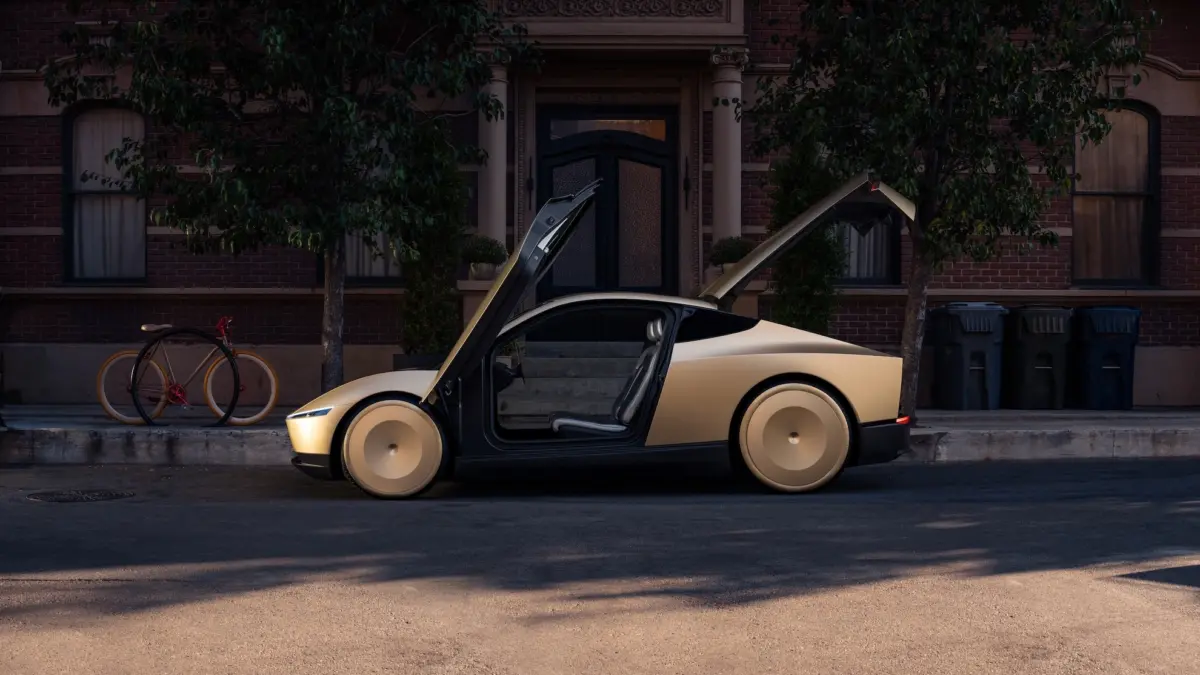
Tesla has announced that it will begin selling its futuristic, gold-hued Cybercab directly to customers by the end of the year, even as federal safety regulators actively investigate whether the autonomous vehicle complies with established federal vehicle safety standards. The vehicle, which is an autonomous two-seater entirely lacking a traditional steering wheel, pedals, and other manual driving controls, represents a major gamble for the automaker as it pushes deeper into the competitive robotaxi market.
The revelation came during Tesla’s third-quarter earnings call, where Lars Moravy, the company’s vice president of engineering, provided details regarding the production and eventual rollout strategy for the vehicle. According to Moravy, all of the Cybercabs currently rolling off the production lines are initially destined for Tesla’s own proprietary robotaxi fleet. However, as that operational fleet continues to expand, the company intends to pivot and begin delivering fully designed autonomous vehicles directly to third-party customers, albeit on a very small scale to start.
Moravy explained that Tesla plans to scale up its delivery efforts gradually as the company gains valuable operational insights into the delivery, ownership dynamics, and fleet management processes associated with autonomous vehicles.
The prospect of selling the autonomous vehicle to third parties was first floated by Tesla just last month around the time of its high-profile Cybercab launch event in Austin. During that period, the company even went so far as to post an online interest form for individuals and entities looking to purchase and operate their own robotaxi fleets. Despite that public solicitation, it remained unclear at the time whether Tesla would genuinely follow through with the concept, or what the logistical framework for such sales would actually look like.
For years, Tesla CEO Elon Musk has talked extensively about building a massive, sprawling network of low-cost robotaxis. Until recently, however, those ambitious plans centered primarily on a different approach: transforming privately owned Tesla vehicles already on the road into self-driving taxis simply by deploying a comprehensive over-the-air software update.
That original vision has yet to materialize in the form Musk initially promised, and his recent remarks during the earnings call highlight a distinct shift in his strategic perspective.
Currently, everyday Tesla owners can purchase or subscribe to Full Self-Driving (Supervised), an advanced driver-assistance system designed to automate many common driving tasks. Even so, the software still explicitly requires a human driver to remain fully attentive and ready to take over control at a moment’s notice. While the company continues to push out frequent software updates aimed at enhancing the system’s overall capabilities, a human operator is still legally and practically required to remain engaged, despite the countless online videos showcasing drivers testing the absolute limits of that safety mandate.
During the earnings call, Musk stated that an unsupervised version of FSD—the genuinely fully self-driving iteration that does not require human supervision—would finally be rolled out to customers sometime in the second quarter of next year. For many Tesla owners, this represents yet another delay in a long line of postponed timelines, especially for those who originally purchased or subscribed to the software years ago under the impression that true autonomy was just around the corner.
If both of Tesla’s current timelines manage to hold true, it would result in a fascinating industry dynamic: third-party fleet customers would be able to purchase the fully autonomous Cybercab and potentially operate it as a commercial robotaxi service before everyday Tesla owners are granted access to the exact same level of autonomous capability within their own personal passenger vehicles.
Addressing the long-term utility of the vehicle, Musk emphasized that the Cybercab is intentionally designed from the ground up to serve strictly as a dedicated ride-hailing vehicle rather than a traditional passenger car meant for individual consumer ownership.
The Cybercab is primarily going to be something that is offered as a transport-as-service model, Musk explained during the call, contrasting it with Tesla’s broader lineup of consumer vehicles. He noted that cars like the Model 3, the Model Y, and the Roadster are vehicles that individuals would naturally want to own and drive personally. In contrast, Musk stated that the vast majority of the Cybercab deployment will essentially consist of Tesla-owned assets operating via transport-as-a-service frameworks, though third-party buyers will also be entering the fold.
Despite the ambitious roadmap laid out by company executives, there is at least one major regulatory obstacle that threatens to upend Tesla’s Cybercab fleet plans. The National Highway Traffic Safety Administration, which serves as the primary federal auto safety regulator in the United States, announced last month that it had officially opened a formal investigation into the Cybercab. Notably, this regulatory action was launched just hours after the unorthodox vehicles first began operating on public streets in Austin.
Federal Motor Vehicle Safety Standards traditionally dictate that automobiles must be equipped with mandatory manual controls, including physical brake pedals, alongside other legacy features such as rearview and side-view mirrors. Under the standard regulatory framework, automakers traditionally self-certify whether their manufactured vehicles comply with these FMVSS rules, a path that Tesla followed with the Cybercab.
However, current federal regulations do not inherently accommodate vehicles that lack manual controls entirely, presenting a legal hurdle for autonomous vehicle developers. This regulatory friction exists even though the Department of Transportation recently proposed removing those traditional brake pedal requirements for vehicles explicitly designed to be autonomously driven—a move widely viewed as a significant regulatory boost for Tesla and other AV developers.
In the interim, NHTSA officials stated that the agency’s newly launched investigation is intended to closely examine the specific processes and technical data upon which Tesla relied when it certified the Cybercab, alongside various related safety and compliance issues.
The ultimate legal outcome of that federal investigation could profoundly impact whether Tesla, or any prospective third-party fleet operator, can legally operate the Cybercab on public roads moving forward.