
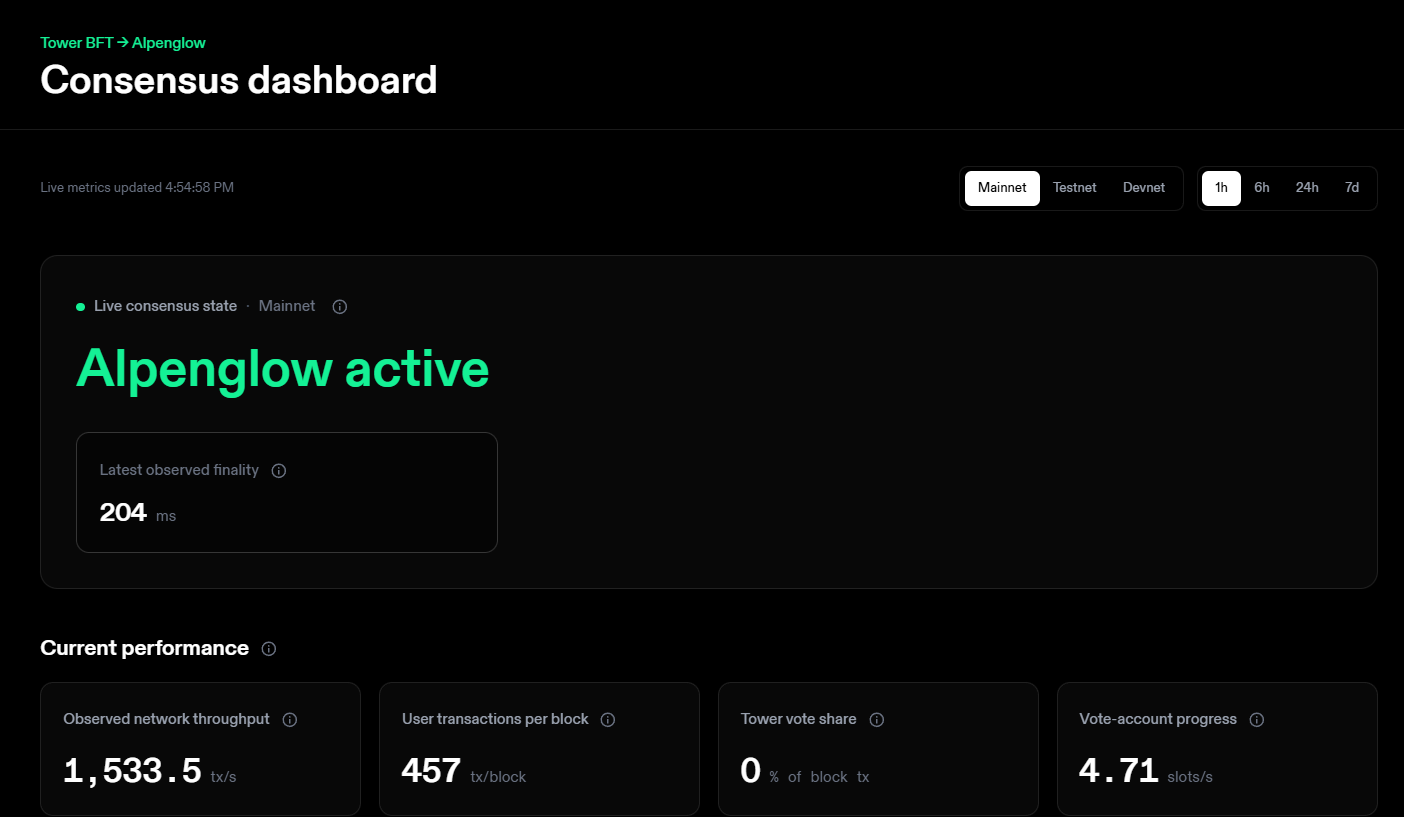
Solana’s first major consensus upgrade, Alpenglow, officially went live on the mainnet on Wednesday, reaching deployment around 1:54 pm UTC, according to data from the Solana Foundation’s Alpenglow activation dashboard.
The deployment marks a watershed moment for the high-performance layer-1 blockchain network. According to initial projections detailed in the Solana Foundation’s July announcement, Alpenglow is designed to drastically reduce transaction finality by roughly 99%. Before the rollout, transaction finality hovered at approximately 12.8 seconds. The network-wide integration of Alpenglow aims to compress that timeframe down to roughly 150 milliseconds, introducing a radically faster operational standard for users and developers alike.
The transition is being executed in distinct phases. The first phase centers on Votor, a critical mechanism that replaces Solana’s existing voting and finalization architecture. Votor introduces a direct validator voting process alongside a specialized certificate-based system explicitly built to achieve the target 150-millisecond transaction finality. Following this initial phase, a subsequent upgrade cycle will introduce Rotor, a novel block data-distribution protocol engineered to eventually replace the network’s current Turbine system.

Alpenglow serves as Solana’s first comprehensive consensus upgrade, stepping in to replace TowerBFT, the foundational consensus model that has powered the network since its inception. By targeting a 150-millisecond finality window, the upgrade seeks to deliver near-immediate confirmation for network participants. For everyday users and institutional operators, this leap forward translates into significantly faster digital payments, instantaneous trade settlements, and highly responsive decentralized applications capable of rivaling traditional financial rails.
At the time of publication, live metrics displayed on the Alpenglow dashboard indicated that the Solana mainnet was operating with a transaction finality of roughly 6.6 seconds and a robust throughput of 4,721 transactions per second as the network steadily adjusted to the structural shifts introduced by the upgrade. Observers and analysts are watching closely to see how these baseline metrics evolve as the phased components of Alpenglow fully propagate across global validator nodes.
Alpenglow Marks “Biggest Change” for Solana’s Core Protocol
The magnitude of the Alpenglow upgrade has been widely underscored by core development teams. In a comprehensive blog post published in May, researchers from Anza—an offshoot of Solana Labs—designated Alpenglow as the “biggest change to Solana’s core protocol” since the network’s genesis block.
In that May 19 publication, Anza researchers Quentin Kniep, Kobi Sliwinski, and Roger Wattenhofer emphasized the broader implications of achieving 150-millisecond latency. They noted that such unprecedented speed allows Solana to effectively compete with traditional Web2 infrastructure in terms of system responsiveness. This capability, the researchers argued, could fundamentally unlock blockchain technology for entirely new categories of applications that previously found public ledger latency prohibitive.
This architectural evolution builds upon a series of aggressive performance optimizations pursued by the Solana ecosystem over the past year. In August, the network successfully reduced its block slot time for the first time since genesis. That milestone was part of a broader initiative outlined by the Solana Foundation to systematically halve slot times down to 200 milliseconds, a move intended to continuously improve latency and accelerate transaction confirmations. The network officially completed the fourth and final stage of that strategic slot reduction roadmap in October.
Looking ahead, Solana validators are already preparing for subsequent protocol enhancements. Chief among these is Agave 4.5, an upcoming upgrade that proposes expanding the capacity of versioned transactions by increasing the number of supported accounts from 64 to 96. According to the Solana Foundation, this enhancement could facilitate better token swap routes and more favorable execution prices for traders. While the upgrade remains in active development, it is currently scheduled for deployment in December.
Market context surrounding the network update reflects a period of ongoing recovery and structural maturation. In the 24 hours leading up to the mainnet activation of Alpenglow, the price of the Solana native token, SOL, ticked upward by nearly 3%. This movement helped pare back some of the broader market corrections experienced over the preceding year, during which the token traded through a 42% decline from previous cyclical highs, according to CoinMarketCap data. As developers continue rolling out successive performance enhancements, the broader digital asset community remains focused on how these deep protocol-level changes will translate into sustained adoption and utility across the decentralized finance ecosystem.