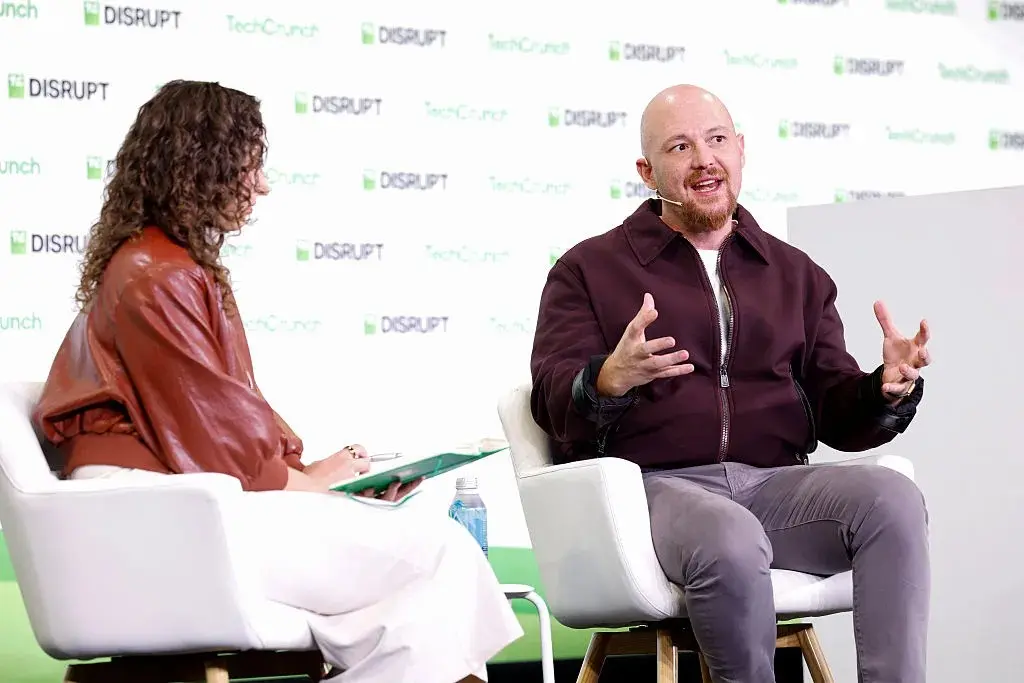
SAN FRANCISCO — As artificial intelligence continues to reshape industries around the globe, business leaders are confronting a fundamental question about what the future holds for human workers. While much of the public discourse focuses on job displacement, industry insiders are increasingly looking at how AI will redefine, rather than erase, daily labor. Amjad Masad, CEO and co-founder of software development platform Replit, offered a firsthand look at this transformation on Thursday at the TechCrunch Disrupt conference in San Francisco, sharing how his company has adapted to an era where autonomous AI agents work alongside human employees.
Drawing from Replit’s internal operations, Masad introduced the concept of the “self-driving company.” He clarified that the term does not refer to autonomous vehicles or robotaxis, but rather to an organizational model where AI agents shoulder the heavy, repetitive grunt work, allowing human workers to focus their energy on judgment, strategy, and creative taste.
The rapid evolution of these technologies over the past year has caught many by surprise, Masad noted, suggesting that while tech-industry insiders and software developers have already seen their daily routines upended, the broader workforce may not yet fully realize the magnitude of the changes heading their way.
"The reality is, all of our jobs — perhaps everyone in this audience, especially — changed over the past year," Masad told the Disrupt audience. "But a big part of America and the world, they still don’t know that that change is coming, and it’s going to be surprising to a lot of people."
According to Masad, the shift inside Replit accelerated earlier this year as AI agents achieved a level of reliability that allowed them to be integrated directly into core operational workflows. Rather than treating AI merely as an external tool or a novelty, Replit restructured its internal processes so that software agents actively participate in day-to-day business functions.
To illustrate this new operational model, Masad described how the company handles customer support requests. When a new support ticket arrives, it is not immediately routed to a human representative. Instead, an AI agent performs the initial triaging process. The agent examines relevant GitHub issues, searches the underlying codebase, and cross-references Linear tickets to gather context. By the time the support request is finally handed off to a human employee, the worker is equipped with all the synthesized background information necessary to evaluate the problem and decide on a course of action.
Once the human support professional determines the appropriate fix and submits a patch, another agent can be deployed with a single click to execute the deployment. This seamless loop—where agents handle the heavy lifting of information gathering and execution, guided by human oversight—exemplifies the operational philosophy of the self-driving company.
Despite the heavy reliance on automation, Masad emphasized that human participation remains essential to the process. Rather than eliminating human involvement, the technology shifts the focal point of human labor toward higher-level decision-making.
"You have an entire loop where agents did most of the work, but crucially, there’s human judgment in the middle, and we don’t think that’s going away anytime soon," Masad explained. "You need human judgment; you need taste."
Rather than destroying jobs, this integration of AI agents is fundamentally altering the nature of what people do during their working hours. At Replit, employees are spending less time on routine administrative tasks and manual execution, and significantly more time on conceptual planning, architectural design, and collaborative problem-solving.
"We’re spending a lot more time figuring out what to work on," Masad said. "I go around the company, I see a lot more discussions, a lot more whiteboarding. We spend a lot more time on architecture, how to build things. And so I think the future of work — the self-driving company idea — is really trying to discover what AI transformation means."
These operational shifts are also shaping how Replit engages with other businesses that adopt its AI-powered coding tools. When discussing the practical implementation of AI with corporate clients, Masad noted that the conversations typically center on enhancing human productivity and improving workplace satisfaction. By removing mundane and repetitive tasks from the daily routine, AI agents can make work both more creative and more enjoyable for employees.
Masad concluded by expressing a desire for the technology sector to champion a more optimistic narrative regarding the future of artificial intelligence. While dystopian forecasts often dominate cultural conversations, he believes that the industry should actively promote a constructive vision of how AI can elevate human capability and foster a more rewarding professional landscape.
"There’s a positive vision of the world that Silicon Valley is not really putting out, and we’re hoping to do that," Masad added.