Bitcoin faces a significantly tougher macroeconomic environment and rising interest-rate risk following a hot September United States inflation reading that caught financial markets off guard. The latest economic data, released by the Bureau of Labor Statistics on October 14, immediately pushed market bets on another Federal Reserve interest rate hike sharply higher. As Treasury yields surged in response, the resulting strengthening of the US dollar exerted intense downward pressure on the cryptocurrency market, triggering an immediate sell-off that dragged Bitcoin down to an intraday low of $81,588.88.
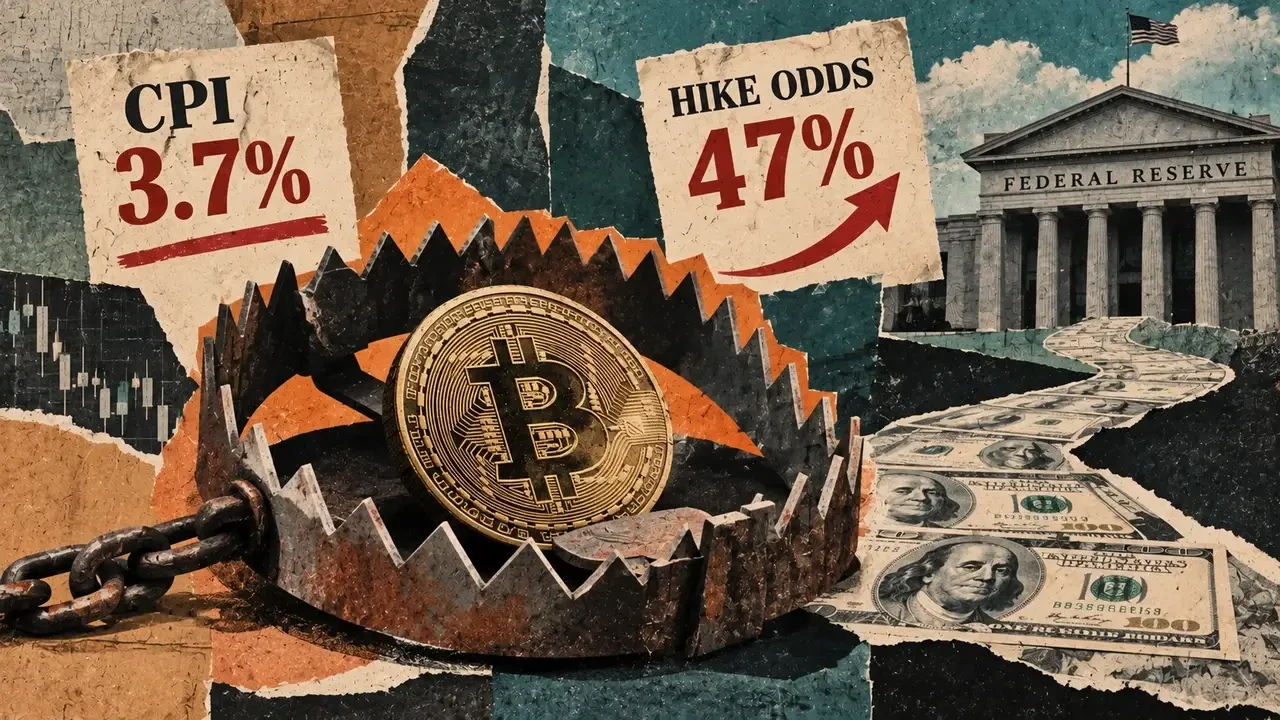
The shift in monetary policy expectations highlights the delicate balancing act facing risk-on assets as macroeconomic headwinds persist. According to market-data provider LSEG, money markets rapidly priced in roughly a 47% chance of another October rate increase following the consumer price index release. This represents a dramatic doubling of expectations from just a day prior, when the probability of a consecutive rate hike hovered closer to 20%. The sudden recalibration by traders underscores how sensitive modern financial markets—including digital assets—remain to incoming inflation metrics and the subsequent trajectory of central bank policy.
Hotter-Than-Expected Inflation Shocks Markets
The catalyst for the sudden market repricing was a Consumer Price Index (CPI) report that exceeded consensus forecasts across nearly all major categories. According to the Bureau of Labor Statistics, September consumer prices rose 3.7% compared to the same period a year earlier, accelerating from the 3.4% annual rate recorded in August. Meanwhile, annual core inflation—a crucial metric closely monitored by Federal Reserve policymakers because it strips out volatile food and energy components—increased to 2.6% from 2.4% in the previous month.
Both headline and core figures outpaced the consensus forecasts of economists surveyed ahead of the data release, who had anticipated an annual headline reading of 3.6% and a core rate of 2.5%. On a seasonally adjusted monthly basis, headline CPI jumped 0.6%, following a 0.4% increase in August. A significant driver of the monthly acceleration was the energy sector, where gasoline prices surged 9.1%, accounting for more than half of the total monthly headline increase. Additionally, shelter costs maintained their stubborn upward trajectory, rising 0.4% on the month. Monthly core CPI rose 0.3%, matching the pace set in August but coming in hotter than the 0.2% monthly forecasts expected by Wall Street analysts.
The combination of persistent shelter inflation and a rebound in energy costs shattered hopes that inflation was safely on a smooth downward path toward the Federal Reserve’s long-term 2% target. Consequently, financial markets were forced to reevaluate the likelihood that the central bank would pause its tightening cycle at the upcoming Federal Open Market Committee meeting.
Another Increase Would Extend September’s Tightening
The latest inflation surprise arrives on the heels of a monetary policy decision just weeks prior. The Federal Reserve had already raised its benchmark target range by a quarter percentage point to 3.75%-4.00% during its September 16 meeting, signaling that officials remained vigilant against lingering price pressures. A subsequent rate hike in October would extend this monetary tightening cycle, catching many investors off guard who had hoped the September adjustment would mark the plateau of the current policy tightening path.

The next policy meeting for the Federal Open Market Committee is scheduled for October 27-28, giving policymakers ample time to digest the implications of the September CPI report. In the immediate aftermath of the data publication, fixed-income markets reacted violently. The two-year US Treasury yield climbed to 4.872%, registering a sharp increase of seven basis points on the day. Concurrently, the US dollar Index posted broad gains against a basket of major international currencies, reflecting a flight toward safety and yield in traditional financial markets.
This swift realignment in borrowing costs and currency valuations directly impacts the investment thesis for digital assets. For Bitcoin holders and institutional allocators alike, the consequences depend heavily on whether these higher yields prove to be sticky over the medium term. Continued competition from interest-bearing dollar assets—such as Treasury bills and high-yield cash equivalents—creates a formidable structural headwind for a decentralized cryptocurrency that does not generate regular interest or dividend payments. Even if the Federal Reserve ultimately decides to leave interest rates unchanged at the October meeting, the mere persistence of elevated yields alters the opportunity cost of holding non-yielding assets like Bitcoin.
Derivatives Markets Brace for Downward Volatility
The macroeconomic shock wave was preceded by notable positioning within the cryptocurrency derivatives sector, suggesting that some sophisticated market participants were already positioning themselves for a potential negative surprise. Data from derivatives exchange Deribit revealed a concentration of put options leading up to the data release. Specifically, traders had accumulated substantial downside protection centered around the $76,000 to $80,000 strike price range for options expiring on October 16.
These put options represent financial instruments that buyers utilize to hedge against or profit from falling asset prices, indicating that parts of the trading community were bracing for a volatile reaction if the inflation data missed expectations to the upside. When the hot CPI numbers materialized, the combination of macroeconomic tightening fears and active downside hedging contributed to the swift downward price action, culminating in Bitcoin testing the $81,500 support region before attempting to stabilize.
The immediate consequence of the inflation report is a heightened state of market anxiety regarding further monetary tightening from the US central bank. As macroeconomic indicators continue to dictate short-term sentiment across global exchanges, market participants are left weighing whether Bitcoin possess sufficient fundamental strength and spot demand to withstand sustained high yields and a surging dollar as the crucial October Federal Reserve decision rapidly approaches.