The quarterly board meeting is looming just two weeks away, and the security operations center has plunged into a familiar, high-stress ritual. Engineers and analysts are frantically pulling raw data exports from an identity provider, a cloud posture management tool, a vulnerability scanner, a security information and event management system, and an endpoint detection and response console. Someone has been tasked with building a massive spreadsheet to reconcile the conflicting data formats, while another team member works late into the night translating those rows and columns into polished presentation slides.
Then, during the actual briefing, a board member asks three fundamental questions about the organization’s true risk exposure, the return on investment for the security budget, and whether critical assets are genuinely protected.
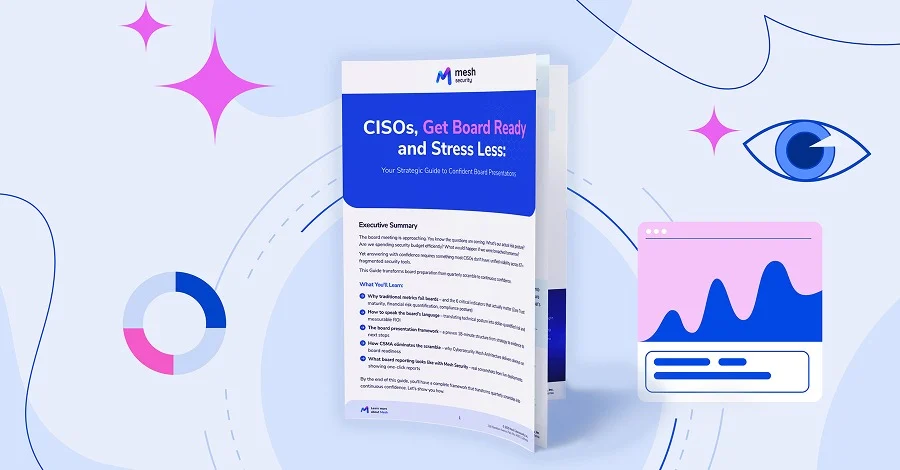
In most enterprises, security leaders find themselves unable to answer any of those questions with genuine confidence. This hesitation rarely stems from a lack of data or a poorly performing security team. Rather, it happens because the critical security data lives scattered across a dozen disparate tools that fail to share context with one another. A new resource, the guide to confident board reporting for CISOs published by Mesh Security, examines this persistent enterprise challenge, detailing precisely why traditional security reporting mechanisms continue to fail and exploring what a more mature, risk-informed model looks like for modern leadership teams.
Boards Have Stopped Trusting Activity Metrics
For years, corporate security reporting has operated on a diet of raw activity counts. Security teams have routinely presented metrics detailing the number of vulnerabilities discovered, patches successfully applied, security alerts closed, and phishing simulation tests passed. While these figures accurately measure the sheer volume of effort expended by technical personnel, they fail to measure actual risk reduction or business resilience.
A board member who hears that the cybersecurity team successfully closed thousands of individual findings over the previous quarter still has no objective way to judge whether the overall enterprise is fundamentally safer today than it was three months ago. When the obvious follow-up question is raised—safer from what specific threats, and by precisely how much?—an empirical, data-driven answer is rarely forthcoming.
Modern corporate boards are no longer satisfied with administrative trivia or operational busywork. They are demanding clear, strategic insight into three core areas: the true extent of the organization’s vulnerability to sophisticated attacks, the efficacy of the existing technology stack in mitigating those risks, and a clear understanding of where financial investments will yield the most significant security improvements.
The Real Problem Lives in the Gaps Between Tools
The root cause of this reporting breakdown lies in the architectural fragmentation of the modern enterprise security stack. A typical mid-sized or rapidly growing enterprise operates an identity and access management provider, a cloud security posture management tool, endpoint detection solutions, a centralized SIEM, a vulnerability scanner, and a sprawling long tail of software-as-a-service applications. Each individual tool is highly accurate within its own specialized domain, yet none possesses visibility into how these isolated slices connect to form an end-to-end attack surface. Advanced threat actors, naturally, do not respect organizational silos or technological boundaries.
To understand how this fragmentation undermines security visibility, consider a realistic compromise path unfolding across a modern enterprise infrastructure. An attacker targets an employee through a credential harvesting campaign, successfully compromising a phishable user account that lacks multi-factor authentication protection. Because that account possesses excessive permissions, the attacker pivots into an internal development environment. From there, the actor discovers an unmonitored API key hardcoded within a cloud storage bucket, allowing them to access a downstream staging database that happens to contain unencrypted customer personal identifiable information.
This seemingly straightforward scenario actually involves four distinct security findings distributed across four separate specialized tools, each registering a moderate standalone severity score. Viewed in isolation by individual tool administrators, none of these findings triggers an enterprise-level emergency. Yet, when chained together, they form a critical, end-to-end attack path leading directly from a low-level credential compromise to the organization’s most sensitive data assets. Because no single native dashboard maps these cross-domain relationships, the threat remains entirely invisible during routine operational reviews. It typically goes unnoticed until discovered during a post-incident forensic investigation.
This structural blind spot has been dramatically widened by the rapid enterprise adoption of artificial intelligence technologies. AI agents, non-human identities, automated service accounts, and specialized model-context-protocol-connected tools are being deployed across organizations faster than security teams can inventory them. Each new artificial intelligence integration functions as a newly minted identity equipped with its own distinct access privileges. Because most legacy security stacks were never architected to map where these digital pathways lead, shadow AI and machine learning initiatives have introduced an entirely unprecedented layer of hidden, unmonitored attack paths into the corporate network.
Why Adding Another Tool Doesn’t Fix It
When leadership recognizes these visibility gaps, the immediate reflex is often to procure yet another specialized security product designed to cover the missing area. Predictably, this knee-jerk reaction usually results in nothing more than one additional console to monitor, one more data export to clean, and one more complex column added to the manual reconciliation spreadsheet.
Skeptics within the organization often push back with a fair observation, noting that the enterprise has already invested heavily in cloud security posture management tools and comprehensive zero-trust architectures. These foundational security investments are undeniably crucial, but they remain isolated controls scoped strictly to individual technological domains. The complex questions being asked by the board of directors inherently cross those traditional domains. What the modern security organization lacks is not another standalone defensive control, but rather a unified layer of shared context connecting the disparate security tools already deployed across the enterprise.
This challenge forms the conceptual foundation of Cybersecurity Mesh Architecture, a strategic model defined by industry analysts as a method for connecting distributed security tools through a common intelligence layer. Rather than forcing organizations into costly and disruptive rip-and-replace cycles, a mesh architecture correlates data from existing endpoints, cloud environments, and identity providers so that assets, access controls, and active exposures can be evaluated cohesively as a single, interconnected graph.
A Practical Framework for Board-Ready Reporting
Security leaders seeking to overhaul their executive reporting framework to focus on actual risk exposure rather than administrative effort can adopt a structured, business-aligned methodology. The process begins with defining the organization’s crown jewel assets directly in collaboration with business unit leaders. These are the critical data stores and systems whose compromise would inflict the most severe damage on the enterprise, such as customer databases, proprietary source code, payment processing infrastructure, and protected health information. Anchoring security metrics to these mutually agreed-upon assets ensures that technical reporting remains firmly aligned with overall business strategy.
The next phase involves consolidating existing telemetry without introducing disruptive new sensors. By pulling identity, cloud, endpoint, SaaS, and vulnerability data into a single, correlated view through agentless, API-based integrations, security teams can achieve rapid deduplication and enrichment while maintaining normal production workflows. Once this foundational context is established, the focus shifts from reviewing static lists of isolated vulnerabilities to mapping real, actionable attack paths that connect threat vectors directly to the organization’s most critical assets.
By identifying which human and non-human identities possess viable routes to crown jewel systems through chains of access permissions and misconfigurations, security teams can prioritize remediation efforts according to real-world blast radius. Under this model, a moderate-severity misconfiguration sitting directly on an active path to sensitive customer data rightfully outranks a standalone critical vulnerability residing on an isolated, non-production test server. Remediation is prioritized entirely by the potential damage it prevents rather than by rigid, vendor-supplied CVSS scores.
To communicate effectively with the executive suite, security leaders must translate technical exposure into financial terms, linking each reachable crown jewel asset to a concrete business impact estimate developed in partnership with finance and risk management teams. This transformation allows security reporting to pivot away from abstract counts of patched vulnerabilities and toward clear assessments of dollars at risk—the standard vocabulary utilized by the board of directors for every other category of enterprise risk. Finally, tracking trends across reporting cycles demonstrates how the number of active attack paths to critical assets has evolved over time, providing direct empirical evidence of return on investment for the existing security technology stack.
Transforming the Dynamics of the Boardroom
When executive security reports are constructed around validated attack paths and business context rather than raw operational activity counts, the fundamental dynamic of the quarterly board meeting shifts dramatically. Instead of struggling to defend ballooning operational expenditures against ambiguous threats, the CISO is empowered to present clear, measurable risk reduction metrics. At the same time, this data-driven clarity equips the internal security engineering team with a prioritized, highly focused remediation queue that directly reflects the operational priorities of executive leadership.
Enterprise security teams operating across fragmented technological environments can leverage unified intelligence layers like Mesh to correlate signals seamlessly across identity, cloud, SaaS, endpoint, and artificial intelligence ecosystems. By revealing viable attack paths to critical assets without requiring disruptive operational overhauls, such platforms enable organizations to eliminate enterprise risk with greater speed and precision, ensuring security leaders are fully prepared for their next executive reporting cycle.