

Malta’s premier financial regulatory body has taken a proactive step toward bridging the gap between traditional oversight and the fast-evolving landscape of decentralized finance. The Malta Financial Services Authority (MFSA) has officially issued a comprehensive discussion paper outlining a potential legal framework designed specifically for decentralized finance (DeFi), which includes formal recognition for decentralized autonomous organizations (DAOs). This move comes at a crucial time as European policymakers continue to grapple with the complex realities of regulating blockchain-based financial services and establishing clear accountability across digital asset ecosystems.
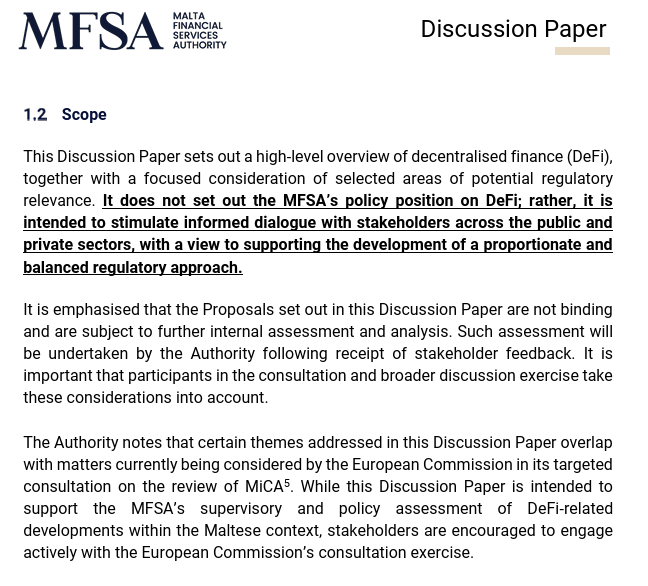
On June 12, the MFSA opened a public consultation on DeFi operating under the broader umbrella of the European Union’s landmark Markets in Crypto-Assets (MiCA) regulation. The newly published discussion paper invites vital feedback from industry stakeholders, legal experts, and market participants through July 10. Within the document, the regulator proposes introducing an entirely new legal category designated for so-called “software-based organizations.” This classification would specifically encompass DAOs and other entities whose governance and operations are fundamentally dictated by software rather than traditional corporate structures.
Rather than attempting to treat DAOs as a standalone legal concept that fits awkwardly into existing corporate law, the MFSA suggests a more nuanced approach. By recognizing them as a distinct type of software-based organization, the regulator aims to cleanly separate the legal framework governing the organization itself from the separate rules governing the underlying protocol and software code. This structural distinction could provide much-needed legal certainty for developers, contributors, and users who frequently operate in regulatory gray areas.

This initiative builds directly on Malta’s long-standing reputation as a pioneer in the digital asset industry. Back in 2018, the island nation introduced one of the region’s first comprehensive crypto regulatory frameworks, positioning itself as a forward-thinking hub for blockchain innovation. However, as the digital asset market has matured, the regulatory challenges have grown exponentially. While stressing that fully decentralized services generally fall entirely outside the scope of MiCA, the Maltese regulator argues that many projects marketed as decentralized finance actually retain centralized features. According to the MFSA, these centralized elements heavily complicate claims of true decentralization and raise critical questions regarding regulatory accountability and consumer protection.
The discussion paper points directly to the language of the EU regulation to highlight this distinction, noting that MiCA explicitly excludes fully decentralized models from its regulatory scope. Consequently, projects that operate entirely without intermediaries or central control may not need to comply with the stringent requirements of MiCA. However, because absolute decentralization is often difficult to prove or maintain in practice, the regulator is stepping in to address the gray area where traditional corporate governance intersects with autonomous software protocols.
EU Regulators Increasingly Turn Attention to DeFi
Malta’s detailed discussion paper does not exist in a vacuum; it arrives amid a broader, coordinated push across the entire European Union to clarify how decentralized finance and decentralized autonomous organizations should be treated under the MiCA regime. As the digital asset industry continues to scale, European institutions are increasingly scrutinizing the degree of decentralization boasted by various market participants.
Earlier in March, a comprehensive research paper published by the European Central Bank found that governance and control across four major DeFi protocols remained heavily concentrated in the hands of a small number of entities or token holders. This empirical finding suggested that many prominent projects might struggle to officially qualify as “fully decentralized” under regulatory definitions, meaning they could inadvertently fall under the regulatory purview of MiCA and other financial statutes.
The regulatory debate gained further momentum in May when the European Commission launched a targeted review of MiCA. This review actively sought public and institutional feedback on several contentious issues, including stablecoin interest payments, the regulatory treatment of decentralized finance, and whether potential gaps in the existing legislative framework warrant the creation of additional, specialized regulation.
Despite the growing appetite for tighter oversight, not everyone within the European policy sphere believes that an entirely new DeFi rulebook is necessary or beneficial for market growth. Speaking to Cointelegraph at the WAIB Summit Monaco earlier this month, European Commission adviser Peter Kerstens argued that policymakers should prioritize other objectives. According to Kerstens, regulators should focus on integrating asset tokenization into a broader digital asset framework rather than expending energy on drafting a theoretical second version of MiCA specifically targeted at DeFi.
As these regulatory discussions unfold, the broader European crypto landscape is also bracing for imminent enforcement deadlines. Crypto asset service providers face a crucial July 1 cutoff as the MiCA grace period draws to a close, forcing unlicensed exchanges and digital asset firms either to secure proper regulatory authorization or to exit the European market entirely. Against this backdrop of tightening compliance standards and evolving European policy, Malta’s new consultation paper offers a localized glimpse into how individual member states are attempting to construct workable bridges between rigid legal frameworks and the fluid, borderless nature of decentralized technology.